From the subdivisions around Brighton and Hartland to the farm roads outside Fowlerville, a lot of Livingston County was built for people raising families. The county's population grew 54.2% starting in the 1970s. Much of the housing in places like Brighton Township, Genoa Township and Hamburg Township went up as suburban subdivisions from that decade onward.
Those homes hold up well, but many were designed around stairs: split-levels with short flights between floors, ranch-style homes with a basement laundry, and townhouses with bedrooms upstairs. This page walks through how those layouts affect stair lift choices in Howell, Brighton, Fowlerville, Pinckney and Hartland, and where local families can look for help paying.
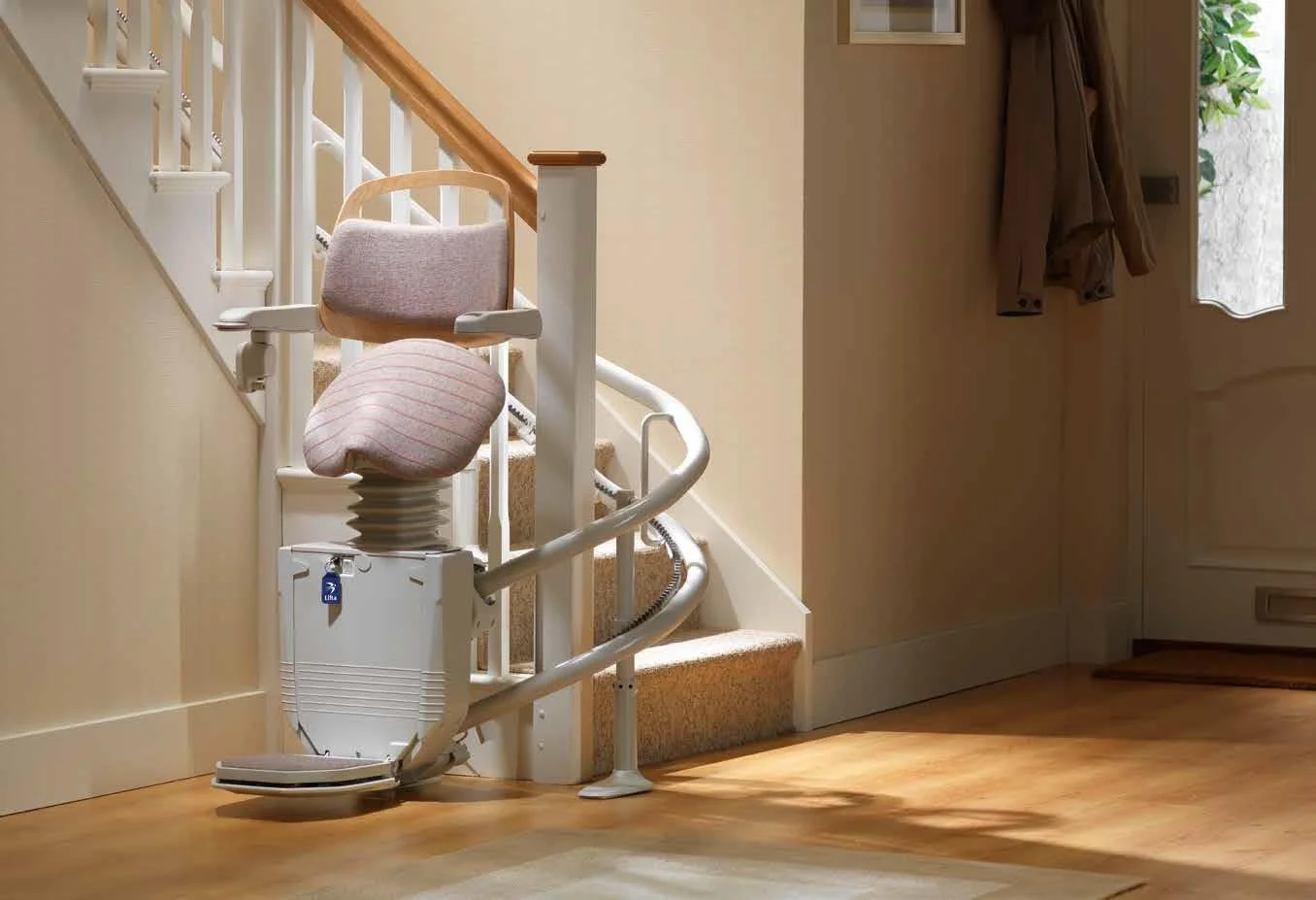
Split-level homes are common in the county's 1970s and later subdivisions. They usually have several short flights instead of one long staircase, and the flights often turn at a landing. A straight stair lift can work on each short run, but if someone needs to move between three levels, a curved rail that follows the turns is often the more practical choice.
Ranch-style homes keep daily living on one floor, so the stairs that matter are usually the ones down to the basement. If the washer, dryer or a family room is down there, a straight lift on the basement stairs can keep the whole house usable. We measure the width at the top and bottom, since basement stairways can be tight.
Townhouses often put the bedrooms and the full bath on the second floor, which makes that one staircase the main barrier. Most townhouse stairs are straight, which keeps the installation simple. If the stair turns or has a winder at the bottom, a curved rail is the fit.
In walk-up apartments, the stairs are often shared or belong to the building owner. Talk to the landlord or association before planning anything, because permission usually comes first. For single-family homes, the layout varies widely, so an in-home measurement tells you more than any photo can.
Livingston County covers 585 square miles, and about 39.5% of residents live in rural areas. Rural homes often have porch or deck steps that are as much of a problem as anything inside. Outdoor stair lifts are built to sit outside, and for someone who uses a wheelchair, a vertical platform lift may make more sense than a seat.
The other 60.5% live in urban areas, mostly in the towns and townships along I-96, US-23 and M-59. Those homes tend to need indoor lifts more than outdoor ones. Either way, we look at every set of steps between the driveway and the bedroom before recommending anything.
About 21.3% of county residents are 65 or older, and roughly 60.7% own their homes. For homeowners, a stair lift is often the step that lets someone stay in a house they already know instead of moving.
Neither program listed below names stair lifts on its source page, so ask directly before counting on funding. AgeWays, the Area Agency on Aging for Region 1-B, lists home repair, home safety equipment and ramp construction among its service categories and can be reached at (800) 852-7795. The Region 1B AAA office in Southfield also takes calls at (248) 357-2255.
Veterans can start with Livingston County Veteran Services at 1420 Lawson Dr. in Howell, phone (517) 546-6338, to ask about VA housing grants. Statewide programs worth asking about include the MI Choice Waiver Program, MI Coordinated Health (formerly MI Health Link), the MSHDA Property Improvement Program (PIP), and VA Benefits for Veterans (HISA + Prosthetics).
AgeWays serves older adults in Livingston, Macomb, Monroe, Oakland, St. Clair and Washtenaw counties and points them to local providers under Home Repair, Home Safety Equipment/Home Injury Control and Ramp Construction. Its source page does not mention stair lifts, so call (800) 852-7795 to ask whether a local program will fund one and what the age and income rules are.
These VA grants help veterans and service members with a qualifying severe service-connected disability adapt a home they own or will own, or a family member's home under TRA, with FY2026 maximums of $126,526 for SAH, $25,350 for SHA, and $50,961 or $9,100 for TRA. The source lists ramps and widened doorways as examples but does not name stair lifts, so ask Livingston County Veteran Services at (517) 546-6338 before planning around it.
Older adults
29508 Southfield Rd., Suite 100, Southfield, 48076
Veterans
1420 Lawson Dr., Howell, 48843
Usually, yes. Split-levels have several short flights, so the choice depends on how many levels need to be reached and whether the stairs turn. A straight lift can cover one short run, while a curved rail can follow turns and landings.
Its source page does not mention stair lifts. It does list home repair, home safety equipment and ramp construction as service categories for Livingston County, so call (800) 852-7795 and ask whether a local provider will fund one.
The VA source names ramps and widened doorways as examples and does not mention stair lifts either way. The grants are for veterans with a qualifying severe service-connected disability, so ask Livingston County Veteran Services at (517) 546-6338.
Livingston County Veteran Services is at 1420 Lawson Dr., Howell, MI 48843. The phone number is (517) 546-6338.
Possibly, but the stairs in a walk-up usually belong to the building owner. Get the landlord's or association's approval first, then we can measure the stairway.
Outdoor stair lifts are made for porch and deck steps. If the person uses a wheelchair, a vertical platform lift is often the better fit, and we can look at both during a home visit.
Tell us about the stairs in your home and we will explain which lift fits, what it costs and how installation works.
