Iron County is spread across about 1,211 square miles of the western Upper Peninsula. It runs from Iron River and Caspian through Crystal Falls, Alpha, Amasa and Gaastra, down to the Wisconsin line. The 2020 Census counted every resident as living in a rural area. Many of the homes here are older houses that owners have held for a long time, not new subdivisions.
That shapes how families here think about stairs. When a parent in Crystal Falls or Iron River can no longer manage the trip to a second-floor bedroom, moving often isn't the first choice. A stair lift lets them keep using the house they already own. This page covers how local homes affect the type of lift, and which programs serving Iron County may help with the cost.
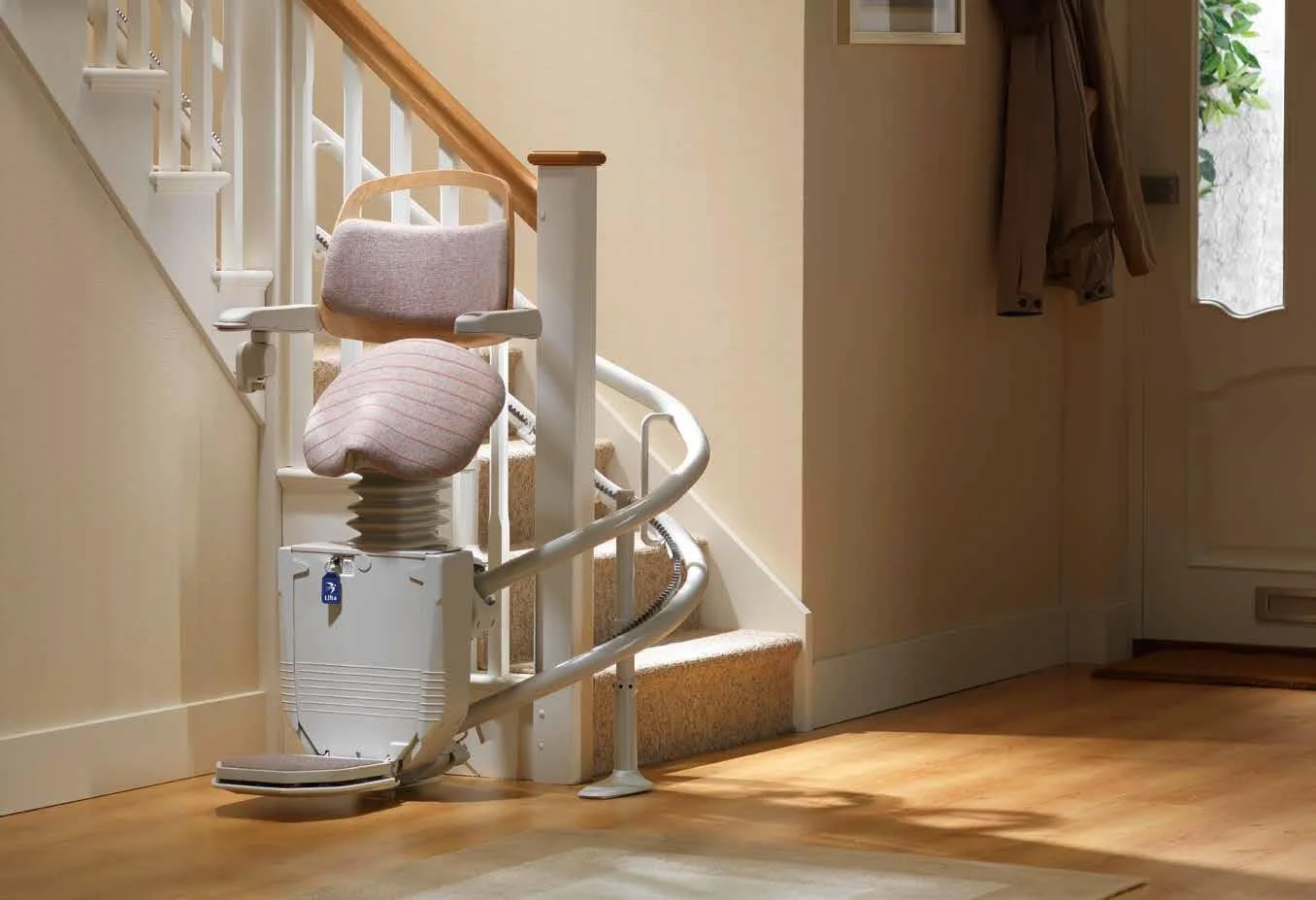
Most housing in the county is single-family homes and detached houses, with some split-level homes and walk-up apartments. A single-family home with one straight run of stairs is usually the simplest case. A straight stair lift mounts to the treads, not the wall, and is often the lowest-cost option.
Split-level homes are different. They have several short flights, sometimes with a turn or landing between them. That can mean a curved lift built to the shape of the stairs, or a separate straight lift on each flight, depending on how the rider moves between levels.
Walk-up apartments share their stairways, so a lift there needs the building owner's agreement before anything is planned. If the rider uses a wheelchair and cannot transfer to a seat, a platform lift may be the better fit, and that also takes more room on the stairs.
Iron County was built around iron ore mining, and its population has dropped from a 1920 peak of 22,107 to 11,631 at the 2020 Census. The median age is 53.6, and 21.9% of residents are 65 or older. In a county where 77.4% of residents own their homes, a lot of people are aging in houses they've lived in for decades.
The median home value is $109,100, and the 2023 median household income was $55,940. For many owners on fixed or modest incomes, a stair lift costs far less than adding a first-floor bedroom and bath or relocating. Because the whole county is rural, specialty medical and mobility-equipment providers are farther away than in more urban parts of Michigan. A safe way to reach every floor at home matters more when help isn't close by.
Before talking about models, an installer will look at the stairs: how many steps, whether there's a turn, how wide the treads are, and what's at the top and bottom landings. These details decide between straight, curved and platform lifts more than anything else.
Some homes also have steps at the entrance that are the real problem. Outdoor stair lifts are built for exterior steps, and ramps are another route. Habitat for Humanity Menominee River builds wheelchair ramps for income-qualified Iron County homeowners, which is worth knowing if the front steps are the main barrier.
Two UPCAP programs explicitly list home modifications among their services: the MI Choice Medicaid Waiver and MI Options counseling. MI Choice is for people who meet Michigan Medicaid nursing facility level of care and financial rules. MI Options is free counseling open to anyone, and its counselors help you find and apply to funding.
For veterans, the VA Specially Adapted Housing and Special Home Adaptation grants fund home adaptations for qualifying service-connected disabilities. The VA's own examples are ramps and wider doorways, and stair lifts aren't named. The Veterans Service Office at 106 W. Genesee St in Iron River, (906) 265-3819, is the local place to ask.
USDA Rural Development Section 504 repair grants and loans, SAIL and the Upper Peninsula Veterans Assistance Fund may also be worth a call, though their sources don't mention stair lifts. Statewide, you can also ask about the MI Choice Waiver Program, MI Coordinated Health (formerly MI Health Link), the MSHDA Property Improvement Program (PIP) and VA Benefits for Veterans (HISA + Prosthetics). Details on each local program are below.
A Medicaid waiver for people 65 and older, or 18 and older who are blind or disabled, who meet nursing facility level of care and prefer services at home. Home modifications for accessibility are listed as a possible part of the care plan; call UPCAP at (906) 786-4701.
Free counseling for anyone looking for long-term services, regardless of age, income or payer, including veterans and caregivers. Home modifications are among the services counselors give information and referrals on; call (800) 803-7174.
UPCAP is the regional aging agency serving Iron County, and the Iron River Senior Center, (906) 265-6134, offers meals and social programs for people 55 and older. The source doesn't list stair lifts, but UPCAP at (906) 786-4701 is a good first call to be screened for MI Choice or MI Options.
Loans of $20,000 or less, and grants of $7,500 or less for very-low-income homeowners 62 and older, to repair, improve or modernize a home or remove health and safety hazards. The source doesn't list stair lifts specifically, and rural eligibility is confirmed address by address.
Up to $126,526 for FY2026 for veterans with qualifying severe service-connected disabilities who own or will own the home. The VA names ramps and wider doorways as examples but doesn't list stair lifts.
Up to $25,350 for FY2026 for veterans with disabilities such as loss of use of both hands, with a Temporary Residence Adaptation grant for adapting a family member's home. Stair lifts are not named among the VA's examples.
The Upper Peninsula's center for independent living, serving people with disabilities in all 15 counties, including Iron County. The source doesn't describe stair lift or home modification help, so call (906) 228-5744 for specifics.
Repair help for income-qualified homeowners in Iron and Dickinson counties, including home access repairs and ramps at about $25 per linear foot in materials with volunteer labor. Stair lifts aren't listed; call (906) 779-5377.
A state-funded fund for Upper Peninsula veterans with financial needs that other veteran sources don't cover. The source doesn't mention stair lifts or home modifications; call UPCAP at (906) 786-4701.
Older adults
P.O. Box 606, 2501 14th Ave. South, Escanaba, 49829
Veterans
106 W. Genesee St, Iron River, 49935
Start with UPCAP at (906) 786-4701. They can screen you for the MI Choice Medicaid Waiver and MI Options, the two programs that list home modifications. You can also dial 211.
The MI Choice Medicaid Waiver lists accessibility home modifications as a possible service. You need to be 65 or older, or 18 or older and blind or disabled, meet nursing facility level of care and Medicaid financial rules. The budget is set by each person's care plan.
MI Choice covers adults 18 and older who are blind or disabled, and MI Options counseling is open to any age. USDA Section 504 grants are for very-low-income homeowners 62 and older, while 504 loans have no age limit listed.
No. Split-level homes usually have short flights between levels. Depending on the layout, that can mean a curved lift or a straight lift on each flight the rider needs to use.
The Veterans Service Office is at 106 W. Genesee St in Iron River, (906) 265-3819. They can explain the VA SAH and SHA grants, which fund home adaptations for qualifying service-connected disabilities, though the VA doesn't list stair lifts by name.
Most of Iron County outside incorporated Iron River and Crystal Falls qualifies as rural for Section 504, but it has to be confirmed for each address. The program pays for repairs and removing health and safety hazards and doesn't list stair lifts specifically.
Tell us about the stairs in your home and we will explain which lift fits, what it costs and how installation works.
