Eaton County covers 579 square miles of central Michigan farmland and small cities, with 11 towns from Grand Ledge and Waverly in the north to Eaton Rapids, Olivet and Bellevue farther south. In Charlotte, the county seat, the historic core still has multi-story buildings like the 1885 Grand Trunk Depot and the 1931 Art Deco Eaton Theatre. Many of the houses around these old downtowns are just as old, with full flights of stairs between floors.
That older, multi-level housing is the reason many families here start asking about stair lifts. A lot of homeowners in Charlotte, Eaton Rapids, Grand Ledge, Olivet and Potterville would rather stay in a long-owned two-story house than move. Below, we walk through how local home styles affect the choice of lift, and which agencies and programs can help with the cost.
The older cities and villages in Eaton County have a lot of long-established, multi-level homes. In many of these houses the main staircase runs in one straight flight from the front hall to the bedrooms. That layout usually takes a straight stair lift, which is the simplest type to fit.
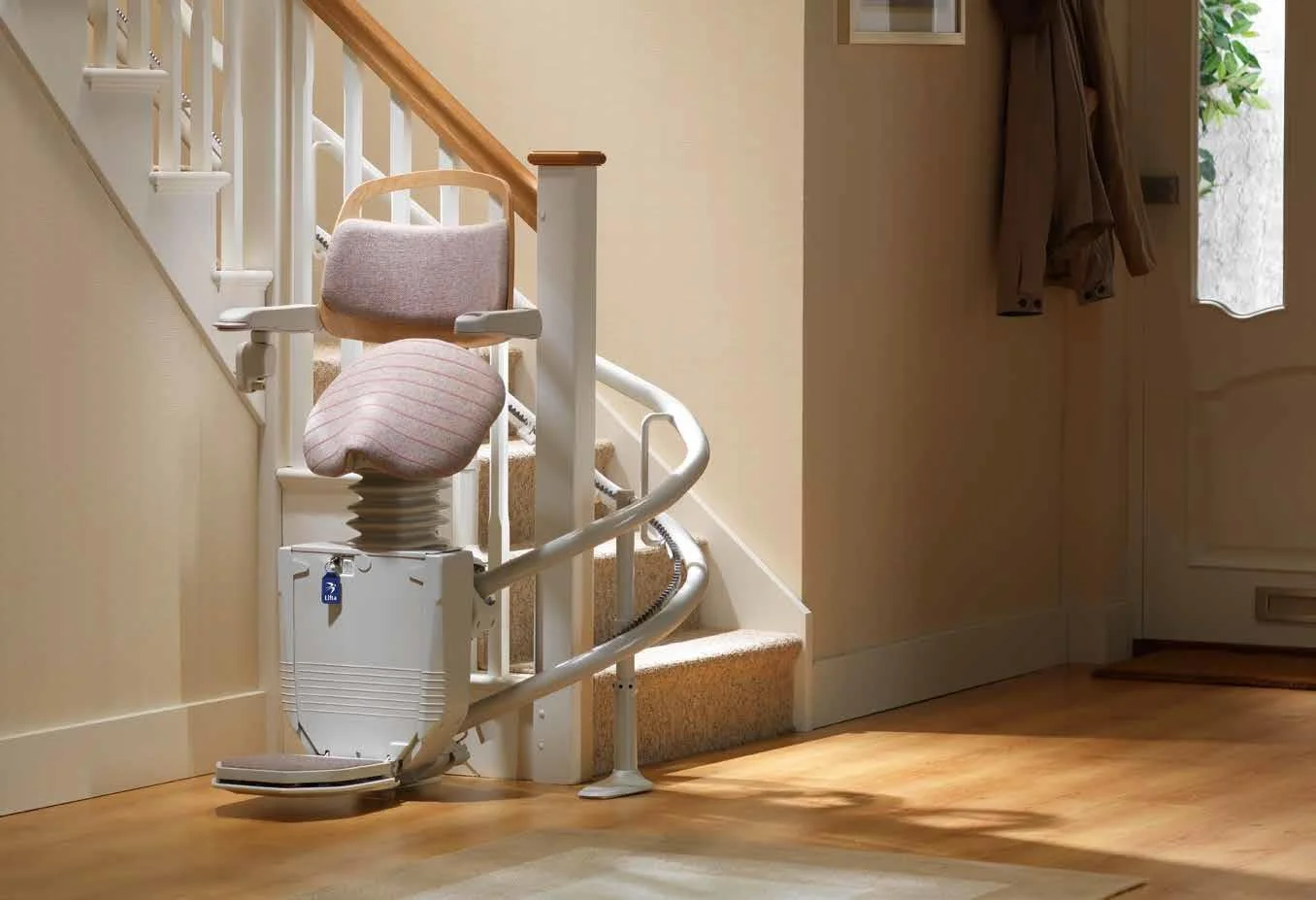
Older homes do bring a few things to check. Stairs may be narrow or steep, and a landing halfway up turns a straight job into a curved one. We measure the width, the pitch and any turns before recommending a model, so the rail fits the staircase you actually have.
Split-level homes are common here, and they work differently. Instead of one long flight, there are several short runs of stairs between levels. Sometimes one short straight lift covers the stairs a person uses every day, and sometimes a platform lift makes more sense for a few steps.
Townhouses often have stairs that turn at a landing, which calls for a curved rail built to that staircase. In walk-up apartments, the building owner has to approve any installation first. With 62.4% of households here owning their homes, most families can make that decision themselves, but renters should talk to their landlord before we schedule a visit.
About 38.0% of Eaton County residents live in rural areas, and the county is crossed by the Battle Creek, Grand and Thornapple Rivers. Farmhouses and homes on sloped lots often have porch or deck steps that are harder to manage than the stairs inside.
For those steps, an outdoor stair lift built to handle Michigan weather is an option. Some homes need both an indoor lift and an outdoor one to get from the driveway to the bedroom. We look at the whole path during the home visit.
Eaton County Veteran Services in Charlotte, at 1045 Independence Blvd, Room 153, can help a veteran sort out which VA benefits apply. Call them at (517) 543-3740.
The VA Specially Adapted Housing (SAH) Grant and the VA Special Home Adaptation (SHA) Grant pay for home changes for veterans with qualifying service-connected disabilities. The VA materials list examples like ramps and wider doorways but do not name stair lifts, so ask Veteran Services about a lift before you apply. VA Benefits for Veterans (HISA + Prosthetics) is another statewide route worth asking about.
None of the programs below name stair lifts directly in their published materials, so the best move is to call and ask about your situation. The Tri-County Office on Aging (Region VI), at 5303 S. Cedar Street, Suite 1 in Lansing, is a good first call for anyone 60 or older. Their number is (517) 887-1440.
For Medicaid-eligible residents, the MI Choice waiver includes a home adaptations category. Lower-income homeowners can also look at Rebuilding Together Tri-County for volunteer repairs or the MSHDA home improvement loan. Other statewide programs to ask about include MI Coordinated Health (formerly MI Health Link) and the MSHDA Property Improvement Program (PIP).
A Medicaid waiver for people 65 and older, or 18 and older with a disability, who qualify for nursing facility care but want to live at home; it lists Environmental Accessibility Adaptations as a service, though stair lifts are not named and there is a waitlist. Call (517) 887-1440 for a screening.
An information and care-coordination office for older adults, mainly 60 and older, and family caregivers in Eaton, Ingham and Clinton counties; it does not fund stair lifts itself but refers people to housing resources. Call (517) 887-1440.
Volunteers do free repairs for low-income homeowners in Ingham, Clinton and Eaton counties who are 60 or older or have a disability, with an income limit of $1,956.25 a month for one person plus $687.50 for each additional member. Stair lifts are not named, so call (517) 445-5068 to ask whether one could qualify.
Grants or low-interest loans for low and moderate-income residents inside Lansing city limits, which includes a small part of Eaton County near Delta Township; stair lifts are not specifically listed. Call (517) 483-4040.
A statewide loan for low-to-moderate-income homeowners of up to $50,000, with no equity required on loans of $25,000 or less and rates of 4%, 6% or 8% depending on income. It is a general home improvement loan that does not name stair lifts; call (517) 373-8370.
A VA grant of up to $126,526 for veterans with severe service-connected disabilities who own or will own their home, with up to $50,961 for a temporary residence. The VA lists ramps and wider doorways as examples and does not name stair lifts.
A VA grant of up to $25,350, or up to $9,100 for a temporary residence, for veterans with qualifying disabilities such as loss of use of both hands or severe burns, in a home the veteran or a family member owns. Stair lifts are not named in the VA description.
A free referral line and directory for any Michigan resident, with categories for home modification consultation and bathroom modification services; it does not fund stair lifts directly but can point you to local help. Call (844) 875-9211.
Older adults
5303 S. Cedar Street, Suite 1, Lansing, 48911
Veterans
1045 Independence Blvd, Room 153, Charlotte, 48813
The MI Choice waiver covers Environmental Accessibility Adaptations, but its materials do not name stair lifts. It is for people who qualify for Michigan long-term-care Medicaid and nursing facility level care, and it has a waitlist. Call (517) 887-1440 to start a screening.
MI Choice accepts adults 18 and older with a disability who meet its other requirements. Rebuilding Together Tri-County also serves homeowners with a disability, not only those 60 and older, if they meet the income and ownership rules.
Low-income homeowners who are 60 or older or have a disability, with income at or below $1,956.25 a month for one person plus $687.50 for each extra household member. You must have owned and lived in the home for at least 2 years, have homeowners insurance, be current on property taxes and plan to stay at least 2 more years.
Only if your home is inside Lansing city limits, since a small part of the city extends into Eaton County near Delta Township. Call (517) 483-4040 to confirm your address qualifies.
It depends on which stairs are used most. A short straight stair lift can cover one run, and a platform lift can work for a few steps. We measure each flight during a home visit before recommending anything.
The Tri-County Office on Aging at (517) 887-1440 is a good start for older adults and caregivers. Michigan 2-1-1 at (844) 875-9211 can also route you to home modification resources, and veterans can call Eaton County Veteran Services at (517) 543-3740.
Tell us about the stairs in your home and we will explain which lift fits, what it costs and how installation works.
