Delta County runs along Lake Michigan and Green Bay in the Upper Peninsula, with Escanaba as the county seat and Gladstone and Rapid River close by. Escanaba grew as a lumber-and-shipping town, and its downtown historic district is listed on the National Register of Historic Places along with the Sand Point Lighthouse. Many homes here have been lived in by the same families for a long time.
That matters when stairs start to get hard. According to 2020 Census data, 78.5% of occupied housing units in the county are owner-occupied, so most people facing a stair problem are deciding whether to adapt a home they own rather than move. This page walks through how local homes, winters and funding programs affect that choice.
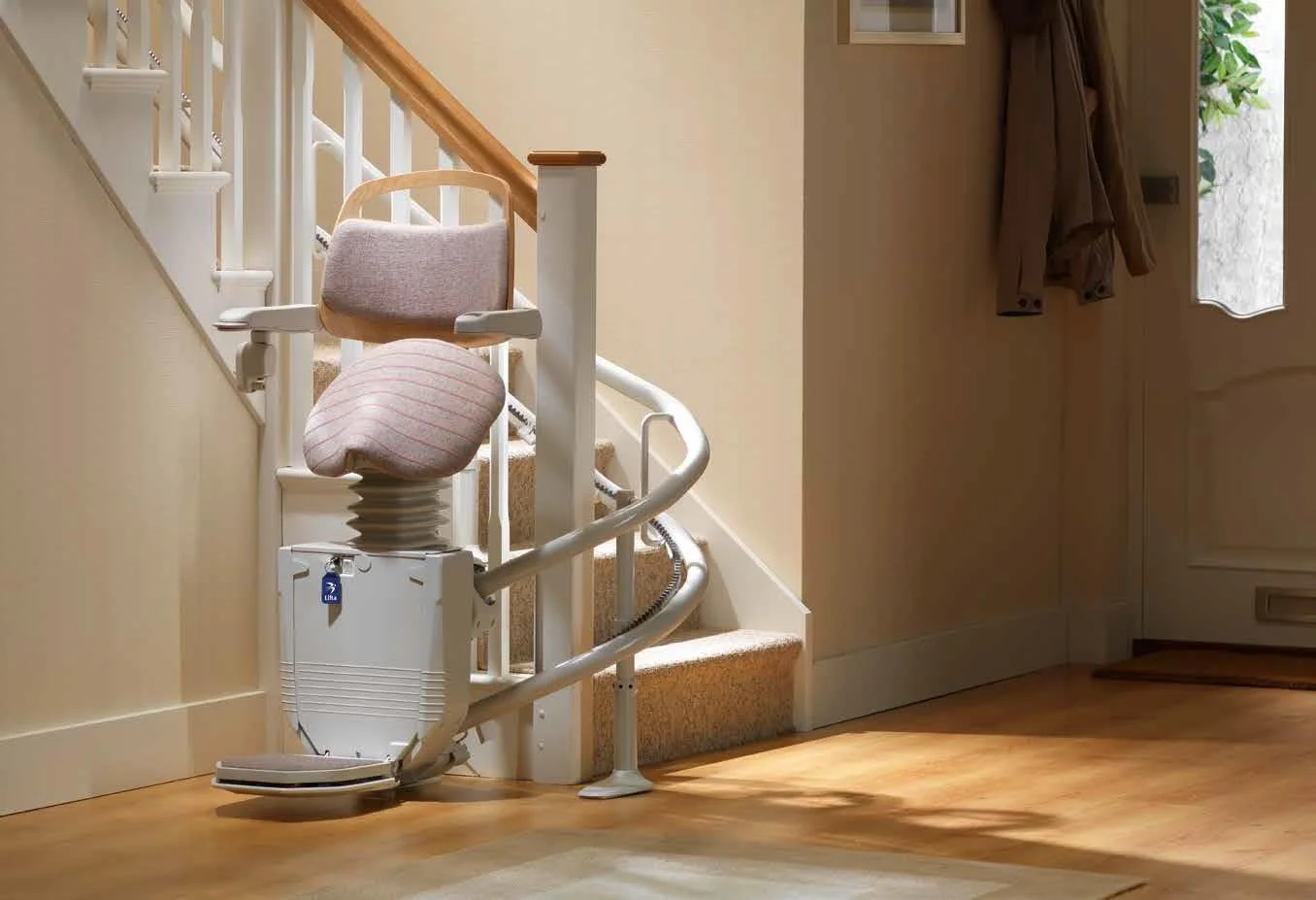
The county's housing mix includes single-family homes, split-level homes, townhouses, walk-up apartments and low-rise buildings. A single straight staircase, common in many single-family homes and townhouses, usually takes a straight stair lift, which follows one rail from bottom to top.
Split-level homes are different. They often have short runs of stairs between several levels, sometimes with a turn or landing, and that can call for a curved lift or separate lifts for each run. We measure every flight before recommending anything.
In walk-up apartments and low-rise buildings, shared stairways usually need the building owner's approval before any lift goes in. If you rent, talk with the owner first.
Heavy seasonal snowfall is a fact of life here. Exterior ramps can be hard to keep clear, which is one reason a permanently installed lift inside the home is often the more practical choice for getting between floors safely in winter.
For porch or entry steps, an outdoor stair lift or a platform lift may be worth discussing. These have to stand up to snow and cold, so placement and cover matter. With 42.7% of county residents living in rural areas, many homes have longer driveways and entries that deserve a close look during the visit.
The county's 2020 Census population was 36,903, with a median age of 47.8 and 24.9% of residents age 65 or older. That is a large share of households where a parent or spouse may be starting to struggle with the stairs.
If someone in your family served, the veterans programs below and the Delta County Veteran Services office in Escanaba are worth contacting early.
No program listed here names stair lifts as a covered item, and the VA HISA benefit specifically excludes stair glides. Still, several programs cover home modifications or repairs in general, and it is worth calling to ask how they apply to your situation.
A good first call is UPCAP, the Area Agency on Aging for the Upper Peninsula, at (906) 786-4701. Its office is at 2501 14th Ave. South in Escanaba. Veterans can reach Delta County Veteran Services at (906) 786-7228, at 2840 College Avenue, Suite #2, Escanaba.
Statewide options you can also ask about include the MI Choice Waiver Program, MI Coordinated Health (formerly MI Health Link) and the MSHDA Property Improvement Program (PIP).
UPCAP's care management lists home modifications for accessibility, but its page does not mention stair lifts, and eligibility requires a Nursing Facility Level of Care through 2-1-1 or ADRC intake. Call 2-1-1 or UPCAP at (906) 786-4701 to ask whether a stair lift can be funded or referred.
Repair loans up to $40,000 and grants up to $10,000 for homeowner-occupants age 62+ in eligible rural areas, with combined help up to $50,000; stair lifts are not mentioned in the source. Eligibility must be confirmed for each address on the USDA map.
A lifetime benefit of up to $6,800 or $2,000 for medically necessary home accessibility work, but it does not cover stair lifts, as it excludes stair glides and porch lifts. Delta County Veteran Services at (906) 786-7228 can help with VA questions.
FY2026 grants of up to $126,526 (SAH), $25,350 (SHA) and up to $50,961 or $9,100 (TRA) for veterans with qualifying severe service-connected disabilities; the source mentions ramps and widened doorways but not stair lifts. Ask Delta County Veteran Services at (906) 786-7228 about applying.
A regional disability network that lists an Accessibility Program, though its page does not say what is covered and stair lifts are not mentioned. Call (906) 228-5744 to confirm Delta County is served and ask about stair lift help.
Statewide emergency help that can include home repairs, with a $15,000 asset limit and an income test that may require a co-payment; accessibility work and stair lifts are not mentioned. Call (888) 783-8190 with questions.
Older adults
P.O. Box 606, 2501 14th Ave. South, Escanaba, 49829
Veterans
2840 College Avenue, Suite #2, Escanaba, 49829
With heavy Upper Peninsula snowfall, exterior ramps can be hard to keep safe. A permanently installed indoor stair lift avoids that problem, and outdoor steps can be looked at separately for an outdoor or platform lift.
Usually, yes. Split-level homes often have short flights between levels, so the answer may be a curved lift or a separate lift on each run. We measure each flight during the home visit.
The HISA benefit specifically excludes stair glides. The SAH, SHA and TRA grants cover adaptations for qualifying veterans but do not name stair lifts, so call Delta County Veteran Services at (906) 786-7228 to ask.
The USDA Section 504 grant requires age 62+, but the repair loan does not have that age rule in our source. UPCAP and UP SAIL do not list an age limit on the pages we checked, so it is worth calling them.
UPCAP's office is at 2501 14th Ave. South in Escanaba, and the phone is (906) 786-4701. You can also start through the 2-1-1 Call Center.
Tell us about the stairs in your home and we will explain which lift fits, what it costs and how installation works.
