Branch County covers 520 square miles of south-central Michigan farm country, and 69.4% of its people live in rural areas. Around Coldwater, Bronson, Union City, Quincy and Sherwood, a lot of families still live in multi-level farmhouses and single-family homes that date back to the county's 19th-century farm settlement. Those houses were built with stairs, not elevators.
That matters when a parent starts having trouble getting to a bedroom or a basement laundry. This page walks through how the county's homes tend to shape the kind of stair lift that fits, and which local and federal programs are worth a phone call before you pay out of pocket.
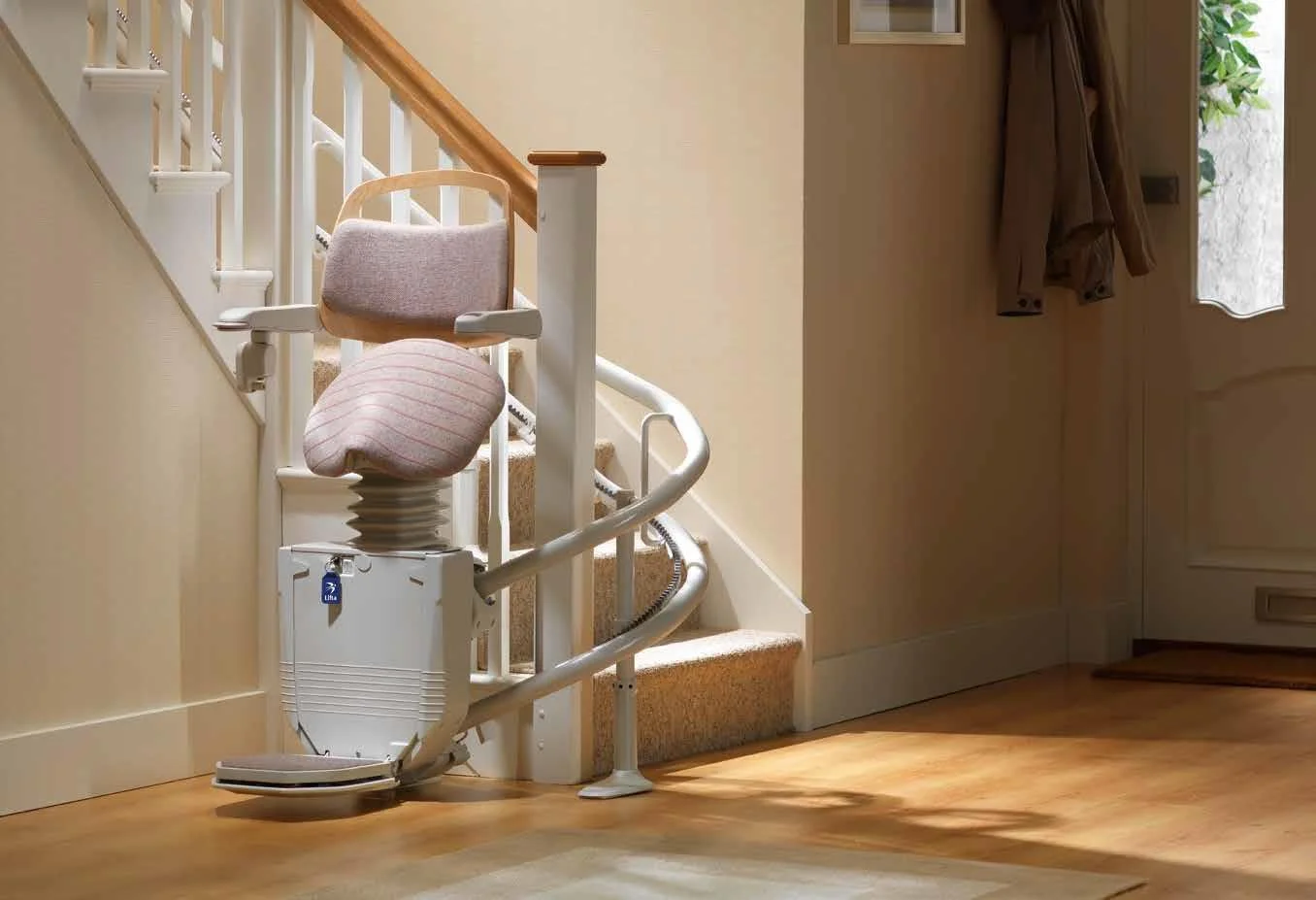
Farmhouses from the county's early farm days often have steep, narrow stairways, and some turn at a landing. A straight staircase usually takes a straight rail, which is the simpler and faster install. A stairway with a turn or landing needs a curved rail built to the exact shape of those steps.
Before quoting, we measure the stair width, the angle and any turns, and check where the rail can mount. In an older house, that visit tells you more than any brochure will.
Split-level homes in Branch County have short flights between levels, so one family may need a lift on one flight or on two. Ranch-style homes are mostly on one floor, and the stair question usually comes down to the basement steps.
Duplexes and low-rise buildings add another wrinkle: if the stairs are shared or the unit is rented, the owner has to agree to the install. It helps to have that conversation early.
About 13 square miles of the county is water, and the lakes are part of daily life here. Homes with steps up to a porch or down to a yard may need an outdoor stair lift built to handle Michigan weather.
If someone uses a wheelchair and cannot transfer to a seat, a platform lift may be the better fit than a chair. We can look at both options during the same visit.
Out of a population of 19,719, about 16.5% of residents are 65 or older, and 63.7% are homeowners. Many of those owners plan to stay in the house they already have, which is where a stair lift does its job.
Branch County Veterans Affairs at 570 Marshall Street, Suite F in Coldwater can help a veteran sort out which VA benefits apply. Call them at (517) 279-4322.
The county's median household income was $41,855 in 2010 American Community Survey data, so paying for a lift is a real question for a lot of families. None of the programs below promise a stair lift, but several cover home modifications or safety repairs, and a call can tell you where you stand.
Start with your Area Agency on Aging and, if a parent is on Medicaid, the MI Choice waiver. Low-income rural homeowners should also look at USDA Section 504. Statewide, you can also ask about the MSHDA Property Improvement Program (PIP) and MI Coordinated Health (formerly MI Health Link).
A Medicaid program for Michigan residents 65+ or disabled adults who meet nursing-facility level of care, with services covering environmental accessibility adaptations and home modifications; stair lifts are not named, so coverage depends on the individual care plan. Branch County is served by CareWell Services Southwest at (800) 626-6719.
The designated Area Agency on Aging for Branch County, offering meals, caregiver support through MI Caregiver Connection and housing-options counseling; no stair lift or home-modification fund is listed. Call (517) 278-2538 to ask about referrals.
Very-low-income rural homeowners can get loans up to $20,000 at 1% over 20 years, and those 62 or older can get grants up to $7,500, with combined help capped at $27,500. Funds go toward removing health and safety hazards; stair lifts are not named, and your address must be confirmed as an eligible rural area.
A lifetime benefit of $6,800 or $2,000, depending on disability status, for medically necessary changes like ramps and roll-in showers. HISA specifically does not pay for stair glides or porch lifts.
Grants for veterans with severe service-connected disabilities, up to $126,526 for SAH and $25,350 for SHA in FY2026. The source gives ramps and widened doorways as examples and does not list stair lifts.
A volunteer-built wheelchair ramp program for people with disabilities in Branch and nearby counties; it does not cover stair lifts. Call (269) 345-1516.
Weatherization and small home repair for low-income households in Barry, Branch, Calhoun and St. Joseph counties; stair lifts and accessibility work are not mentioned. Call (877) 422-2726 to confirm what they can do.
Older adults
200 W. Michigan Ave., Suite 102, Jackson, 49201
Veterans
570 Marshall Street, Suite F, Coldwater, 49036
Usually, yes. A straight flight takes a straight rail, and stairs with a turn or landing need a curved rail made to fit. We measure the stairs in person before recommending either.
The HISA grant specifically does not pay for stair glides or porch lifts. The SAH and SHA grants do not list stair lifts either, so call Branch County Veterans Affairs at (517) 279-4322 to talk through your situation.
The MI Choice waiver covers home modifications for people who qualify, but stair lifts are not named. Whether one is approved depends on the care plan and medical need. CareWell Services Southwest can explain the process at (800) 626-6719.
USDA Section 504 offers grants up to $7,500 for homeowners 62 and older, plus low-interest loans, for removing health and safety hazards. The home must be in an eligible rural area, and stair lifts are not specifically named.
The Branch-St. Joseph Area Agency on Aging at (517) 278-2538 is a good first call. They can point you toward services and referrals for older adults in the county.
A platform lift may fit better, or a ramp at the entry. Disability Network Southwest Michigan runs the Ramp Up Program for people with disabilities in Branch County at (269) 345-1516.
Tell us about the stairs in your home and we will explain which lift fits, what it costs and how installation works.
