Howard County housing comes from two very different eras. Around the county seat of Ellicott City you find historic, multi-level homes. In Columbia, the master-planned community the Rouse Company began building in 1967, the streets are lined with contemporary-design houses and townhouses.
Those two styles call for different stair lifts, and so do the rolling hills between Elkridge, Savage, Fulton and Highland. This page walks through what tends to fit the homes here, what to measure before you call anyone, and which local programs can help with the cost.
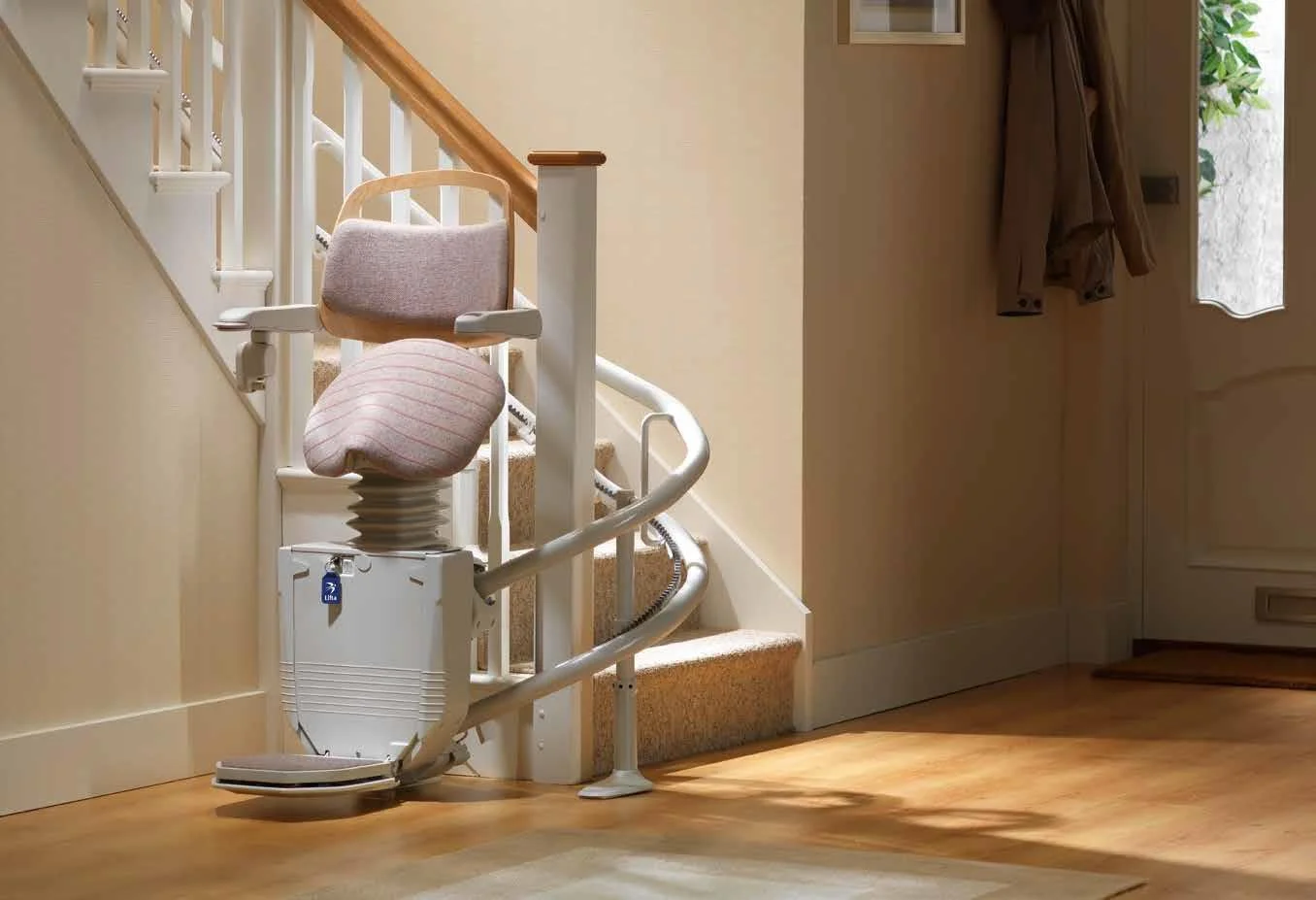
Historic homes often have stairs that turn, narrow, or change direction at a landing. A straight rail usually can't follow that path, so these houses are where curved stair lifts come up most often. A curved rail is built to the exact shape of your staircase.
Before a visit, it helps to note where the stairs turn, whether there is a landing, and how wide the stairway is at its tightest point. Also look at what is at the top and bottom. A doorway or wall right at the end of the stairs affects where the chair can park.
Split-level homes are common in the county, and they bring their own puzzle. Instead of one long staircase, you may have two or three short flights between levels. Each short straight flight can often take its own straight stair lift, which is usually simpler to install than one curved rail.
Townhouses tend to have straight, steep stairs between floors. Many of those staircases suit a straight lift well. If your home is in a low-rise building, shared stairways are a different matter, and you will want to talk with whoever manages the building before planning anything.
The county sits on Maryland's Piedmont Plateau, an area of rolling hills between the Patapsco River and the Patuxent River. On a sloped lot, the trouble is often outside: front steps, a walk-out basement, or a deck stair up to the back door.
Outdoor stair lifts are made for this, but the county averages roughly 45 inches of rain a year in a humid subtropical climate. Ask about weather covers and how the unit handles moisture. If a wheelchair is involved, a platform lift may be a better fit than a seat.
About 71% of housing units were owner-occupied as of the 2020 Census, which matters because most of the help described below is aimed at people who own and live in their home.
Veterans and their families can reach the county Office of Veterans & Military Families at (410) 313-0821, at 9830 Patuxent Woods Drive in Columbia.
The clearest local source of help is the Howard County Homeowner Housing Repair Loan Program. Its own page lists chair lifts as a fundable modification, alongside exterior ramps, height adjustments and grab bars. Loans go up to $50,000, and the terms depend on household income.
VA grants are more limited for stair lifts than many families expect, and Medicaid's Community First Choice benefit has an environmental adaptations category without stair lift detail. If you are not sure where to start, the Howard County Office on Aging and Independence at (410) 313-1234 can point you toward the right program. Maryland also lists statewide options including Accessible Homes for Seniors and the Maryland Assistive Technology Loan Program, which are worth asking about.
A county home-repair loan of up to $50,000 that explicitly lists chair lifts as a fundable modification, with terms ranging from 0% interest and forgiveness over 5 years for the lowest-income tier to 2% with monthly payments. Call Housing & Community Development at (410) 313-6333.
The county's information and referral hub for older adults, adults with disabilities and caregivers; it does not list a stair lift benefit itself but connects residents to the repair loan program and Medicaid waiver applications. Call (410) 313-1234.
A Medicaid benefit for people who meet a nursing-facility level of care and choose services at home; it references an environmental adaptations category, but stair lifts are not listed. Call (410) 767-6500.
A VA home-modification grant with a lifetime cap of $6,800 for service-connected conditions or $2,000 otherwise. The VA specifically excludes stair glides, so it does not cover stair lifts; applications go through the local VA Prosthetic and Sensory Aids Service office.
A grant of up to $126,526 (FY2026) for veterans with certain severe service-connected disabilities to buy, build or modify a home. The VA gives ramps and widened doorways as examples and does not list stair lifts.
A grant of up to $25,350 (FY2026) for veterans with certain service-connected disabilities to adapt a home. Stair lifts are not listed as a covered item.
A nonprofit serving people with disabilities in Anne Arundel and Howard County, offering housing navigation and assistive technology support; stair lifts and funding amounts are not listed. Call (410) 636-2274.
Older adults
9830 Patuxent Woods Drive, Columbia, 21046
Veterans
9830 Patuxent Woods Drive, Columbia, 21046
It can. The program lists chair lifts among the modifications it funds. You must own and live in the home as your primary residence for at least a year, have household income at or below 80% of the county median, a credit score of at least 620, and a debt-to-income ratio below 45%. Call (410) 313-6333.
Townhomes, condos and mobile homes all qualify along with single-family homes, as long as you are current on your mortgage, taxes, insurance and HOA fees.
Not through the HISA grant, which specifically excludes stair glides. The SAH and SHA grants do not list stair lifts either. The county Office of Veterans & Military Families at (410) 313-0821 can help you sort out what applies.
Not always. Each short straight flight can often take its own straight lift. A curved rail makes more sense when one staircase turns or has a landing you want to ride past.
Yes, outdoor models exist for porch and deck stairs. With roughly 45 inches of rain a year here, ask about covers and weather protection when you compare options.
Start with the Howard County Office on Aging & Independence at (410) 313-1234, 9830 Patuxent Woods Drive, Columbia. It serves older adults, adults with disabilities and caregivers, and refers people to the county repair loan and Medicaid waiver applications.
Tell us about the stairs in your home and we will explain which lift fits, what it costs and how installation works.
