Cecil County runs from sea level along the Chesapeake Bay up to 534 feet in the northwest, and its homes vary just as much. In Elkton you can find houses like Holly Hall, built in the 1810s, a few miles from mid-century homes that grew up along U.S. Route 40. Out in Rising Sun, Cecilton or Port Deposit, the setting turns rural.
That mix matters when someone in the family starts having trouble with the stairs. Many long-time homes here were never built for single-floor living or no-step entries. This page walks through what that means for a stair lift in your house and where Cecil County residents can ask about help paying for one.
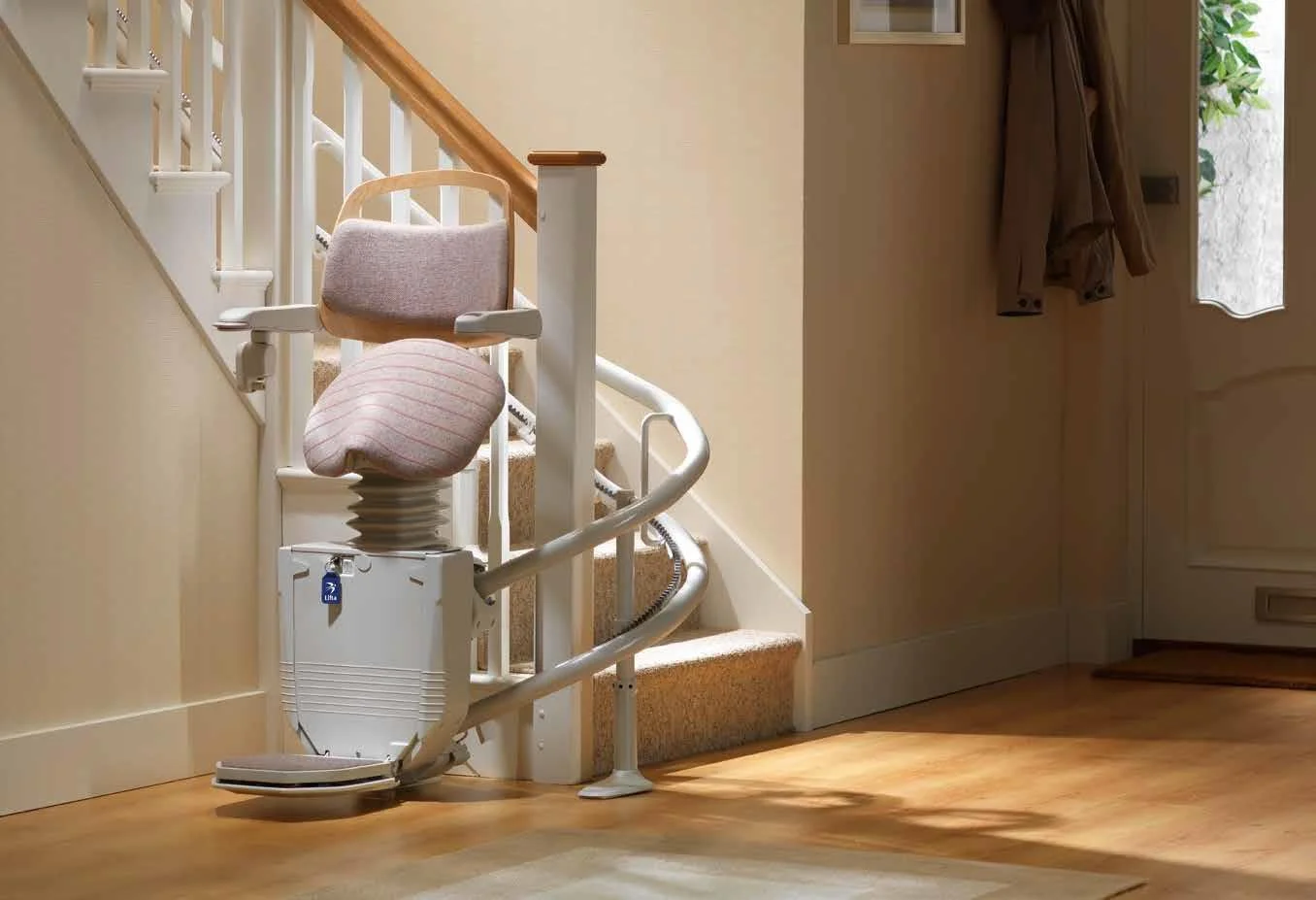
Split-level homes are common here, and they often have several short flights instead of one long staircase. Each flight may need its own straight lift, or one curved rail if the runs connect with a turn. We look at how the levels join before recommending either.
Townhouses usually have a single straight staircase between floors, which is the simplest and most common install. Older multi-story homes, like the colonial-era houses around Elkton, tend to have landings, turns or narrow treads. Those usually call for a curved rail built to the exact shape of the stairs.
A ranch-style home seems like it should be stair-free, but many have basement stairs to the laundry or a few steps at the front or back door. An outdoor stair lift can handle entry steps, and it is built to stand up to weather.
The county straddles the rolling hills of the Piedmont Plateau and the flatter Atlantic Coastal Plain. On hillier lots, a house may sit above the driveway with a long run of outdoor steps. If a wheelchair user needs to get in and out, a platform lift may make more sense than a seated lift.
At the 2020 Census, 16.6% of Cecil County residents were 65 or older, and the median age was 40.7. Much of the county is rural, and many people in North East, Charlestown or Chesapeake City have lived in the same house for decades.
For those families, a stair lift is often the change that keeps a bedroom and bathroom upstairs usable. It installs on the stair treads, not the wall, so it can usually go into older homes without major construction.
None of the programs listed below names stair lifts in its source material, so coverage has to be confirmed case by case. Start with Cecil County Aging and Disability Services at (410) 996-5295, at 200 Chesapeake Boulevard, Ste 2550, in Elkton. They can tell you which state and federal programs fit your situation.
Veterans can contact the Cecil County Service Center of the Maryland Department of Veterans and Military Families at (443) 206-8408, 105 Chesapeake Blvd., Suite A, Elkton. Statewide options worth asking about include Accessible Homes for Seniors, Community First Choice (Maryland Medicaid), the Maryland Assistive Technology Loan Program and VA Benefits for Veterans (HISA + Prosthetics).
The county's Area Agency on Aging offers information, referral and case management for older adults and adults with disabilities. Its source does not list stair lifts or home modifications, so call (410) 996-5295 to ask which services apply.
MAP is Maryland's No Wrong Door resource center for older adults and people with disabilities looking for long-term care and independent-living help; it is a referral service, not a funding source, and does not mention stair lifts. Reach it statewide at 1-844-MAP-LINK or through the county aging office at (410) 996-5295.
This state grant serves people 62 and older with income below 60% of state median income who need help with daily activities, and its services include safety related minor home repairs and modifications, though stair lifts are not named. Funding depends on annual availability; call (410) 767-1100.
These Medicaid programs support enrollees who need medical, personal and social help at home due to age, illness or disability. The source does not say whether stair lifts are covered, so call (410) 767-6500 to ask.
A federal grant of up to $126,526 for FY2026 for veterans and service members with qualifying service-connected disabilities to adapt their homes. Stair lifts are not named, but one may be funded as part of a broader project with VA approval.
A federal grant of up to $25,350 for FY2026 for veterans with qualifying service-connected disabilities that limit mobility. It funds home adaptations generally and does not name stair lifts specifically.
Older adults
200 Chesapeake Boulevard, Ste. 2550, Elkton, 21921
Veterans
105 Chesapeake Blvd., Suite A, Elkton, 21921
Yes. Split-level homes often have more than one short flight, so the answer may be a separate straight lift for each flight or a single curved rail if the flights connect. We measure each run before recommending one.
Older homes with turns, landings or narrow stairs usually need a curved rail made to fit that staircase. The lift mounts to the treads, so the walls are typically left alone.
SOAR starts at age 62, but Cecil County Aging and Disability Services also serves adults with disabilities, and Maryland Medicaid programs cover people based on need from age, illness or disability. Call (410) 996-5295 to see what fits.
None of the listed programs names stair lifts in its source. SOAR covers safety related minor home repairs and modifications, and the VA grants fund home adaptations, so ask each one whether a lift qualifies in your case.
Call the Cecil County Service Center of the Maryland Department of Veterans and Military Families at (443) 206-8408. They can help with the VA SAH and SHA grants and VA Benefits for Veterans (HISA + Prosthetics).
An outdoor stair lift is built for weather and can handle entry steps. For a wheelchair user, a platform lift is often the better choice.
Tell us about the stairs in your home and we will explain which lift fits, what it costs and how installation works.
