Caroline County is the one Eastern Shore county in Maryland that touches neither the Chesapeake Bay nor the Atlantic Ocean. Its seven towns, Denton, Federalsburg, Greensboro, Ridgely, Preston, Williston and Goldsboro, sit among farmland, and 85.0% of residents lived in rural areas as of the 2020 Census.
That farm history shows up in the houses. Many are older, single-family, multi-story rural homes, including farmhouses, and that is the type of home where the stairs most often become the problem when someone wants to stay put. This page walks through what a stair lift looks like in these homes and where Caroline County families can look for help paying for one.
The county's settlement goes back a long way. The Caroline County Courthouse in Denton dates to 1797, and plenty of homes around the county come from the same agricultural pattern of building. In an older farmhouse, the bedrooms and the only full bathroom are often upstairs.
A straight stair lift is the usual answer when the staircase runs in one line from bottom to top. It mounts to the stair treads, not the wall, so plaster walls in an older house are not a barrier. Older stairs can be narrow or steep, so we measure width, rise and the landing space at the top before recommending a model.
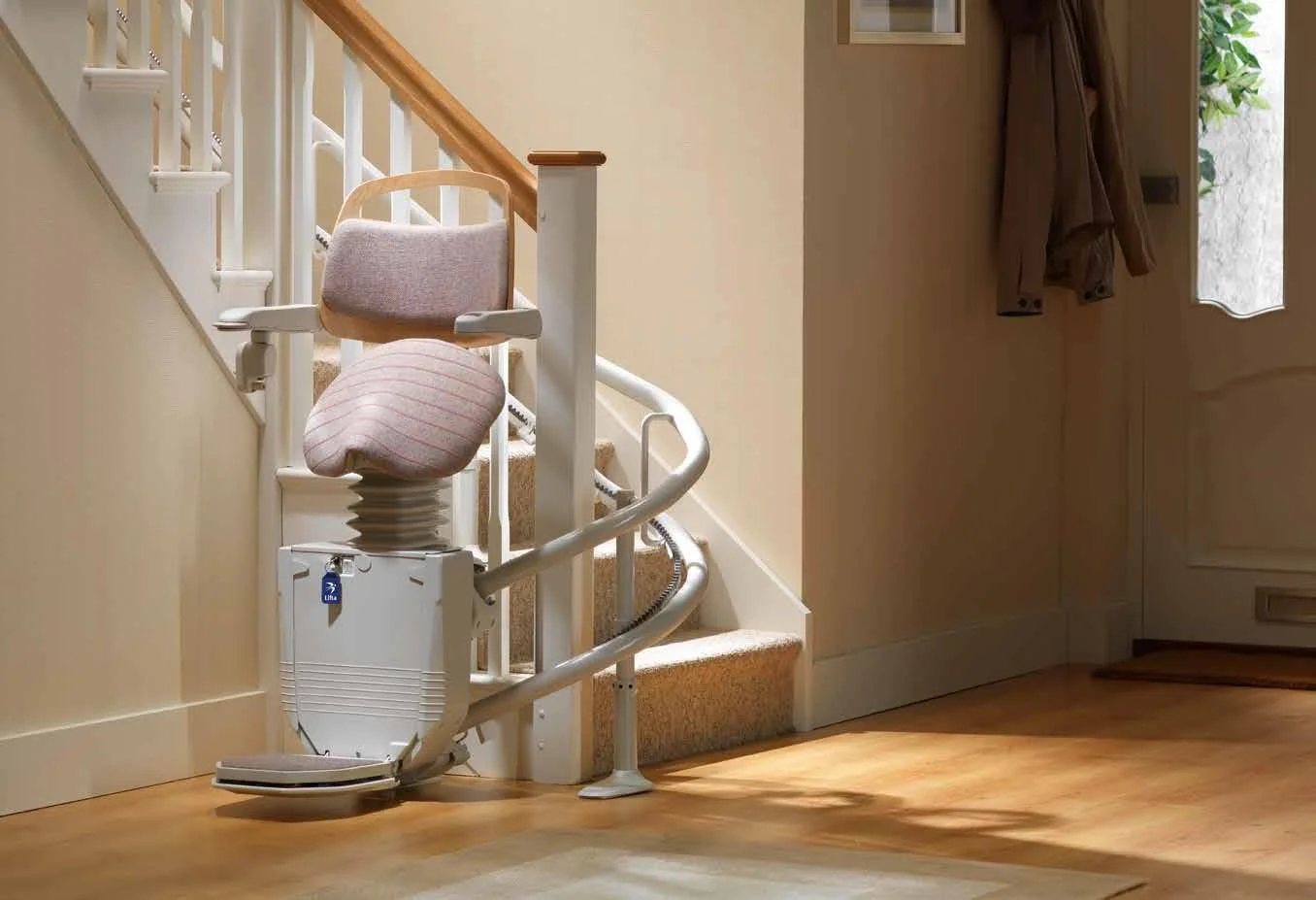
When a staircase turns at a landing or winds partway up, a curved stair lift with a custom-built rail is the fit. Curved rails take longer to make and cost more than straight ones, which is one reason the funding section below matters.
Not every home here is a farmhouse. The county also has split-level homes, townhouses, row houses and walk-up apartments, and each brings its own stair questions.
A split-level home has short flights between levels, so a person may need lifts on more than one run, or may choose to put the lift only on the flight that leads to the bedroom. Townhouses and row houses tend to have long, straight, enclosed staircases that suit a straight lift well, though narrow stairs need a model with a slim rail and a folding seat.
Walk-up apartments raise a different issue: the stairs may be shared or owned by a landlord. With 55.8% of residents owning their homes, a good share of households can make the decision themselves, but renters will need written permission before any installation.
Caroline County covers 326 square miles of low, level ground on the Eastern Shore, drained by the Choptank River and Tuckahoe Creek. Unlike some of its coastal neighbors, it is inland and level, so most of the access problems we see are inside the house or at the front porch, not on a sloped yard.
Porch and entry steps on an older home can be handled with an outdoor stair lift built to stand up to weather. For someone who uses a wheelchair and cannot transfer to a seat, a platform lift is the option to look at instead, since it carries the person and the chair together.
In 2020, 17.4% of Caroline County residents were 65 or older, and the median age was 40.0. The county also draws retirees and cross-Bay commuters looking for a rural setting and low cost of living, which adds to the number of homeowners planning to age in the house they own.
If that includes you or a parent, the VA programs listed below are worth a call, with one important caution about which VA grant does and does not pay for stair lifts.
The clearest funding route in the sources we have is the Maryland Assistive Technology Loan Program, which lists home modifications as an eligible loan category. Unsecured home-modification loans go up to $20,000, and a family member or friend can be the borrower for a Maryland resident with a disability.
Other programs may help indirectly. Upper Shore Aging, the Area Agency on Aging for Caroline County, offers case management and durable medical equipment referral, and Maryland Medicaid Community First Choice lists accessibility adaptations. Neither names stair lifts, so ask directly. Accessible Homes for Seniors is also among Maryland's statewide programs and worth asking about.
For veterans, do not count on the VA HISA grant: its official page excludes stair glides. The local Veterans Service and Benefits Program, Upper Shore Office, at 11 South Harrison Street in Easton, (410) 690-7181, can help sort out which VA benefits apply.
The state-designated Area Agency on Aging for Caroline County, offering in-home services, case management and durable medical equipment referral, with the SOAR program aimed at adults 63+ at risk of nursing-home placement. Stair lifts and home modifications are not listed, so ask a case manager at (410) 778-6000 whether any funding stream could apply.
Information, counseling, respite funds and support groups for family caregivers of older adults in Caroline, Kent and Talbot counties. Stair lifts and home modifications are not listed, and respite funds are not earmarked for equipment; call (410) 778-7180.
A Medicaid benefit for people with full Maryland Medicaid who need a nursing-facility level of care but live in the community, with no age restriction. Accessibility adaptations is a listed service, but stair lifts are not named, so coverage would be case by case; call (410) 767-1739.
Below-market-rate loans from $500 to $70,000, including unsecured home-modification loans up to $20,000, and home modifications are an eligible category, so a stair lift fits. The person with a disability, a family member or a friend can apply by calling (410) 554-9230.
A lifetime grant of up to $6,800 or $2,000 for medically necessary structural alterations to a veteran's home. Stair glides are explicitly excluded, so HISA does not cover a stair lift; the VA can be reached at (877) 222-8387.
The VA benefit that provides durable medical equipment, ramps, wheelchairs and other devices by clinical prescription for veterans enrolled in VA health care. Stair lifts are not named, so a veteran should confirm with the local PSAS office whether one can be authorized.
A monthly amount added to a VA pension for veterans who need help with daily activities, are bedridden, live in a nursing home due to disability or have severe vision loss. The official page does not address stair lifts, since it is a cash benefit rather than a purchase grant.
Older adults
100 Schauber Road, Chestertown, 21620
Veterans
11 South Harrison Street, Easton, 21601
Usually, yes. A stair lift attaches to the stair treads rather than the walls, so older construction is rarely a barrier. We check stair width, steepness and landing space first, and a staircase that turns will need a curved rail.
The HISA grant will not, because its official page excludes stair glides. PSAS does not name stair lifts either, so a veteran should ask the local PSAS office directly. The Veterans Service and Benefits Program, Upper Shore Office in Easton, (410) 690-7181, can help.
Yes. The Maryland Assistive Technology Loan Program lists home modifications as an eligible category, with unsecured home-modification loans up to $20,000 and no age restriction. Call (410) 554-9230.
Maryland Medicaid Community First Choice lists accessibility adaptations among its services, but the program page does not mention stair lifts. It requires full Medicaid enrollment and a nursing-facility level of care, and coverage would be decided case by case. Call (410) 767-1739.
Caroline County is served by Upper Shore Aging at 100 Schauber Road, Chestertown, MD 21620. The phone number is (410) 778-6000, and a case manager can tell you whether any of their services could help with stair access.
Split-levels have several short flights, so you may need a lift on more than one run or only on the flight that matters most, usually the one to the bedrooms. An in-home visit is the easiest way to sort out which flights need one.
Tell us about the stairs in your home and we will explain which lift fits, what it costs and how installation works.
