From the row houses of Dundalk and Essex to the split-level homes on the slopes around Towson, Cockeysville and Owings Mills, Baltimore County has a lot of stairs. Much of the county sits on hills that often rise to 800 feet above tide water, and the land climbs to about 960 feet near the Pennsylvania border.
That terrain shapes the houses. Sloped lots lead to split-level and multi-story homes with stairs inside and steps outside. This page walks through which kind of stair lift tends to fit the homes here, what to measure for, and which Baltimore County and Maryland programs are worth calling about cost.
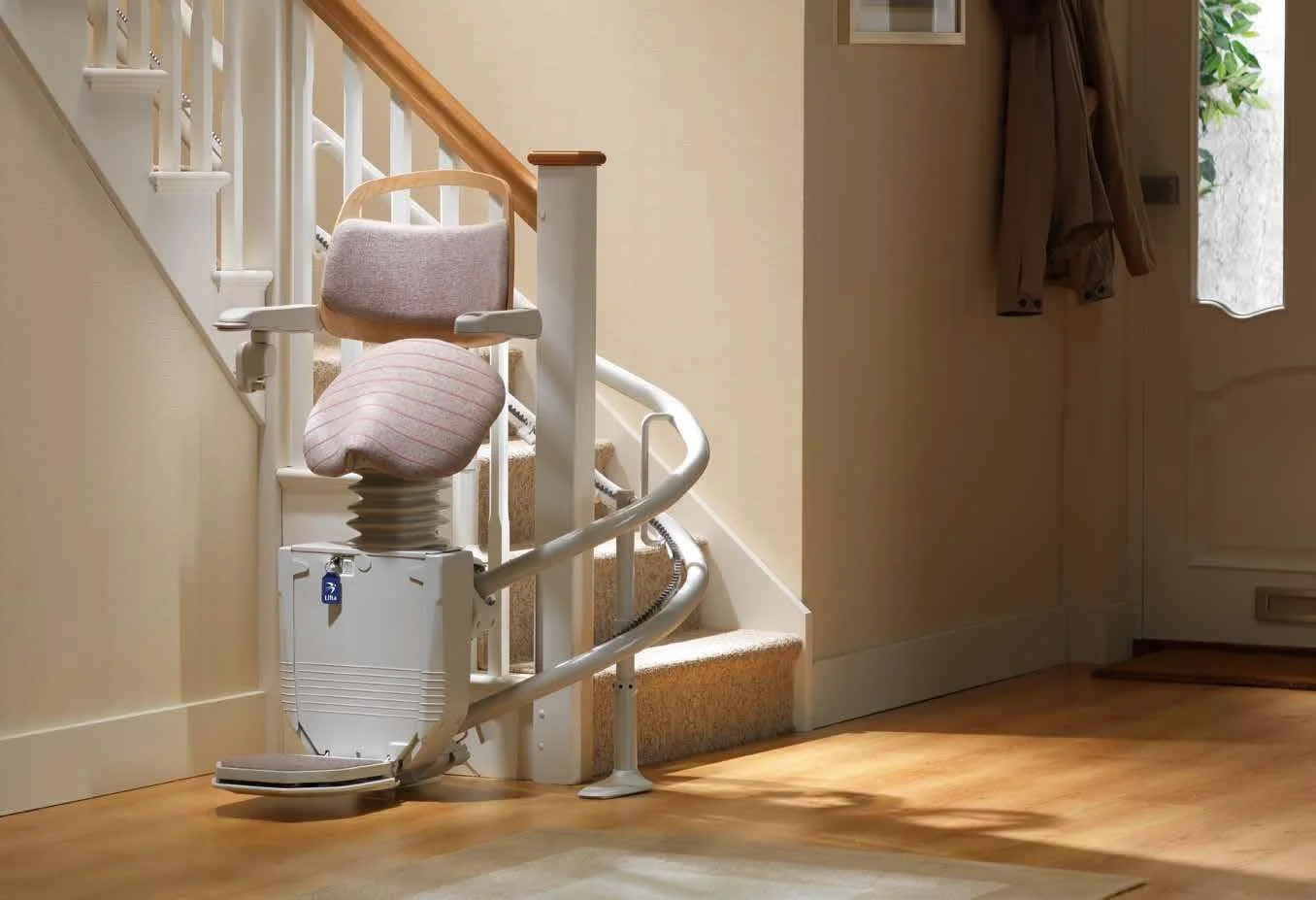
The county's housing runs from detached single-family houses and townhouses to row houses, walk-up apartments and split-level homes. Each one puts different demands on a stair lift.
A row house or townhouse often has one straight flight between floors. That is usually the simplest install, since a straight rail mounts to the stair treads and does not need to be bent to fit.
Split-level homes are a different job. Short flights with a landing or a turn between them may need a curved rail built to the shape of the stairs, or a separate lift on each flight. Walk-up apartments raise a separate question about who controls the shared stairway, so check with the building before planning anything.
On a hilly lot the hardest stairs are sometimes outside. Steps from the driveway or sidewalk up to the front door, or down to a lower-level entry, can keep someone at home as much as the stairs inside.
Outdoor stair lifts are built for weather exposure, and a platform lift is an option when someone uses a wheelchair and cannot transfer to a seat. When we look at a home in Perry Hall, Catonsville or Reisterstown, we check the outside approach as well as the indoor staircase.
About 17.3% of residents in the county's listed towns are 65 or older, and the 2020 census put the county figure at 17.7%. In 12.6% of households, someone 65 or older lives alone, which often means one person is handling the planning and the bill without help.
Most people who need a lift also own the house. Of the county's 350,163 housing units, 64.0% of occupied units are owner-occupied. For a homeowner, no landlord approval is needed. Renters should get written permission before any rail is mounted to the stairs.
None of the programs below names stair lifts in its published materials, so coverage is not confirmed for any of them. Several do fund home adaptations or assistive technology, and that makes them worth a phone call before you pay out of pocket.
A good first call is the Baltimore County Dept of Aging at (410) 887-2594, 611 Central Avenue, Towson. That line is also the intake for BCAUSE, the no-cost program for homeowners 65 or older. People on full Medicaid should ask about Community First Choice, which lists accessibility adaptations. Veterans with a qualifying service-connected disability can contact the Baltimore VA Regional Benefit Office at (800) 827-1000.
Statewide, you can also ask about Accessible Homes for Seniors and VA Benefits for Veterans (HISA + Prosthetics). When you call any office, ask directly whether a stair lift counts as an approved adaptation or device.
A Maryland Medicaid state-plan benefit for people who already have full Medicaid, need an institutional level of care and live in the community, with no age limit. It lists accessibility adaptations, assistive technology and environmental assessments, but stair lifts are not named, so call (410) 767-1739 to ask whether one qualifies.
A Medicaid waiver for adults 18 and older who need nursing-facility level of care, with income up to 300% of SSI and countable assets generally $2,000-$2,500, and a registration waitlist. Its listed services do not mention home modifications or stair lifts. Call (844) 627-5465 with questions.
Federal grants for veterans and service members with certain service-connected disabilities who own or will own the home: SAH up to $126,526 and SHA up to $25,350 for FY2026. The VA mentions adaptations such as ramps and wider doorways but does not name stair lifts, so ask the Baltimore VA Regional Benefit Office at (800) 827-1000.
A partnership including the Baltimore County Department of Aging that helps Baltimore County homeowners age 65 or older age in place at no cost. The program does not list which modifications it funds, so call Maryland Access Point of Baltimore County at (410) 887-2594 to ask whether a stair lift is in scope.
A low-interest loan program for Maryland residents with disabilities of any age, used to buy assistive technology. Stair lifts are not named on its page, so call (800) 832-4827 to ask whether one is loan-eligible.
The county's Area Agency on Aging, offering information and referral for older adults and caregivers rather than direct funding. It is the intake line for BCAUSE and other county aging programs: (410) 887-2594, 611 Central Avenue, Towson.
Older adults
611 Central Avenue, Towson, 21204
Veterans
31 Hopkins Plaza, Fallon Federal Building, Baltimore, 21201
Usually, yes. Split-level homes often have short flights with a landing or turn, which may call for a curved rail or a separate lift on each flight. The layout decides which, so we measure on site.
BCAUSE helps Baltimore County homeowners age 65 or older age in place at no cost. It does not list stair lifts specifically, so call (410) 887-2594 to ask whether one is covered.
Not confirmed. The Community First Choice Program covers accessibility adaptations and assistive technology for people with full Medicaid who need an institutional level of care. Call (410) 767-1739 and ask whether a stair lift counts as an accessibility adaptation.
Some programs have lower or no age limits. Community First Choice has no age limit, the Community Options Waiver starts at age 18, and the MDTAP loan program serves Maryland residents with disabilities of any age.
Contact the Baltimore VA Regional Benefit Office at (800) 827-1000, 31 Hopkins Plaza, Fallon Federal Building, Baltimore. The SAH and SHA grants require a qualifying service-connected disability and do not name stair lifts, so ask whether one would be approved.
Yes, outdoor stair lifts are made for steps exposed to weather, and a platform lift is an option for wheelchair users. On sloped lots in the county, the outdoor approach is often worth looking at along with the indoor stairs.
Tell us about the stairs in your home and we will explain which lift fits, what it costs and how installation works.
