Plymouth County runs from Brockton, its largest city, down through South Shore towns like Marshfield, Duxbury and Kingston and out to cranberry country around Carver, Middleborough and Wareham. Across its 45 towns you will find historic town centers, detached houses on bigger rural lots, duplexes, townhouses and walk-up apartments.
The county was created in 1685 by the Plymouth General Court, and it has numerous districts listed on the National Register of Historic Places. Many of the older homes in those town centers were built long before modern accessibility codes, with stairs that are narrower and steeper than what newer construction allows. That shapes which stair lift will work and how it gets installed.
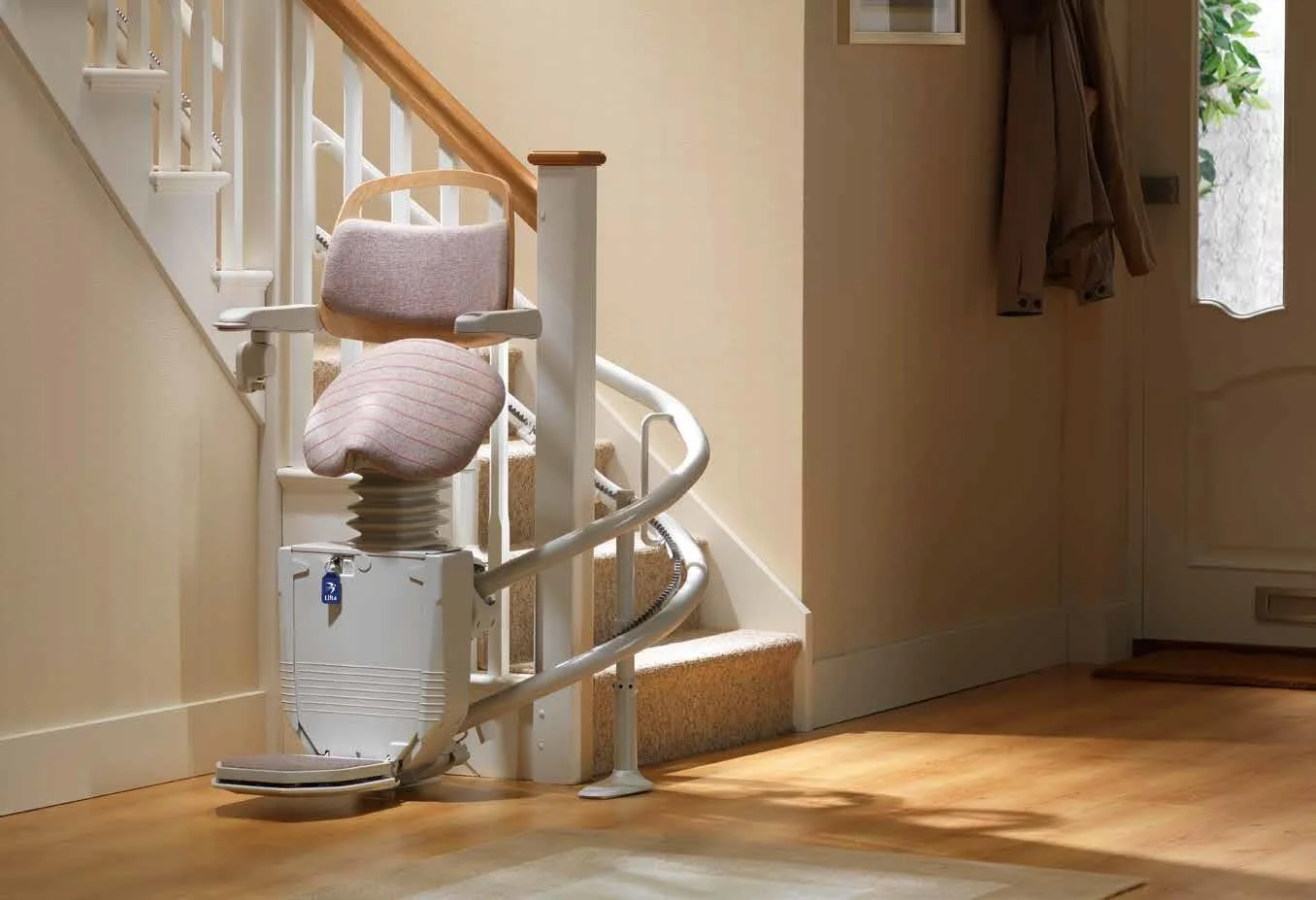
In the older parts of towns like Plymouth, Hingham, Scituate and Middleborough Center, interior staircases are often tight and steep. Some run straight from bottom to top. Others turn at a landing or wind around a corner, which is common in houses built long ago.
A straight staircase usually takes a straight rail, which is the simplest install. A staircase that turns or has a landing in the middle calls for a curved rail built to that exact stair. On narrow stairs we also look at how much room the folded seat leaves for others still walking up and down.
Not everyone in the county lives in a single-family home. Duplexes and townhouses often have one long flight between floors, and walk-up apartments can mean shared stairs the resident does not control.
If the stairs belong to a landlord, the owner has to agree to the install. Massachusetts has a loan program that also serves small landlords who rent to a person with a disability, covered below.
Plymouth County covers about 1,093 square miles, and roughly 40% of that is water. The north is denser around Brockton, Abington, Whitman and Rockland, while towns to the south and west, like Lakeville, Rochester, Halifax and Carver, are more rural.
That split matters for money as well as for the house. Some western and southern towns may count as rural for the USDA Section 504 repair program, while denser Brockton-area parcels generally do not. The only way to know is to check your exact address on the USDA eligibility map.
Homes with exterior steps up to a porch or side door may need an outdoor lift or a platform lift instead of, or in addition to, an indoor one. We look at the entry steps during the same visit as the inside stairs.
About 19.7% of the county's 590,789 residents are 65 or older, and 77.0% of households own their home. That matters because the most direct state funding for stair lifts, the Home Modification Loan Program, is built around homeowners.
Veterans can reach the county's Veteran Services office at 26 Court Street in Plymouth, (508) 322-3389, for help sorting out which VA benefits apply.
The clearest option is the Home Modification Loan Program (HMLP). It offers 0% interest loans with no monthly payment, and the state program has been used to pay for stair lifts. Repayment waits until the home is sold or transferred.
MassHealth waivers, including the Frail Elder Waiver, cover home modifications such as ramps, grab bars and doorway widening, but stair lifts are not named on the source page. VA grants are similar: the HISA benefit specifically excludes stair glides, and the SAH and SHA grants do not mention stair lifts at all.
A good first call is Old Colony Elder Services at (508) 584-1561. It is the intake point for Plymouth County residents age 60 and older and can connect you to MassHealth waivers and other local help. The state also lists the Massachusetts Assistive Technology Loan Program (Easterseals MA), which is worth asking about directly.
A statewide MassHealth waiver for members 65 and older, or 60-64 with a disability, who need a nursing facility level of care, with a 2026 income limit of $2,982/month and a $2,000 asset limit for a single applicant. Home modifications like ramps, grab bars and doorway widening are listed, but stair lifts are not mentioned; call MassOptions at (800) 243-4636 or start with Old Colony Elder Services.
Run by MassAbility for people 65 and older, or 18 and older with a disability, who have spent at least 90 days in a nursing facility or hospital and are moving back home; enrollment is limited and a waitlist may apply. The source lists ramps, grab bars and doorway widening as modifications and does not mention stair lifts; call (855) 499-5109.
State-funded 0% interest, no monthly payment loans of $1,000-$50,000 for homeowners (up to $30,000 for manufactured or mobile homes), repaid when the home is sold or transferred, with no credit check and income guidelines. It has been used to fund stair lifts; call (413) 233-1615.
A federal repair program for very-low-income homeowners below 50% of area median income who live in a USDA-eligible rural area, which not all of Plymouth County is. Stair lifts are not mentioned in the source, and eligibility has to be checked by address on the USDA eligibility map.
A VA benefit with a lifetime maximum of $6,800 or $2,000, depending on the veteran's status, for medically necessary structural changes prescribed by a VA provider. It does not cover stair lifts: the VA excludes porch lifts and stair glides; call (508) 583-4500.
A grant of up to $126,526 (FY2026) for veterans with certain serious service-connected disabilities who own or will own the home, usable up to 6 times. Stair lifts are not mentioned in the source; call (800) 865-3384.
A grant of up to $25,350 (FY2026) for veterans with qualifying service-connected disabilities such as loss of use of both hands, severe burns or certain respiratory injuries. Stair lifts are not mentioned in the source; call (800) 865-3384.
The county's aging services agency, with offices in Brockton and Plymouth, offering case management, referrals and access to MassHealth waivers and the state Home Care Program for residents 60 and older. It does not give grants or name stair lifts; call (508) 584-1561 (TTY 508.587.0280) or visit 144 Main Street, Brockton.
Older adults
144 Main Street, Brockton, 02301
Veterans
26 Court Street, Plymouth, 02360
Often it can, but those stairs need careful measuring. Homes built before modern accessibility codes commonly have narrower, steeper staircases, and a straight or curved rail is chosen based on how the stairs run.
The Frail Elder Waiver and the MFP-CL Waiver list ramps, grab bars and doorway widening as home modifications. Stair lifts are not named on the source pages, so ask Old Colony Elder Services at (508) 584-1561 or MassOptions at (800) 243-4636 about your own care plan.
No. The VA states that HISA excludes removable equipment such as porch lifts and stair glides. The SAH and SHA grants do not mention stair lifts either, so the county Veteran Services office at (508) 322-3389 is a good place to talk through options.
It depends on your exact address. Some western and southern towns may qualify, while denser Brockton-area parcels generally do not, and the USDA eligibility map is the only way to confirm.
Yes, in some cases. The Frail Elder Waiver accepts people 60-64 with a disability, Old Colony Elder Services serves residents 60 and older, and the Home Modification Loan Program is open to any Massachusetts homeowner with a disability or a household member with a disability.
The Home Modification Loan Program offers 0% interest loans of $1,000-$50,000 with no monthly payment, repaid when the home is sold or transferred. Call (413) 233-1615 to apply.
Tell us about the stairs in your home and we will explain which lift fits, what it costs and how installation works.
