Salem was founded in 1814, and the older homes around its courthouse square still have the tall, multi-story layouts common in small Indiana county seats. Head out toward New Pekin, Campbellsburg or Little York and you find farmhouses on rolling ground and newer single-story ranch houses. Each of those homes puts a different kind of stairway between a person and the rooms they use every day.
This page walks through what those homes mean for a stair lift, how the hilly, spread-out county affects an assessment visit, and which Washington County and Indiana programs may help with the cost. The goal is to help you figure out whether a lift fits the house before anyone signs anything.
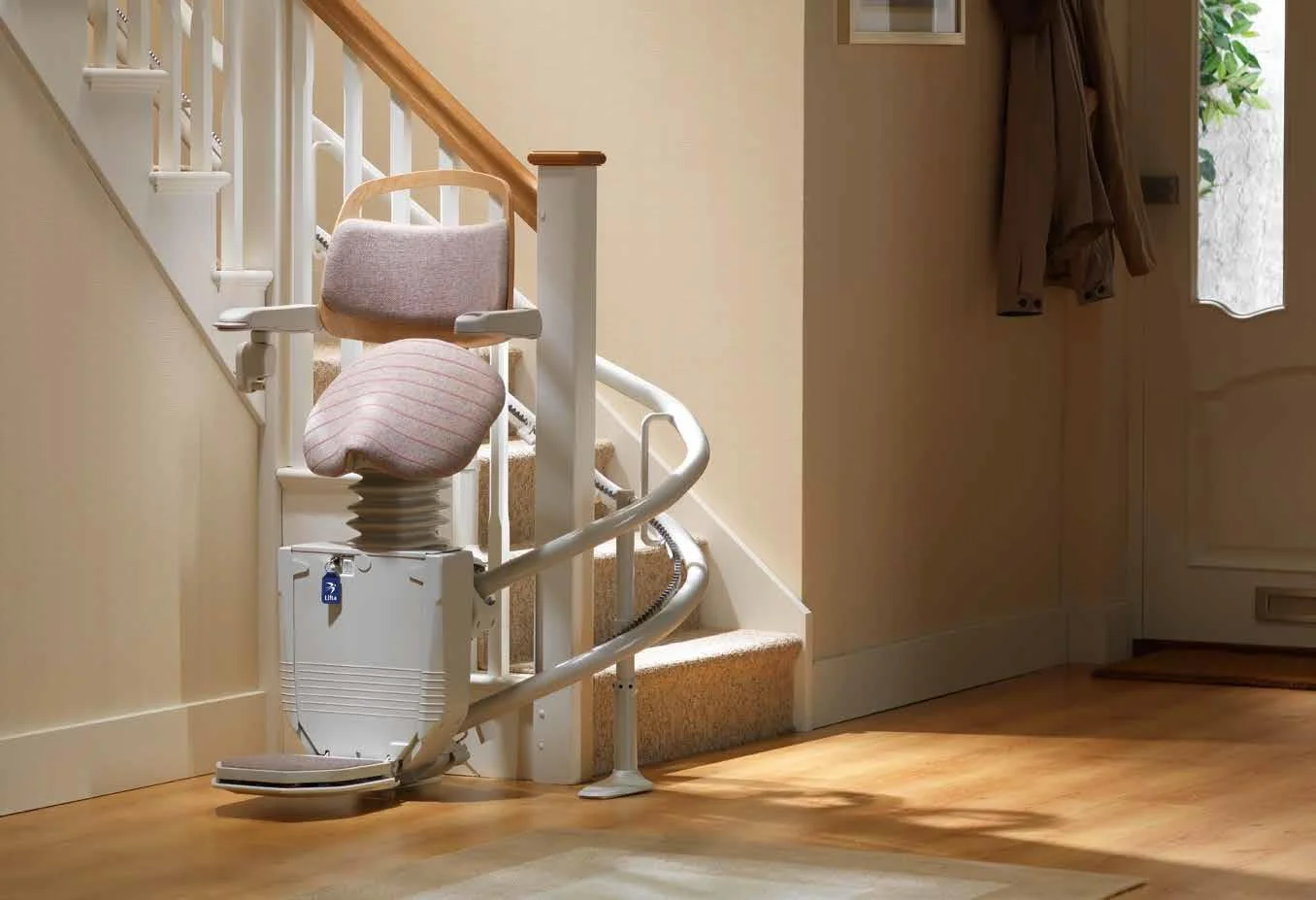
The historic core of Salem holds 19th- and early-20th-century homes with interior stairways that tend to be steep, and some turn at a landing. A stairway that runs straight from bottom to top can usually take a straight rail lift, which is the simplest and quickest to install.
If the stairs turn, wrap around a corner or stop at a landing partway up, a curved lift with a rail built to that staircase is the usual answer. We measure the treads, the width and the turns in person, because older stairways rarely match a standard drawing.
Rural farmhouses across the county often have a second floor bedroom plus a basement used for laundry or storage. A lift on the main stairway helps upstairs, and a second straight lift can make the basement usable again.
Single-story ranch homes may have no interior stairs at all, but they often have porch or entry steps. An outdoor stair lift built for weather, or a platform lift for someone who uses a wheelchair, can solve the trip from the driveway to the door. Townhouses and low-rise buildings in the county bring their own entry and shared-stair questions, so those are worth discussing during the visit.
Washington County covers about 516.6 square miles of low rolling hills in south-central Indiana, with the Muscatatuck River draining the north and the Blue River draining the south. The ground rises to 1,050 feet near New Philadelphia in the east.
With homes spread across farmland and small towns, travel time for an assessment, delivery and installation can run longer than in a city. Planning the visit early, and having the stairway clear when we arrive, helps keep the install to a single trip where possible.
Many families pay privately, but several programs are worth checking first. For residents 60 and older who qualify for Medicaid and a nursing-facility level of care, the Indiana PathWays for Aging Waiver lists home modifications, and a reviewed source names stair lifts as an allowed item.
Hoosier Uplands in Mitchell is the local starting point for the waiver and the CHOICE Program. Low-income rural homeowners can ask about USDA Section 504 repair loans and grants, and Indiana also offers the INDATA Alternative Financing Program (AFP).
A Medicaid waiver for Indiana residents age 60+ who meet a nursing-facility level of care, and it covers home modifications, with stair lifts listed as allowed by a reviewed source and a $500/year maintenance cap. Apply through Hoosier Uplands or call (877) 284-9294.
A state-funded in-home services program for people 60+ or with a disability who are at risk of losing independence; it lists environmental modification but the source does not mention stair lifts. Call (800) 986-3505 or start with Hoosier Uplands.
The Area Agency on Aging for Washington County, at 521 W. Main St., Mitchell, and the required first contact for CHOICE and waiver home-modification benefits; it does not itemize a stair lift benefit. Call (812) 849-4457.
Loans up to $40,000 at 1% fixed interest and grants up to $10,000 for homeowners age 62+ with very low income in rural areas; the source covers accessibility improvements generally but does not mention stair lifts. Call (317) 290-3100.
A VA grant for permanent home alterations such as ramps and roll-in showers, and it does not cover stair lifts because the VA excludes stair glides. Call (800) 827-1000.
Grants of up to $126,526 (SAH) and $25,350 (SHA) for veterans with qualifying severe service-connected disabilities to adapt a permanent home; the VA page reviewed does not mention stair lifts. Call (800) 827-1000.
A center for independent living serving Washington County from 1490 W. Main St., Mitchell, offering information, referral, peer support and advocacy; the source does not mention a stair lift or home-modification program. Call (812) 277-9626.
Older adults
521 W. Main St., Mitchell, 47446
Veterans
99 Public Square Suite #2, Salem, 47167
Call Hoosier Uplands at (812) 849-4457. It is the required first contact for the CHOICE Program and the PathWays for Aging Waiver in the county, and it can point you to other in-home services.
The PathWays for Aging Waiver is for people 60 and older. Indiana residents 59 and under fall under the separate Health and Wellness Waiver, and the CHOICE Program also serves people with a disability regardless of age.
The VA HISA grant explicitly excludes stair glides, so it will not fund a stair lift. The SAH and SHA grants do not list stair lifts either, so call the Washington County Veteran's Service Office in Salem at (812) 883-2063 to talk through your situation.
Often, yes. A straight stairway takes a straight rail lift, while stairs that turn or have a landing need a curved rail built to that staircase, which we measure during the in-home visit.
USDA Section 504 Repair Loans and Grants serve very-low-income owners in eligible rural areas, and Washington County qualifies as rural. The source does not name stair lifts, so ask the USDA at (317) 290-3100 whether your project fits.
Outdoor stair lifts are built to handle weather on porch and entry steps. For someone who uses a wheelchair, a platform lift is usually the better fit.
Tell us about the stairs in your home and we will explain which lift fits, what it costs and how installation works.
