Tell City was laid out in 1858 by the Swiss Colonization Society as a grid of 392 town blocks and 7,328 building lots along the Ohio River. Many of the 3,732 housing units there today reflect that older river-town history, which usually means stairs between floors rather than everything on one level.
Downriver and upriver, Cannelton and Troy sit on the same western riverbank, backed by the hilliest terrain in Indiana. If a parent in one of these towns is starting to struggle with the stairs, this page walks through what kind of stair lift tends to fit local homes and which programs may help cover the cost.
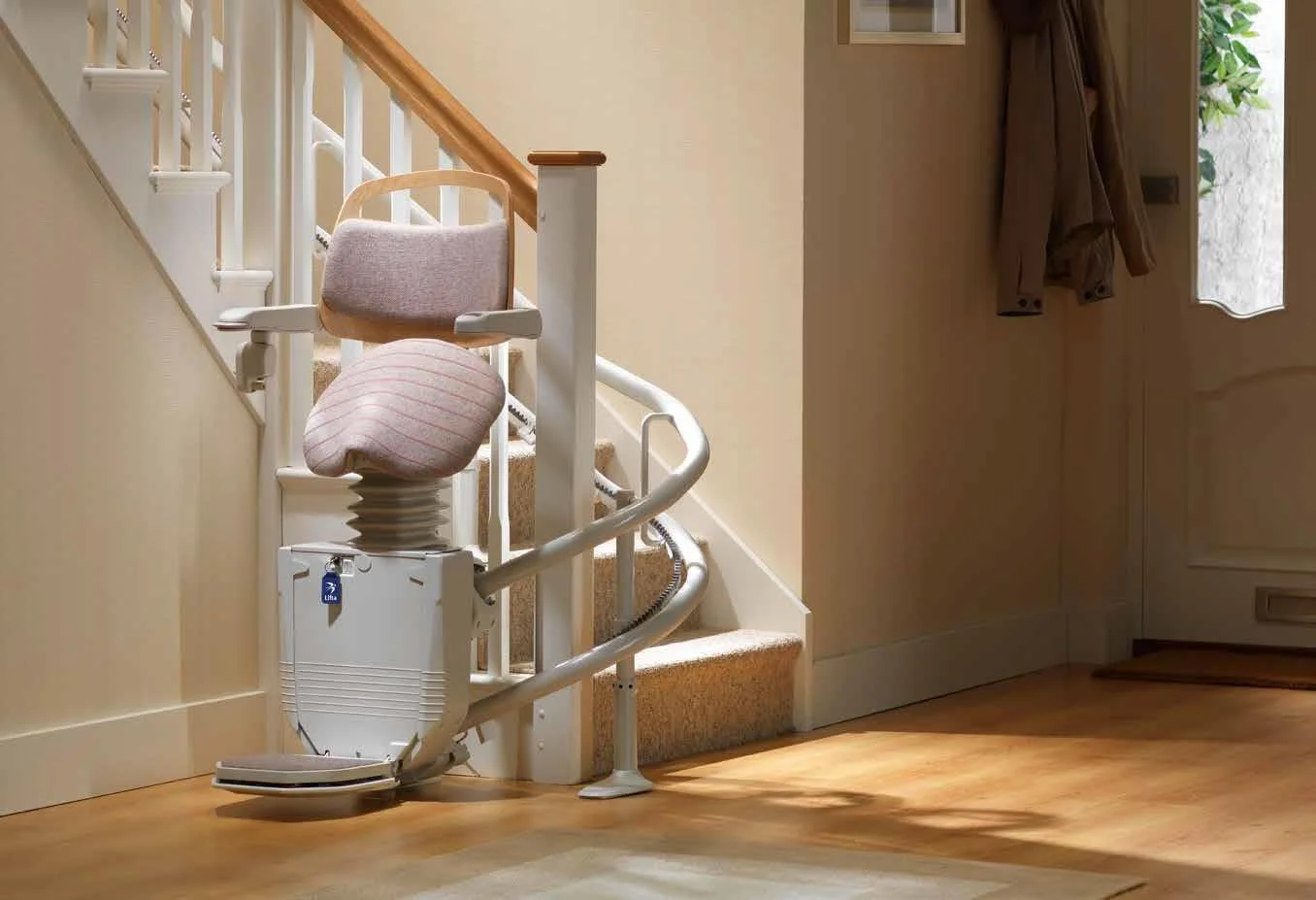
Homes in Tell City, Cannelton and Troy include single-family homes, detached houses, townhouses, walk-up apartments and split-level homes. The older, modest housing stock common in a 19th-century river town often has narrower staircases and fewer first-floor bedrooms than newer construction.
A single straight flight is the simplest case. The rail mounts to the stair treads, not the wall, so plaster walls in an older house are usually not a problem. We measure the width of the stairs and the space at the top and bottom before recommending anything.
Split-level homes often have two or three short runs of stairs instead of one long one. Each short run can take its own straight lift, or a single curved rail can follow the turns if the runs connect.
Townhouses and homes with a landing halfway up often need a curved lift as well. Curved rails are built to the exact shape of your staircase, so expect a measuring visit before ordering and a longer wait than for a straight unit.
Perry County is the hilliest and one of the most forested counties in Indiana, with more than 60,000 acres inside the Hoosier National Forest. On the rolling ground along the river, many houses have steep entry steps, which can make an exterior ramp long or impractical.
An outdoor stair lift, built to handle weather, can run up porch or entry steps where a ramp will not fit. For someone who uses a wheelchair and cannot transfer to a seat, a platform lift is the option to discuss.
About 20.2 percent of Perry County residents are 65 or older, and 62.6 percent of households own their home. Owning matters because most of the funding programs below require the applicant to own and live in the house.
If that includes your parent, start with the Perry County Veterans Service Office in Tell City, since VA rules on stair lifts are specific and worth getting straight before you apply.
The clearest public source of help is Indiana PathWays for Aging and the Health & Wellness Waiver, which list stair lifts among covered home modifications for people who qualify for nursing-facility level of care. SWIRCA & More, the Area Agency on Aging in Evansville, is the entry point for the assessments those waivers require.
USDA Section 504 repair loans and grants can fund health and safety work for very-low-income rural homeowners, though stair lifts are not named in the source. The VA HISA grant does not cover stair glides, while the larger SAH and SHA grants do not name stair lifts either way.
Statewide, you can also ask SWIRCA & More about the CHOICE Program and the INDATA Alternative Financing Program (AFP). Each program is listed below with the number to call.
Indiana's Medicaid home and community waiver lists stair lifts among covered home modifications, with PathWays serving people 60 and up and the Health & Wellness Waiver serving those under 60 with a qualifying disability. Call (800) 403-0864.
The Area Agency on Aging for Perry and five neighboring counties, offering information, case management and the functional assessments needed for Medicaid waivers; stair lifts are not listed among its own services. Call (812) 464-7800.
This in-home service installs safety equipment such as handrails, ramps, deadbolts, smoke detectors and locks; stair lifts are not named. Call (812) 464-7800.
Very-low-income rural homeowners can get loans up to $40,000 at 1% fixed interest, and those 62+ who cannot repay a loan can get grants up to $10,000; stair lifts are not specifically named. Call the Indiana Rural Development office at (317) 290-3100.
A lifetime grant of $6,800 or $2,000 for medically needed structural changes, but it explicitly does not cover stair glides or porch lifts. Call (800) 827-1000.
Up to $126,526 for FY 2026 to build, buy and adapt, or remodel a home for veterans with certain permanent, total service-connected disabilities; stair lifts are not specifically named. Call (800) 827-1000.
Up to $25,350 for FY 2026 to adapt an existing home for veterans with qualifying disabilities such as loss of use of both hands; stair lifts are not specifically named. Call (800) 827-1000.
Provides wheelchair-accessible transportation, congregate and home-delivered meals, and activities for Perry County seniors; no stair lift or home-modification funding is listed. Call (812) 547-8115.
Awards competitive grants to nonprofit organizations serving the county, not directly to individual homeowners; no stair lift program is listed. Call (812) 547-3176.
Builds new homes for low-income Perry County families through 0% interest mortgages; no home-repair or stair lift program was found. Call (812) 547-4805.
Older adults
16 W. Virginia St., Evansville, 47737
Veterans
2219 Payne Street, Room W6, Tell City, 47586
It can through Indiana PathWays for Aging or the Health & Wellness Waiver, which list stair lifts as a home modification. The person must meet nursing-facility level of care and the income and asset limits; call (800) 403-0864 or start with SWIRCA & More at (812) 464-7800.
Yes, adults under 60 with a qualifying disability use the Health & Wellness Waiver instead of PathWays for Aging. The same nursing-facility level of care requirement applies.
The HISA grant specifically excludes stair glides and porch lifts. The SAH and SHA grants do not name stair lifts either way, so talk with the Perry County Veterans Service Office at 2219 Payne Street, Room W6, Tell City, or call (812) 547-2506.
No. On hilly lots like many around Tell City, Cannelton and Troy, a ramp can get very long, and an outdoor stair lift or a platform lift on the entry steps is often the better fit.
The USDA Section 504 program does not name stair lifts, though it funds health and safety hazard removal and accessibility work. Grants up to $10,000 require the homeowner to be 62+ and very low income; call (317) 290-3100 to ask.
Sometimes. Separate short runs can each take a straight lift, or one curved lift can follow connected runs, and we decide after measuring the stairs.
Tell us about the stairs in your home and we will explain which lift fits, what it costs and how installation works.
