Parke County is known for its 31 surviving covered bridges, and many of the houses in Rockville, Montezuma, Mecca, Lyford, Rosedale, Marshall and Bloomingdale share that same older, small-town character. These homes were built long before anyone talked about aging in place. Interior stairs to a second floor or a basement are common, and they were rarely designed with a lift in mind.
Out past the town limits, the county stretches along the Wabash River, cut by creeks and the sandstone ravines around Turkey Run and Shades State Parks. Homes are spread out, and help is not always close by. A stair lift can keep a parent on the main floor and the upper floor at the same time, without a move.
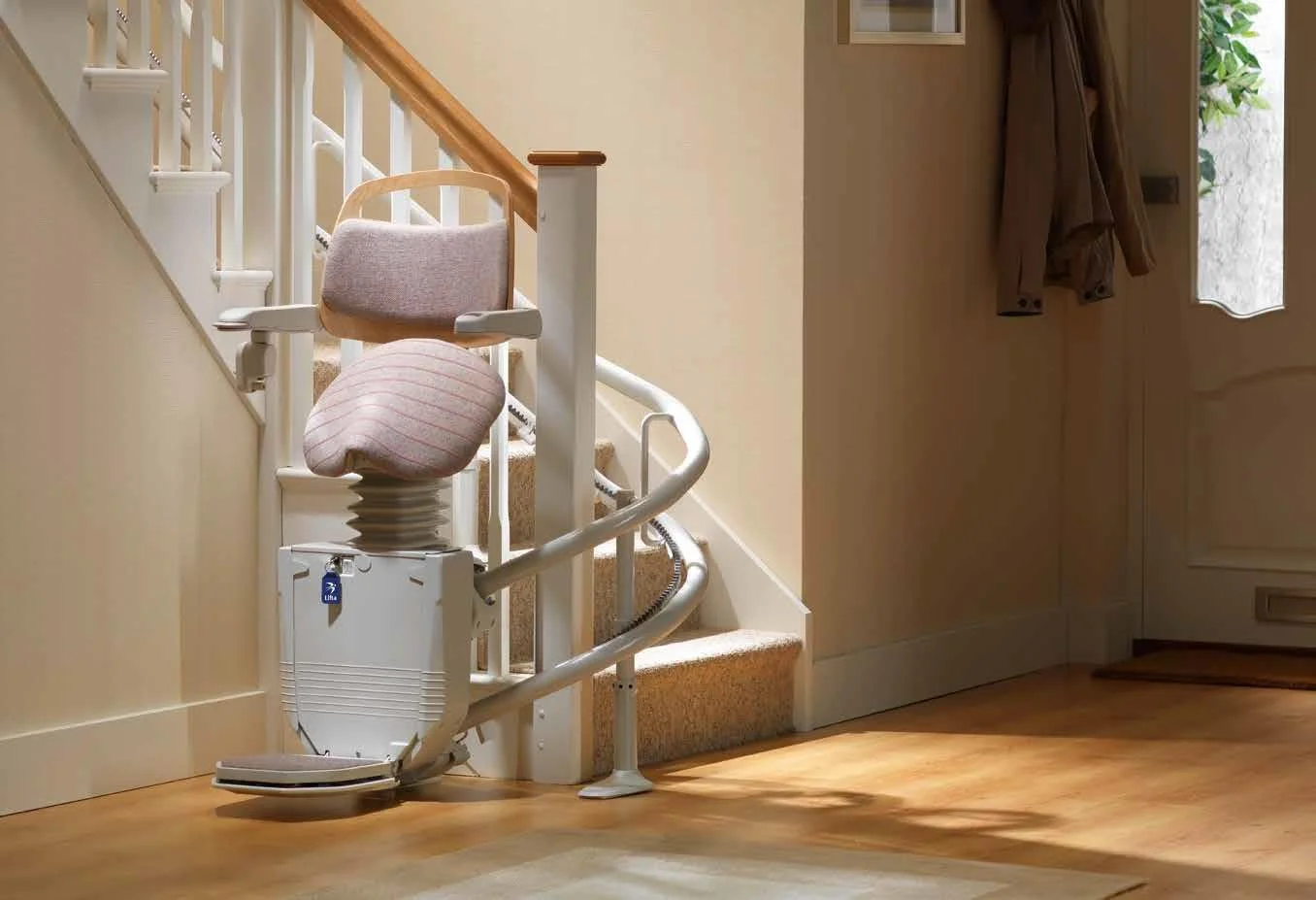
Most homes here are single-family homes and detached houses, and a good share of them are older multi-story buildings. Older staircases can be narrow, steep, or have a landing partway up. Those details decide which lift will fit.
A straight staircase with no turns usually takes a straight rail lift, which is the simplest and quickest to install. If the stairs turn at a landing or wind around a corner, you need a curved rail built to that staircase. We measure on site before recommending either one.
Split-level homes have short runs of stairs between levels. Each run is small, but someone with weak knees may face several of them every day, so it helps to look at which levels they really use before choosing a lift.
Manufactured homes are usually one level inside, so the problem is the steps at the door. An outdoor lift or a platform lift can help there, especially for someone who uses a walker or wheelchair. In walk-up apartments, the building owner will need to approve any lift on a shared stairway.
The creeks and ravines that feed the Wabash River give parts of the county uneven ground. Some homes have steps from the driveway, down to a porch, or to a lower-level entry. An outdoor stair lift is built to handle weather and can serve those steps.
When steps are too short or irregular for a rail, a platform lift may make more sense. It carries a person standing or seated in a wheelchair. We look at the slope, the footing and the path to the door before suggesting one.
About 19.9 percent of county residents are 65 or older, and 70.2 percent of households own their home. Owners can install a lift without asking a landlord, which makes the decision simpler for most families here.
If that includes someone in your family, start with the Parke County Veterans Service Officer at 116 W. High Street, Room 100, Rockville, (765) 569-4036, to sort out which VA benefits apply.
The clearest local source of help is Thrive West Central, the Area Agency on Aging for Parke County. Its Home and Technology Modifications service names chair lifts directly, so call them first at (812) 238-1561.
Indiana Medicaid waivers include a home modifications category, but they do not name stair lifts, so ask before you count on them. USDA Section 504 repair loans and grants may help very-low-income owners in rural areas. Statewide, also ask about the CHOICE Program and the INDATA Alternative Financing Program (AFP). Each program is listed below with what its source says.
A statewide Medicaid long-term care program for people 60 and older who meet nursing-facility level of care; it covers home modification assessments and home modifications, but stair lifts are not listed. Confirm scope with the enrollment broker at (877) 284-9294 or with Thrive West Central.
The companion Medicaid waiver for aged, blind or disabled people under 60 who meet nursing facility level of care; home modifications are covered, but the source does not say whether stair lifts qualify. Call (812) 917-3145 to ask.
The Area Agency on Aging for Parke County and five nearby counties, serving people 60 and older and their spouses; its home modifications service names ramps, chair lifts and handrails, so stair lifts are covered. Call (812) 238-1561.
Loans up to $40,000 at 1% over 20 years, and grants up to $10,000 for owners 62 and older, for very-low-income homeowners in rural areas like Parke County; stair lifts are not listed among examples. Call the local office at (765) 362-0405 to ask.
A VA grant for fixed structural home changes, with a $6,800 or $2,000 lifetime maximum depending on the disability; it does not cover stair lifts, as stair glides are excluded. Call (800) 827-1000.
Up to $126,526 (FY2026) for veterans with qualifying severe service-connected disabilities to buy, build or adapt a permanent home; stair lifts are not listed. Call (800) 827-1000.
Up to $25,350 (FY2026) for veterans with qualifying service-connected disabilities such as loss of use of both hands; stair lifts are not listed. Call (800) 827-1000.
A Terre Haute independent living center whose Ramps for Freedom Program builds ramps and low-rise steps; stair lifts are not mentioned, and whether it serves Parke County is unconfirmed. Call (812) 298-9455 to check.
Older adults
2800 Poplar St., Suite 9A, Terre Haute, 47803
Veterans
116 W. High Street, Room 100, Rockville, 47872
Start with Thrive West Central at (812) 238-1561. It is the Area Agency on Aging for Parke County, and its home modifications service names chair lifts. Its office is at 2800 Poplar St., Suite 9A, Terre Haute.
Both the PathWays for Aging Waiver and the Health and Wellness Waiver cover home modifications, but neither source names stair lifts. Ask the program or Thrive West Central before assuming coverage.
The Indiana Health and Wellness Waiver is for aged, blind or disabled people under 60 who meet nursing facility level of care. Call (812) 917-3145 to ask whether a stair lift could fall under its home modifications service.
No. The VA excludes stair glides from HISA, which only funds fixed structural changes. The SAH and SHA grants do not list stair lifts either, so talk with the Parke County Veterans Service Officer at (765) 569-4036.
Yes, in most cases. A staircase with a turn or landing needs a curved rail made to fit it, while a straight staircase can use a standard straight rail. A home visit tells you which one fits.
Parke County qualifies as a rural area for USDA Section 504. Grants require the owner to be 62 or older and very-low-income, and stair lifts are not named, so call (765) 362-0405 to confirm.
Tell us about the stairs in your home and we will explain which lift fits, what it costs and how installation works.
