LaGrange County spreads across 11 townships of farmland, rolling hills and lakes in the Michiana region of northern Indiana. Homes sit in and around LaGrange, Topeka, Shipshewana, Howe, Mongo, Ontario and South Milford, and along Shipshewana Lake, Wall Lake and Adams Lake. At about 108.8 people per square mile, many houses are a long drive from the nearest town.
That spread-out pattern matters when stairs start to feel like a problem. Help, whether it is an installer, a case manager or a benefits officer, often has to come to you. This page covers how local homes tend to work for a stair lift and which programs a LaGrange County household can call about cost.
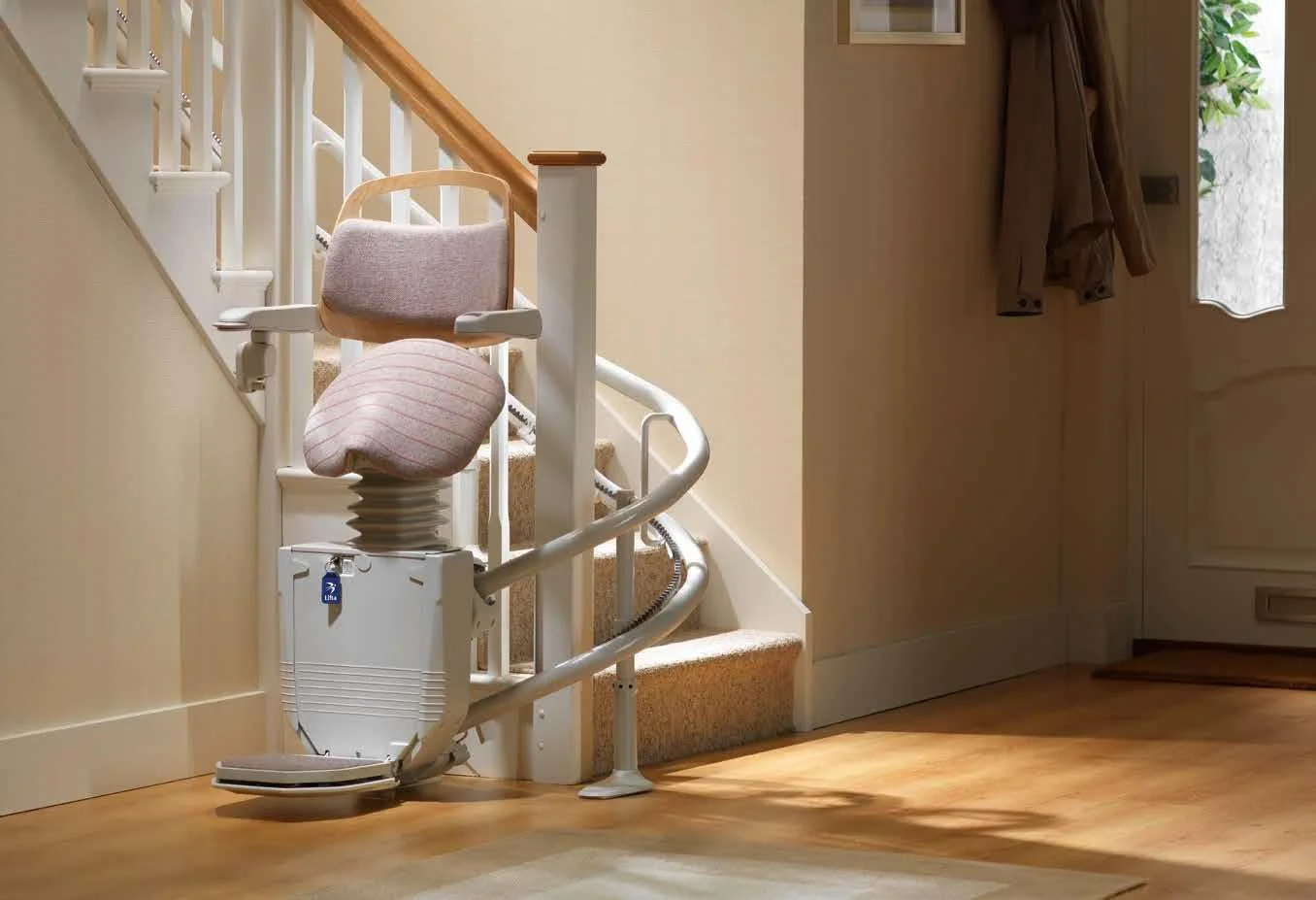
Most housing here is single-family and detached, with split-level and ranch-style homes common, along with some low-rise buildings. Each one puts stairs in a different place, and that decides the type of lift.
A split-level usually has several short flights instead of one long one. If each flight is straight, a straight rail per flight is often the simplest fix. If someone needs to ride past a landing or a turn without getting off, a curved rail built to that staircase is the answer.
Ranch-style homes keep daily living on one floor, so the lift question usually comes down to steps to the basement or to the entry. A straight lift fits a basement run in many cases. Steps at the front or back door may call for an outdoor lift or a vertical platform lift instead.
Rolling ground and lake lots around Shipshewana Lake, Wall Lake, Adams Lake and Twin Lakes can mean steps outside the house, not only inside it. An outdoor stair lift is built to handle weather on exterior steps.
Where a wheelchair user needs to get from the yard to the door, a platform lift may fit better than a seat-style lift. We measure the rise, the landing space at top and bottom, and the path to the door before suggesting one.
About 18.9% of county residents are 65 or older, and 65.1% own their homes. Homeowners can generally install a permanent rail without a landlord's sign-off, which keeps the process simple.
Some VA grants exclude stair lifts, so it pays to know which ones before filing, as explained below.
Roughly 43-50% of the county is Amish, the third-largest Amish community in the United States. Many Amish households build and repair their own homes, and some families may prefer to plan the stairway work alongside their own builders.
The Indiana Aged and Disabled Medicaid HCBS Waiver is the main public route, since it lists Home Modifications among its services. Applications go through Aging & In-Home Services of Northeast Indiana, the Area 3 agency on aging, which also handles the CHOICE Program.
Rural homeowners can look at USDA Section 504 repair loans and grants. Veterans should start with the LaGrange County Veterans Service Office. The full list with phone numbers is below.
Statewide, you can also ask about the Indiana PathWays for Aging & Health and Wellness Medicaid Waivers and the INDATA Alternative Financing Program (AFP).
A Medicaid waiver for people who are aged, blind or disabled, meet nursing-facility level of care and have household income no greater than 300% of the maximum SSI amount; it covers Home Modifications, which is the state's main Medicaid pathway for a stair lift. Apply through Aging & In-Home Services of Northeast Indiana at (800) 986-3505.
A state program for people age 60+ or with a disability who are at risk of losing independence, with no income limit (cost sharing applies) and an asset limit of $250,000 plus a $20,000 exclusion. It lists environmental modification as a service, but the source does not mention stair lifts by name; call (800) 986-3505.
The intake and case-management office for LaGrange County and eight other counties, handling CHOICE, the Aged and Disabled Waiver and other in-home services. It is not a direct funding source and does not list stair lifts itself; call (260) 745-1200.
Loans up to $40,000 at 1% fixed interest over up to 20 years, and grants up to $10,000 lifetime for very-low-income homeowners age 62+ in eligible rural areas. The source mentions ramps and grab bars but does not mention stair lifts; confirm with USDA at (317) 290-3100.
A VA grant of up to $6,800 for service-connected disabilities or $2,000 for other disabilities, for medically necessary home alterations. It specifically excludes stair glides, so it does not pay for a stair lift.
Grants of up to $126,526 (SAH) and $25,350 (SHA) for FY2026, limited to veterans with the most severe qualifying service-connected disabilities. The source names ramps and wider doorways but does not mention stair lifts; call the VA at (800) 827-1000.
Grants go to nonprofits and local governments, which install exterior wheelchair ramps for homeowners with mobility impairments. It is ramps only and does not cover stair lifts.
Free help filing VA claims and navigating benefits for veterans, surviving spouses and dependents connected to the county. It does not list a stair lift service, but it is the local place to start a VA home-modification claim; call (260) 499-6387.
A Northeast Indiana nonprofit offering information, referral, peer support and adaptive equipment help rather than cash grants; stair lifts are not mentioned. Its source does not confirm LaGrange County is served, so call (260) 441-0551 to ask.
Older adults
8101 W. Jefferson Blvd., Fort Wayne, 46804
Veterans
114 W Michigan St, LaGrange, 46761
Start with Aging & In-Home Services of Northeast Indiana at (260) 745-1200. Their office at 8101 W. Jefferson Blvd. in Fort Wayne handles intake for CHOICE and the Aged and Disabled Waiver for LaGrange County.
Yes, possibly. CHOICE is open to people age 60+ or anyone with a disability who is at risk of losing independence, and the Aged and Disabled Waiver covers people who are blind or otherwise disabled as well as aged.
The HISA grant does not; it excludes stair glides. The SAH and SHA grants do not name stair lifts and are limited to severe service-connected disabilities. The LaGrange County Veterans Service Office at (260) 499-6387 can help you sort out what applies.
The county is largely rural, so most addresses should meet the USDA rural-area rule, but it is checked address by address. Income limits and age 62+ for grants also apply; call (317) 290-3100.
No. Ramp Up Indiana funds exterior wheelchair ramps only, through nonprofits and local governments.
No income limit applies, but a cost-sharing formula means higher earners may pay part of the cost. Assets are capped at $250,000 plus a $20,000 exclusion.
Tell us about the stairs in your home and we will explain which lift fits, what it costs and how installation works.
