Madison's historic core runs 133 blocks and about 2,160 acres above the Ohio River, and most of its prominent buildings went up before 1860. Many of those Greek Revival, Federal and Italianate houses still have their original narrow staircases, built long before anyone planned for accessibility.
Outside the historic district, Jefferson County homes in Hanover, Dupont and Canaan include single-family homes, split-level homes, townhouses and walk-up apartments, many on sloped ground. This page walks through how those homes affect the kind of stair lift that fits, and which local and federal programs are worth a call when it comes to paying for one.
The Madison Historic District is a National Historic Landmark and one of the largest contiguous historic districts in the country. Multi-story homes like the Lanier Mansion, the Shrewsbury House and the Costigan House, known for its thirty-foot parlor, show how tall and stacked many local houses are.
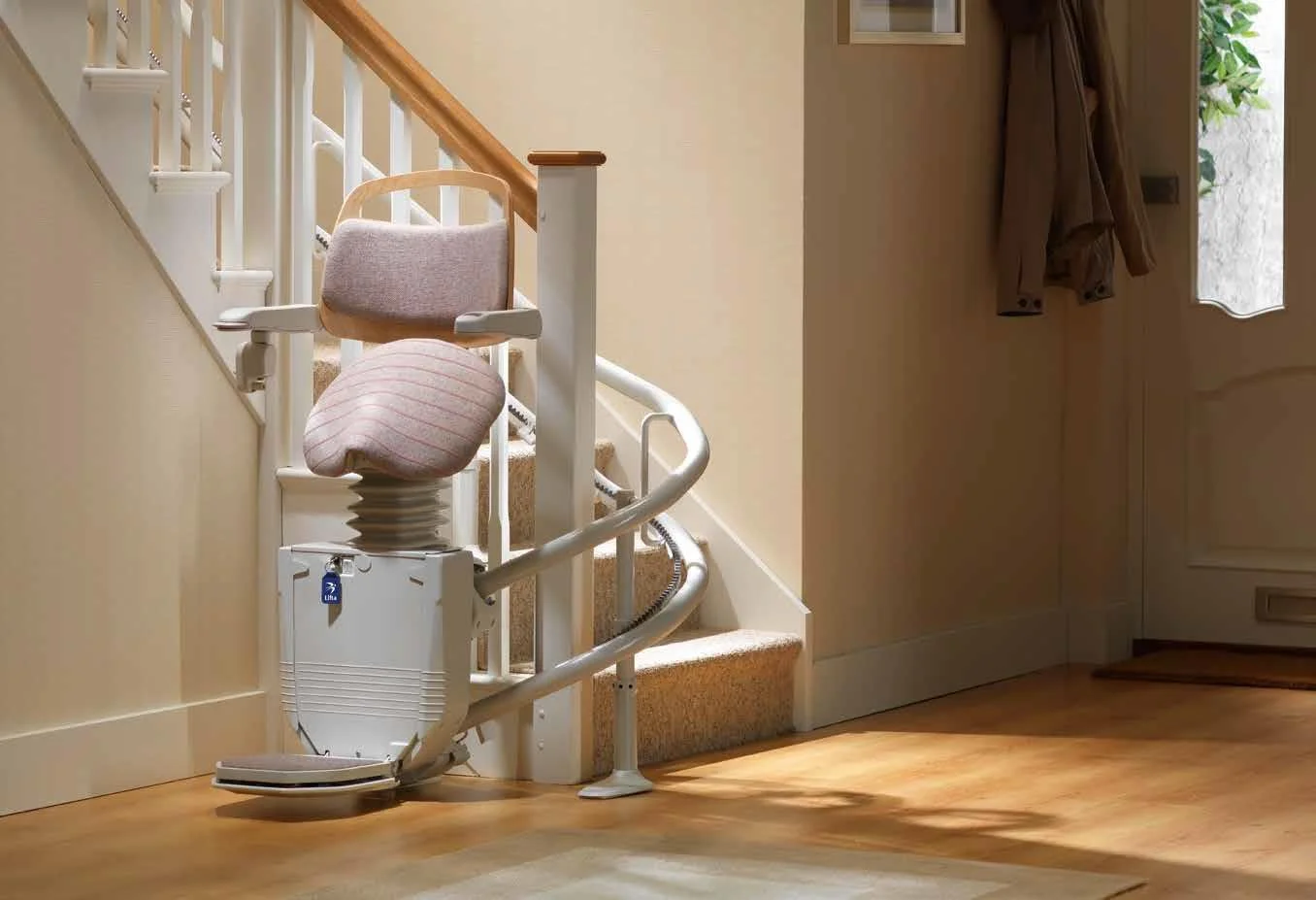
In homes from this era, the staircase is often narrow and may turn at a landing. A straight stair lift can work on a single straight run, but a stair with a turn usually calls for a curved lift with a rail made to fit that exact staircase. We measure the width, the turns and the landing before recommending either.
Madison sits in the Ohio River valley, with high ground rising as much as 400 feet above it near Clifty Falls State Park. Many older river-valley properties are built into that slope, so getting from the driveway to the front door can mean several sets of steps before you reach the indoor staircase.
For those outside steps, an outdoor stair lift built for weather can carry a person up a porch or yard stairway. If someone uses a wheelchair and cannot transfer to a seat, a platform lift may be the better fit. It helps to look at every level change in the home, not just the main stairs, since each one adds to fall risk.
Split-level homes have short flights between floors, often only a few steps each. A short straight lift can handle one of those runs, though a home with several short flights may need more than one lift or a different plan.
Townhouses usually have a straight interior stair, which tends to be the simplest install. In a walk-up apartment, the stairs belong to the building, so the owner or landlord has to approve any lift. About 61.1% of county residents own their homes, and owners have the most freedom to make these changes.
For many families, the question comes up when a parent wants to stay in a multi-level house that has been home for decades.
Veterans should know early that VA grants have specific rules about stair lifts, covered in the next section, before planning a project around VA money.
No program below names stair lifts as a covered item, and one VA grant excludes them outright. That does not mean help is off the table. Several programs cover home modifications in general, and a case manager or counselor can tell you whether a lift could fit your plan.
A good first call is LifeTime Resources (PSA 12) at (812) 432-6200, the aging office in Dillsboro that serves Jefferson County. Veterans can reach the Veterans Service Office at 315 Jefferson Street in Madison at (812) 265-3600. Statewide, it is also worth asking about the CHOICE Program and the INDATA Alternative Financing Program (AFP).
A Medicaid waiver for people age 60+ who meet financial limits and need help with at least three daily activities, and it lists home modifications as a service with scope set in an approved plan by a case manager. Stair lifts are not named in the state FAQ, so ask the case manager whether one can be part of the plan.
Options Counselors help older adults, people with disabilities and caregivers find services and funding, and home modification is among the topics they cover; stair lifts are not itemized. Call (877) 234-3641.
A VA grant of up to $6,800 lifetime for service-connected disabilities, or $2,000 for other qualifying disabilities, for prescribed structural changes like entrance access or roll-in showers. Stair glides are expressly excluded, so it will not pay for a stair lift.
Up to $126,526 for FY2026 for veterans with certain severe service-connected disabilities to build, buy or modify an accessible home they own or will own. The VA page gives ramps and wider doorways as examples and does not name stair lifts.
Up to $25,350 for FY2026 for veterans with qualifying disabilities such as loss of use of both hands or certain severe burns, to adapt a home they own or will own. Stair lifts are not named among covered improvements.
Loans up to $40,000 at 1% and grants up to $10,000 for very-low-income homeowners in eligible rural areas, with grants limited to those 62+ who cannot repay a loan; covered work includes accessibility, but stair lifts are not named. Call (317) 290-3100.
Builds exterior ramps for households below $47,550 a year for one person, or on programs like SNAP, SSI or LIHEAP, in Jefferson and nearby counties. It covers ramps only, and stair lifts are not mentioned.
Serves people with disabilities in Jefferson County with information and referral, peer support, advocacy, independent living skills training and transition services. No stair lift or home modification funding is listed, but they can point you to resources at (812) 427-3333.
Older adults
13091 Benedict Drive, Dillsboro, 47018
Veterans
315 Jefferson Street, Madison, 47250
The HISA grant expressly excludes stair glides, so it will not. The SAH and SHA grants fund home modifications for veterans with certain severe service-connected disabilities but do not name stair lifts. Call the Veterans Service Office in Madison at (812) 265-3600 to ask about your situation.
Many homes in the historic district have original narrow staircases from before 1860. A straight run may take a straight lift, while a stair that turns usually needs a curved lift built to fit. A home measurement is the only way to know for sure.
The PathWays waiver starts at age 60, and the USDA 504 grant requires age 62+. Younger people with disabilities can contact SIILC at (812) 427-3333 or LifeTime Resources, which also serves persons with disabilities.
The USDA Section 504 program offers repair loans and grants to very-low-income homeowners in eligible rural areas, and it covers accessibility work, though stair lifts are not named. Call (317) 290-3100 to check eligibility.
No stair lifts are mentioned. The local program builds exterior ramps only, which can still help if the problem is the steps to the front door.
Start with LifeTime Resources (PSA 12) at (812) 432-6200. Its counselors cover home modification and can help you sort out which funding paths apply.
Tell us about the stairs in your home and we will explain which lift fits, what it costs and how installation works.
