Hancock County's homes cover a lot of ground. There are older farmhouses and small-town homes around Greenfield, Shirley and Wilkinson, and newer subdivisions in McCordsville, Fortville and New Palestine as Indianapolis growth pushes east. Each type of house puts its stairs in a different place, and that shapes which stair lift will work.
The county covers about 307 square miles of gently rolling land just east of Indianapolis. About 16.3% of residents are 65 or older. Many of them live in rural or small-town settings some distance from Indianapolis-based medical and contractor services, so getting the stairs right at home matters.
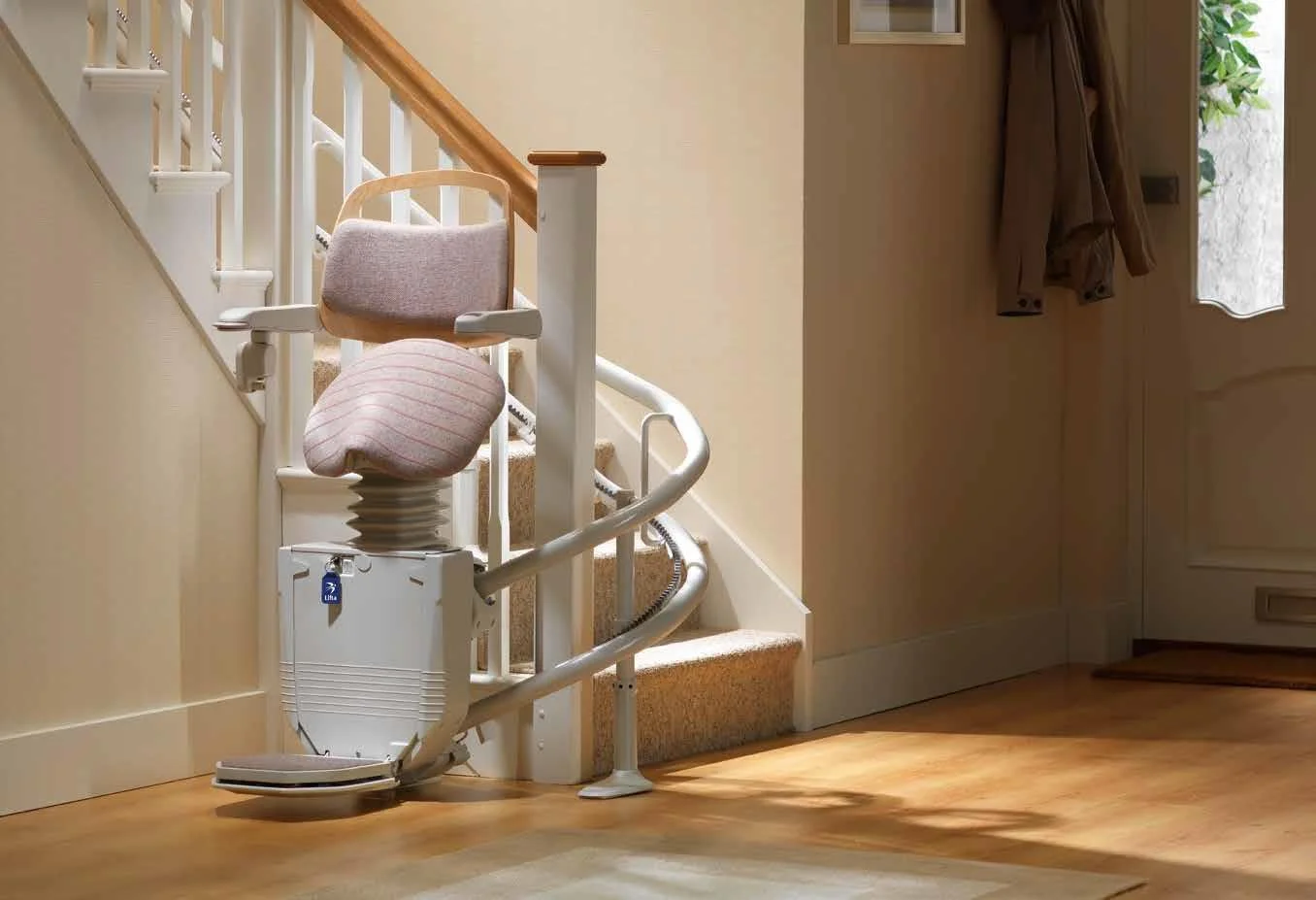
A lot of older Hancock County residents live in farmhouses or ranch homes with stairs to a basement or an upper floor. These are often strong candidates for a stair lift. If the flight runs straight from top to bottom with no turns, a straight rail is usually the simplest fit.
Older farmhouse stairs can be narrow or steep, and some turn partway up. When a staircase bends or has a landing, a curved rail is built to follow it. We measure the full run, the width and the space at the top and bottom before suggesting either type.
Newer subdivisions in places like McCordsville and New Palestine include split-level and two-story homes. A split-level has short flights between several levels, so the question is which levels the person actually needs to reach each day. Sometimes one lift on the most-used flight does the job.
Two-story subdivision homes and townhouses tend to have a single main staircase. If it is straight, a straight lift works. If it turns at a landing, a curved rail or a different plan is needed, and we talk through both at the visit.
Stairs at the entry can be as much of a barrier as the ones inside. An outdoor stair lift is built for exterior steps, and a platform lift is the option for someone who uses a wheelchair and cannot transfer to a seat.
Ramps are another answer for entry steps. Several programs listed below build ramps rather than stair lifts, so it is worth knowing about them if the front steps are the main problem.
The clearest source of help is the Indiana Medicaid HCBS waivers. The PathWays for Aging Waiver serves people 60 and older, and the Health & Wellness Waiver serves people under 60. The program materials name stair lifts as a covered home modification. Applications go through CICOA, the local Area Agency on Aging, at (317) 254-5465.
Veterans should know that the VA HISA grant excludes stair glides. The SAH and SHA grants do not list stair lifts by name, so ask before counting on them. Hancock County Veterans Services is at 98 E North Street, Suite 211, Greenfield, phone (317) 462-8767.
Other programs, such as USDA Section 504 repair loans and grants and the CICOA Safe at Home program, do not list stair lifts but do fund other accessibility work. Statewide options also include the CHOICE Program and the INDATA Alternative Financing Program (AFP). Each program is summarized below.
Medicaid waivers for people who meet nursing facility level of care, with PathWays for Aging serving ages 60+ and Health & Wellness serving those under 60. Stair lifts are named as a covered home modification; apply through CICOA at (317) 254-5465.
A home-modification program for homeowners 60+ or people of any age with a disability who meet income rules; listed work includes grab bars, handrails, ramps and doorway widening, and stair lifts are not listed. Call (317) 803-6131.
Loans up to $40,000 at 1% fixed interest, and grants up to $10,000 for owners 62+, for very-low-income homeowners in USDA-eligible rural areas. Stair lifts are not listed among eligible repairs; call (317) 290-3100 to check your address.
A lifetime grant of up to $6,800 or $2,000, depending on disability status, for medically necessary home changes. Stair glides are excluded from coverage; call (317) 554-0000.
Grants of up to $126,526 (SAH) or $25,350 (SHA) for FY2026 for veterans with specific severe service-connected disabilities who own or will own the home. Stair lifts are not listed by name; call (317) 554-0000.
A nonprofit offering information, referral and advocacy for people with disabilities of any age in Hancock County; it is not a direct funding source and stair lifts are not listed. Call (317) 926-1660.
Volunteers build free wooden wheelchair ramps for low-income, permanently disabled people in Indiana. Stair lifts are not listed; call (317) 844-7664.
A state program that funds exterior ramps at no cost to homeowners at or below 80% of area median income, delivered through nonprofit and local government grantees. Stair lifts are not listed.
Grants go to nonprofits, government agencies and qualifying churches serving Hancock County, not to individuals directly; stair lifts are not listed. Call (317) 462-8870.
Older adults
8440 Woodfield Crossing Blvd., Ste. 175, Indianapolis, 46240
Veterans
98 E North Street, Suite 211, Greenfield, 46140
It can. The Indiana Medicaid HCBS waivers name stair lifts as a covered home modification for people who meet nursing facility level of care and have income not exceeding 300% of the maximum SSI amount. Start with CICOA at (317) 254-5465.
Yes. Since July 1, 2024, people under 60 are served by the Health & Wellness Waiver, while those 60 and older go to the PathWays for Aging Waiver. CICOA Safe at Home also serves people of any age with a disability.
No. The VA states that stair glides are excluded from HISA coverage. The SAH and SHA grants do not list stair lifts by name, so call Hancock County Veterans Services at (317) 462-8767 to talk through options.
Parts of rural Hancock County outside city limits may qualify for USDA Section 504 loans and grants, and eligibility is address-specific. Stair lifts are not listed among eligible repairs, so call (317) 290-3100 to ask.
It depends on which of the short flights the person uses every day and whether those flights are straight or turn. A straight flight takes a straight rail, and a turning one needs a curved rail.
No. Its grants go to 501(c)(3) nonprofits, government agencies and qualifying churches. Individuals may be served through a partnering nonprofit such as SAWs or Hancock County Senior Services.
Tell us about the stairs in your home and we will explain which lift fits, what it costs and how installation works.
