Fort Wayne calls itself the City of Neighborhoods, and for good reason. Dozens of historic residential districts built between the 1830s and 1950s, including West Central, Indian Village and Shawnee Place, are full of two-story homes with their original interior staircases. Those stairs are often the first thing that makes a family wonder whether staying in the house still works.
Outside the historic core, Allen County changes. Towns like New Haven, Huntertown, Leo-Cedarville, Harlan, Woodburn, Grabill, Monroeville and Hoagland have more post-1950s ranch houses, split-levels and townhouses, each with its own stair problem. This page walks through what those homes mean for a stair lift and where local residents can look for help paying for one.
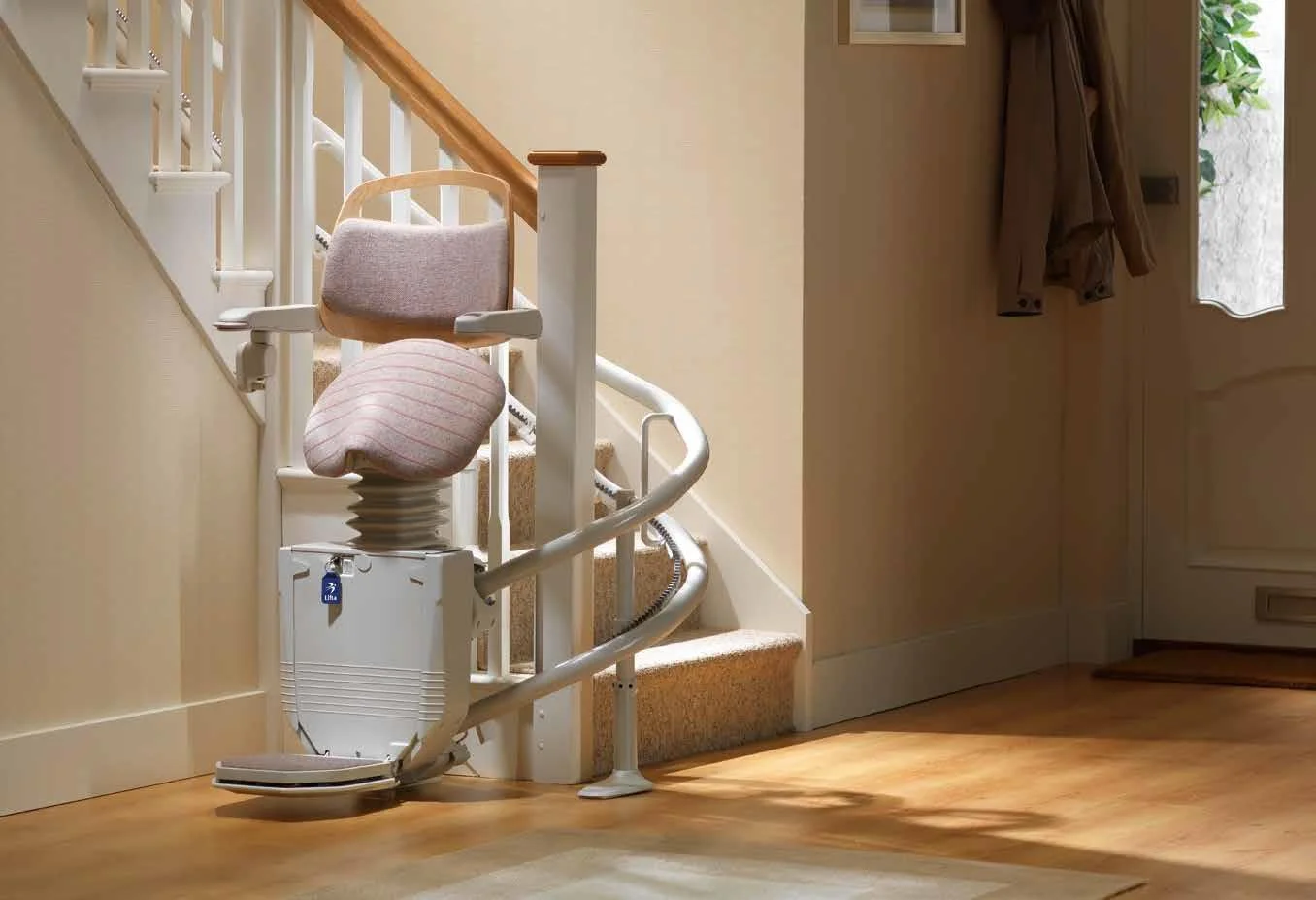
The Victorian, Greek Revival, Colonial Revival, Tudor and Craftsman homes in districts like West Central, Indian Village and Shawnee Place are the houses in Allen County most likely to need a stair lift retrofit. Bedrooms and full baths usually sit upstairs, so the staircase is something a person climbs every day.
West Central is the canal-era 1830s core of the city and holds the largest collection of homes by the architectural firm Wing & Mahurin. Many of these districts are on the National Register of Historic Places. A stair lift rail mounts to the stair treads rather than the wall, which helps keep original woodwork in place.
When we measure an older staircase, the first question is its shape. A straight run from bottom to top can take a straight rail. A staircase that turns at a landing or winds near the top needs a curved rail built to fit that specific stair.
Newer single-story ranch construction is more common in the suburban and rural townships outside the historic core. A ranch may have no interior stairs at all, but it often has a basement stairway to the laundry or a few steps at the entry.
Split-level homes bring short flights between each level, sometimes in more than one spot. Townhouses, walk-up apartments and low-rise buildings usually mean a single straight flight, though in a rental or shared building the owner has to agree to the installation. In these cases a short straight lift, or a platform lift where a wheelchair is involved, can be the better fit.
Allen County sits on flat to gently rolling glacial till plain, where the St. Joseph and St. Marys Rivers meet to form the Maumee River near downtown Fort Wayne. The ground itself is rarely steep, but the winters are a different story.
The region has cold winters with moderate to heavy snowfall, including lake-effect snow from Lakes Michigan and Erie. That makes icy front steps and exterior stairs a recurring seasonal fall risk. For homes where the trouble is the porch or entry rather than the inside, an outdoor stair lift or platform lift built for the weather is worth considering.
Allen County has a population of 302,132 across 9 towns, and 15.1% of residents are 65 or older. About 64.7% of households own their home, which matters because most stair lift funding programs below require home ownership.
Families of veterans should know up front that some VA housing grants do not pay for stair lifts, so it helps to talk with the Allen County Veterans' Service Office at (260) 449-7861 before planning around VA money. The office is at 1 East Main Street, Room 106, Rousseau Centre, Fort Wayne 46802.
Three programs on our list confirm they cover stair lifts or home modifications: the Indiana PathWays for Aging HCBS Waiver, the City of Fort Wayne Residential Accessibility Modifications Program and the INDATA Alternative Financing Program. The city program is the only one that names a chair lift directly, and it is limited to homes inside Fort Wayne city limits.
For homes in New Haven, Grabill, Leo-Cedarville, Huntertown, Monroeville or Woodburn, USDA Section 504 repair loans and grants may apply, though stair lifts are not named in its source. A good first call for almost anyone is Aging & In-Home Services of NE Indiana at (260) 745-1200, 8101 W. Jefferson Blvd., Fort Wayne 46804, which handles intake for CHOICE and the Medicaid waivers.
A Medicaid waiver for people 60 and older who meet a nursing-facility level of care, with home modifications listed as a benefit; the amount is set in each member's service plan and the single-applicant income limit is $1,330 per month. Call (877) 284-9294.
A state-funded program for people 60 and older or any age with a disability, with no income cap and a sliding-scale cost share; its source lists environmental modification but does not mention stair lifts. Call (800) 986-3505.
The local intake, case management and referral point for CHOICE, the Medicaid waivers and other aging services; its source does not list a stair lift benefit, so call (260) 745-1200 to ask about current offerings.
A HUD-funded grant for homeowners inside Fort Wayne city limits with a household member who has a permanent disability and income at or below 80% of Area Median Income, and it lists a chair lift as an eligible modification. Funding is limited and first-qualified, first-served; call (260) 427-8585.
Loans up to $40,000 at 1% over 20 years and grants up to $10,000 for homeowners 62 and older in eligible rural areas, with income at or below 50% of area median income; the source does not mention stair lifts. Call (260) 244-6266.
A VA grant of up to $6,800 or $2,000 for medically necessary home alterations, but the VA lists stair glides as excluded equipment, so it does not pay for stair lifts. Call (800) 827-1000.
Grants of up to $126,526 (SAH) or $25,350 (SHA) for veterans with qualifying severe service-connected disabilities to adapt a home; the source names ramps and doorway widening but does not mention stair lifts. Call (800) 827-1000.
A Center for Independent Living at 5821 S. Anthony Blvd., Fort Wayne, offering advocacy, skills training, adaptive equipment services and case management; its source does not mention stair lifts. Call (260) 441-0551.
A low-interest, extended-term loan, not a grant, for Indiana residents of any age with a documented disability, and it can be used for home modifications. Loans are financed through STAR Financial; call (888) 466-1314.
A home repair program launched in 2026; its source does not describe eligibility or whether stair lifts are included. Call (260) 422-4828 for current details.
Older adults
8101 W. Jefferson Blvd., Fort Wayne, 46804
Veterans
1 East Main Street, Room 106, Rousseau Centre, Fort Wayne, 46802
The Indiana PathWays for Aging HCBS Waiver lists home modifications as a benefit for people 60 and older who meet a nursing-facility level of care. The single-applicant income limit is $1,330 per month and the asset limit is $2,000, and the waiver has an enrollment cap. Call (877) 284-9294 or Aging & In-Home Services of NE Indiana at (260) 745-1200.
No. The City of Fort Wayne Residential Accessibility Modifications Program only serves homes inside Fort Wayne city limits. Outlying towns such as New Haven, Grabill, Leo-Cedarville, Huntertown, Monroeville and Woodburn may qualify for USDA Section 504 repair help, which is checked address by address; call (260) 244-6266.
The VA HISA grant specifically excludes stair glides. The SAH and SHA grants do not name stair lifts in their source. The Allen County Veterans' Service Office at (260) 449-7861 can help a veteran sort out which benefits apply.
Yes, in some cases. CHOICE serves people of any age with a disability, INDATA's loan program is open to Indiana residents of any age with a documented disability, and the Fort Wayne city program requires a household member with a permanent disability rather than a minimum age.
The INDATA Alternative Financing Program offers low-interest, extended-term loans for home modifications through STAR Financial; call (888) 466-1314. For eligible rural homes, USDA Section 504 loans go up to $40,000 at 1% fixed interest over 20 years.
Allen County's cold, snowy winters, including lake-effect snow, make exterior steps a real seasonal hazard. An outdoor stair lift or a platform lift built for the weather can handle entry steps, and we can look at which fits your porch during a home visit.
Tell us about the stairs in your home and we will explain which lift fits, what it costs and how installation works.
