White County covers roughly 500 square miles of prairie and Wabash River bottomland in the southeastern tip of Illinois, with Carmi sitting near the center along the Little Wabash River. Its five towns, Carmi, Norris City, Grayville, Crossville and Enfield, are long-settled places where many families have held the same house for decades.
A lot of those houses are older two-story farmhouses and in-town homes built before single-story living was the norm. That puts steps at the front door and a full flight between floors. For someone who wants to stay in a long-owned home rather than move, a stair lift is often the most direct fix.
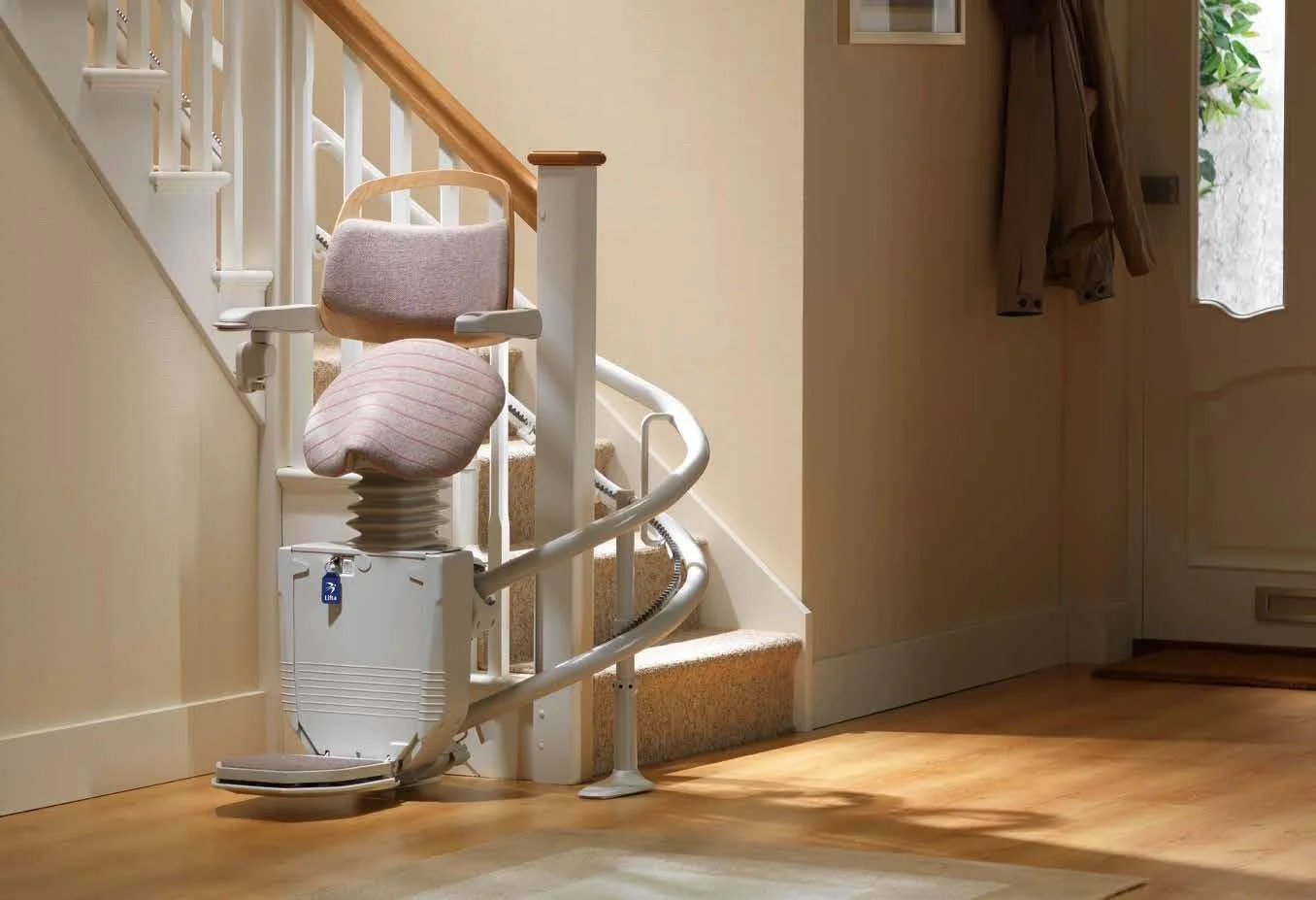
Most housing here is detached houses and single-family homes, with some ranch-style homes and walk-up apartments. In a two-story farmhouse or older in-town house, the main problem is usually one staircase to the bedrooms. If that staircase runs straight from bottom to top, a straight stair lift is the simplest and usually the quickest install.
Older homes often have stairs that turn at a landing or wind near the top. Those need a curved rail built to the exact shape of the staircase, which takes more measuring and more lead time. We look at the stairs in person before recommending either one.
Because so many homes here put stairs at the primary entrance, getting in and out of the house can be as hard as getting upstairs. An outdoor stair lift is built to handle weather on porch or entry steps. Where a wheelchair is involved, a platform lift can be a better match than a seat.
Ranch-style homes may have only a few steps, but those few can still keep someone inside. It is worth looking at every entrance, not only the indoor staircase.
White County is rural and sparsely settled, and the nearest larger hospitals are 25 to 45 miles away in Mount Vernon, IL, or Evansville, IN. That same distance affects how quickly in-home installation and service can happen compared with more urban Illinois counties.
Plan ahead where you can. If a hospital stay or a fall is coming up, start the measuring and paperwork early so the lift is ready when the person comes home.
About 20.5% of residents are 65 or older, and 69.2% of households own their homes. Median household income is $54,813, and for many owners on fixed or modest incomes a stair lift costs less than moving or building a first-floor addition.
The Illinois Department of Veterans Affairs office at 110 N. Main St in Carmi, (618) 382-7211, can help a veteran sort out which VA benefits apply.
Age at application matters a great deal in Illinois. The Home Services Program names stair lifts as a covered example, but it is for people who apply before age 60. For people 60 and older, the Illinois Department on Aging and the Southeastern Illinois Agency on Aging are the place to start for home modification help.
Veterans should know that the VA HISA benefit specifically excludes stair glides. VA SAH and SHA grants, and USDA Section 504 repair loans and grants for rural homeowners, are other paths to ask about. Each program is listed below with its phone number where one is available.
A state Medicaid waiver that lists stair lifts among its home modification examples, for Illinois residents with a severe disability who apply before age 60 and are at risk of nursing facility placement. Call (800) 843-6154.
A state Medicaid waiver for people under 60 at application that pays for changes to the home to make up for loss of function; the source does not mention stair lifts by name. Call (877) 581-3690.
A statewide services page for older adults that lists home modification among its supportive services, with priority for low-income and rural residents. Call the Senior HelpLine at (800) 252-8966 to be connected to the Southeastern Illinois Agency on Aging.
A Medicaid waiver for Illinois residents 60 or older that covers in-home, adult day, emergency home response and medication dispenser services; stair lifts are not listed. Call (800) 252-8966.
The area agency on aging serving White County from 602 E. 5th Street in Mt. Carmel, offering information, referral and service coordination; the source does not list stair lift funding. Call (217) 262-0678.
A nonprofit at 1725 College Avenue in Carmi offering advocacy, peer support and referrals for people with disabilities; stair lifts are not itemized, but it is a practical local place to ask about home modification options. Call (618) 382-7300.
Federal repair loans and grants for very low income rural homeowners, with grants for those 62 and older; stair lifts are not named in the source, and the loan and grant amounts should be confirmed with USDA. Eligibility depends on address, income and assets.
A VA benefit for permanent structural changes, with a $6,800 or $2,000 lifetime maximum depending on the disability. It does not cover stair lifts; stair glides are specifically excluded.
VA grants for veterans with qualifying severe disabilities, up to $126,526 for SAH and $25,350 for SHA. The source mentions ramps and widening doorways but does not mention stair lifts.
Older adults
602 E. 5th Street, Mt. Carmel, 62863
Veterans
110 N. Main St, Carmi, 62821
Yes, possibly. The Illinois Home Services Program names stair lifts as a covered example for people with a severe disability who apply before age 60. Call (800) 843-6154 to start.
The Illinois HCBS Medicaid Waiver for Persons who are Elderly does not list home modifications. Call the Senior HelpLine at (800) 252-8966 to be connected to the Southeastern Illinois Agency on Aging, which can point you to home modification help.
No. The HISA benefit specifically excludes stair glides. A veteran can ask about SAH or SHA grants, and the IDVA office in Carmi at (618) 382-7211 can help with VA paperwork.
Yes. OFACIL has a Carmi office at 1725 College Avenue and serves White County. Call (618) 382-7300 for advocacy and referrals on home modification options.
Usually, yes. Stairs that turn need a curved rail made to fit that staircase, so expect more measuring and a longer wait than a straight lift.
It can. White County is rural, and distance affects response times for in-home installation and service, so it helps to start early, especially before a planned hospital discharge.
Tell us about the stairs in your home and we will explain which lift fits, what it costs and how installation works.
