From Harrisburg and Eldorado down U.S. Route 45 to Carrier Mills, and out to Galatia, Stonefort and Raleigh, Saline County homes sit on ground that rarely stays flat for long. Rolling hills climb toward the Shawnee National Forest, while the lowlands north of Eldorado are flatter. That mix shapes the stairs we see: front porches with steps up from the yard, split-level homes with short flights between floors, and older detached houses with a full staircase to the bedrooms.
This page walks through what those homes mean for a stair lift, which kind tends to fit, and which Saline County and Illinois programs may help with the cost. Most of the programs below do not name stair lifts directly, so we also tell you who to call to ask.
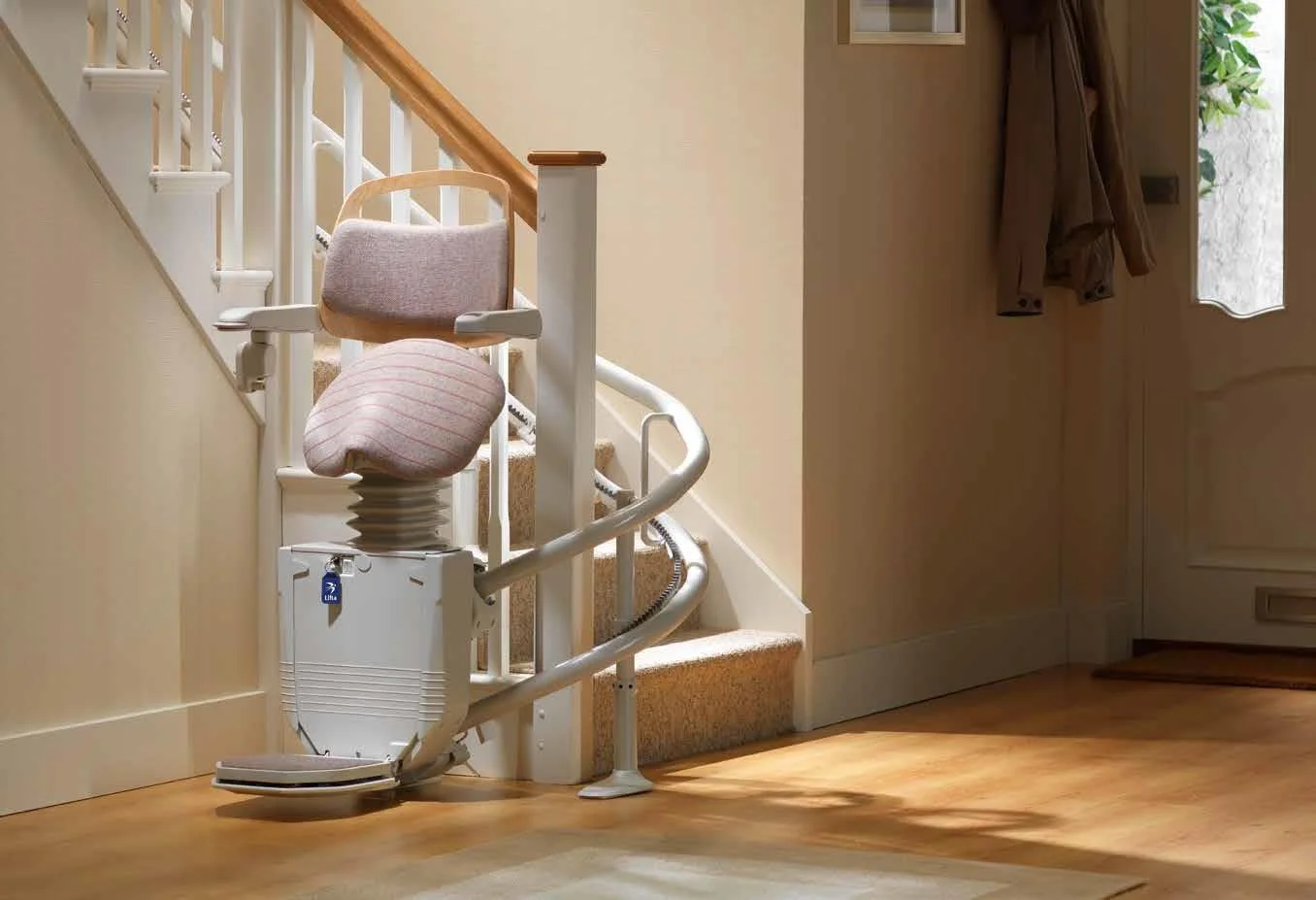
Single-family homes and detached houses make up much of the county, and many have one straight run of stairs between floors. A straight stair lift is usually the simplest fit for those. The rail mounts to the stair treads, not the wall, so the staircase stays in place.
Split-level homes are different. They often have two or three short flights with a landing or a turn, and a straight rail cannot follow that. Depending on the layout, the answer may be a curved lift that bends around the landing or separate straight lifts on each flight.
Walk-up apartments and low-rise buildings bring a shared stairway into the picture. If you rent, the landlord or building owner will need to approve any installation before work starts.
On hilly rural lots, the riskiest steps are often outside: the climb from the driveway to the porch or the back door. An outdoor stair lift is built for weather, and for some homes a platform lift is the better choice, especially when a wheelchair is involved.
Weather here matters. January lows average around 22°F, freeze-thaw cycles come through each winter, and May is the wettest month at an average of 4.98 inches. Wet or icy porch steps are a real fall risk, which is why we look at outside steps on every home visit, not just the indoor staircase.
About 21.1% of Saline County residents are 65 or older, and the county is heavily rural, with 65.2% of residents living in rural areas. Many families are trying to keep a parent in a house far from a nursing facility or a relative's spare bedroom.
Saline County is mostly a homeowning county: 72.2% of occupied housing units are owner-occupied. That matters for funding, because most home repair and modification programs, including USDA 504, IHDA HRAP and HAFHR, and CDBG rehabilitation, require that you own the home.
No program listed here names stair lifts outright, so the honest answer is that you have to ask. The good news is that several programs do cover accessibility work in general, and local income levels mean many households may meet their limits. The county's median household income was $35,644 in 2010 Census figures, with 18.4% of the population below the poverty line.
A good first call for anyone 60 or older is the Egyptian AAA (PSA 13) at (618) 985-8311, based at 200 East Plaza Drive in Carterville. For homeowners on a tight budget, the Southeastern Illinois Regional Planning & Development Commission in Harrisburg handles housing rehabilitation for Saline County at (618) 252-7463.
The IL Dept. of Veterans Affairs - Saline County office is at 320 E Raymond in Harrisburg, phone (618) 253-2005, and can help sort out which VA grants apply. Each program is summarized below.
The area agency on aging for the 13 southernmost Illinois counties, including Saline, lists home modification as a service, but its pages do not name stair lifts and age or income rules are not published. Call (618) 985-8311 to ask about scope.
A state in-home services program for Illinois residents 60 and older with assessed care needs and non-exempt assets of $17,500 or less; it funds in-home help, adult day services and emergency response, and does not mention home modifications or stair lifts. Call (800) 252-8966.
A Medicaid waiver for people under 60 at application with a severe disability who are at risk of nursing facility placement; it covers environmental accessibility adaptations and specialized medical equipment, though stair lifts are not named and depend on individual assessment. Call (877) 581-3690.
For people enrolled in a DDD HCBS waiver, this pays up to $15,000 per participant per 5-year period for Adult Home-Based Services recipients toward equipment and home modification tied to a developmental disability need; stair lifts are not named. Call (800) 843-6154.
Very-low-income rural homeowners can borrow up to $40,000 at 1% fixed over 20 years, and homeowners 62 and older can get grants up to $10,000 to remove health and safety hazards. Ramps and grab bars are typical examples; stair lifts are not named, so confirm with the local Rural Development office.
A VA grant of up to $6,800 or $2,000 lifetime, depending on disability status, for medically needed home changes. HISA specifically excludes stair glides and porch lifts, so it will not pay for a stair lift.
For veterans with qualifying service-connected disabilities who own or will own the home, with 2026 maximums of $126,526 for SAH and $25,350 for SHA. The VA gives ramps and wider doorways as examples and does not name stair lifts; ask the county veterans office at (618) 253-2005.
Helps people with disabilities under 60 move from a nursing facility back home, and equipment, assistive devices and accessibility modifications may be part of that plan; stair lifts are not named. The Harrisburg office is at 32 Veterans Drive, phone (618) 252-7233.
A state grant for low- and very-low-income homeowners that funds health and safety repairs and accessibility improvements through regional partners, with demand exceeding funds statewide; stair lifts are not named. Call (312) 836-5200 or check with SIRPDC locally.
Grants up to $60,000 per household for homeowners at or below 150% of Area Median Income with a COVID-19-related financial hardship since January 2020, aimed at delayed repairs; accessibility equipment is not named. Call (312) 836-5200.
Administers housing rehabilitation grants for low-income homeowners in Gallatin, Hamilton, Hardin, Pope and Saline counties; whether accessibility work or stair lifts qualify is not stated. Call the Harrisburg office at (618) 252-7463.
Older adults
200 East Plaza Drive, Carterville, 62918
Veterans
320 E Raymond, Harrisburg, 62946
Not through the HISA grant, which specifically excludes stair glides and porch lifts. The SAH and SHA grants do not name stair lifts either way, so a veteran with a qualifying service-connected disability should ask the IL Dept. of Veterans Affairs - Saline County office at (618) 253-2005.
Yes, two options are aimed at that group. The Illinois Persons with Disabilities (PD) Medicaid HCBS Waiver covers environmental accessibility adaptations for people under 60 at application, and SICIL's Community Reintegration Program helps people under 60 leaving a nursing facility. Neither names stair lifts, so call (877) 581-3690 or (618) 252-7233 to ask.
For most programs, yes. USDA Section 504, the IHDA programs and SIRPDC housing rehabilitation are for homeowners. If you rent a walk-up apartment, your landlord would also need to approve any stair lift.
A straight rail cannot turn a landing, so the choice is usually a curved lift or a straight lift on each flight. We measure each flight and the landing on a home visit before recommending one.
Yes, outdoor stair lifts are built for weather, and a platform lift may suit homes where a wheelchair is used. With freeze-thaw winters and a wet May here, the porch is often where a lift helps most.
For a parent 60 or older, start with the Egyptian AAA (PSA 13) at (618) 985-8311. For a low-income homeowner, also call SIRPDC in Harrisburg at (618) 252-7463 about housing rehabilitation funds.
Tell us about the stairs in your home and we will explain which lift fits, what it costs and how installation works.
