Monroe County sits right across the Mississippi River from the St. Louis metro area, but the ground here changes fast. The American Bottom floodplain runs along the river, high limestone and dolomite bluffs rise behind it, and flatter prairie farmland opens up to the east. Homes in Columbia, Waterloo, Valmeyer and Hecker were built to fit that land, and many of them have more stairs than their owners planned for.
Early river-bottom towns like St. Philippe and the original county seat, Harrisonville, were lost to Mississippi River flooding. After that, building on higher, sloped or bluff-adjacent ground became the norm. Those sites often lead to split-level and multi-story layouts, which is exactly where a stair lift earns its place.
The bluff zone between the floodplain and the eastern uplands has roughly 500 sinkholes, most of them wooded, along with caves and springs. Builders worked around that by setting homes on elevated or sloped lots. The result is a lot of short flights between levels, walkout lower floors and steps up from the driveway.
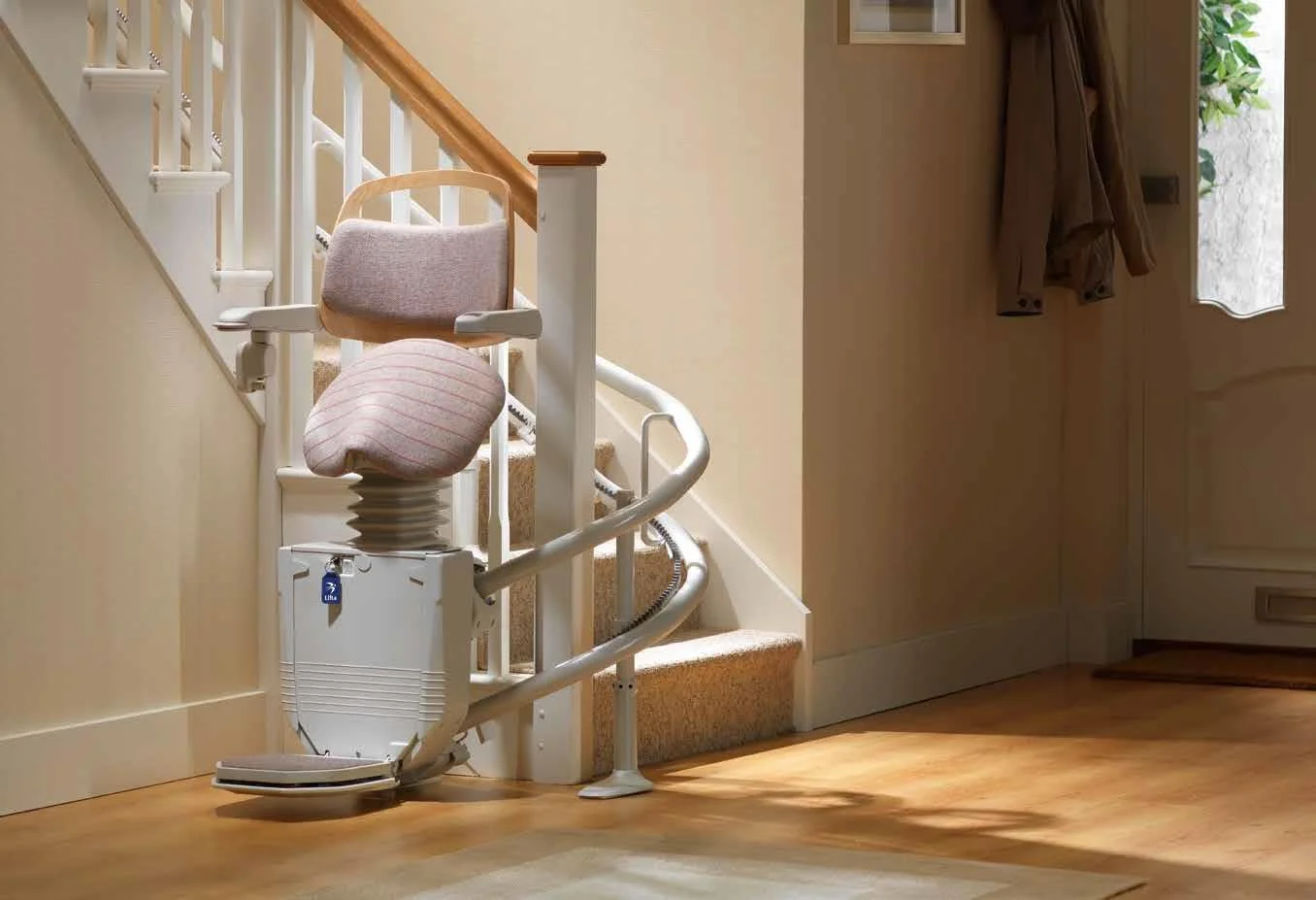
Split-level homes usually have two or three short runs of stairs. Each straight run can take its own straight stair lift, which is the simplest and quickest kind to install. If a run turns at a landing, a curved rail built to that staircase is the usual answer.
Steps outside, from a sloped yard or driveway up to the door, can call for an outdoor stair lift made for weather. Where someone uses a wheelchair and can't transfer to a seat, a platform lift is worth discussing instead.
Ranch-style homes may seem stair-free, but many have a basement where the laundry or a family room lives. A straight lift on the basement stairs keeps that floor usable. Single-family two-story homes in Columbia and Waterloo often have one straight main staircase, which is the most common stair lift job.
Townhouses tend to have narrow, straight stairs between floors, and a slim rail can fit with room left for others to walk past. Walk-up apartments are trickier because stairs may be shared, so the building owner needs to agree before anything is installed. We measure width, turns, landings and the power outlet location before recommending anything.
About 79.2% of Monroe County residents are homeowners, and 17.7% are 65 or older. Rental vacancy is low, and there is little turnover in accessible housing. That means most older residents stay in the homes they already own rather than moving somewhere with fewer stairs.
For an adult child helping a parent in Waterloo or out near Valmeyer, that often makes a stair lift the practical choice. It keeps the bedroom or bathroom on its current floor without a move or a major remodel.
One state program clearly names stair lifts: the IDHS Home Modification and Assistive Technology program, which works through Centers for Independent Living. For Monroe County, that local center is LINC Inc., which also runs its own Home Modification Loan Program.
Veterans should know that the VA HISA grant does not pay for stair lifts, since it lists stair glides as excluded equipment. Other programs below cover home changes in general but don't name stair lifts on their source pages, so ask each one directly. SW Illinois Aging Resources (PSA 7) at 2365 Amann Dr., Swansea, (618) 222-2561, is a good first call for seniors and caregivers.
Rural addresses outside Waterloo and Columbia may qualify for USDA repair loans and grants. Statewide, the IATP ATLOAN$ Program and the Senior Citizens Assessment Freeze Homestead Exemption are also worth asking about.
A state disability services program for Illinois residents with disabilities that explicitly lists stair lifts among covered home modifications, along with ramps and widened doorways. Start through your local Center for Independent Living (LINC Inc. for Monroe County) or call (800) 843-6154.
In-home services for Illinois residents under 60 with severe disabilities, including home modifications that help make up for lost mobility or strength; the source does not name stair lifts specifically. Call (800) 843-6154.
Nine Medicaid waivers, including ones for persons who are elderly and persons with disabilities, for people who meet Medicaid financial and level-of-care rules; stair lifts are not mentioned on the program's landing page. Call (866) 468-7543.
In-home help such as housekeeping, personal care and emergency home response for Illinois residents 60 and older with non-exempt assets of $17,500 or less; the source does not mention home modifications or stair lifts. Call (800) 252-8966.
The Area Agency on Aging referenced for the Monroe County area, offering benefits help, caregiver support and referrals; stair lifts are not listed. Call (618) 222-2561 to confirm coverage and get pointed to the right program.
A statewide Center for Independent Living program that funds ramps, interior accessibility changes and home safety updates for income-eligible households with a member who has a documented disability; stair lifts are not named, and the waiting list has been long. Call (217) 525-1308.
The local Center for Independent Living for St. Clair, Monroe and Randolph counties offers financial help and guidance for accessibility changes to homes of people with disabilities; the source does not name stair lifts. Call (618) 235-9988.
Loans up to $40,000 at 1% interest and grants up to $10,000 for very low income homeowners in eligible rural areas, with grants for owners 62 and older; stair lifts are not named, though accessibility items like ramps are.
A VA grant of up to $6,800 or $2,000 for medically necessary home changes like entrances, bathrooms and ramps. It does not pay for stair lifts, which it lists as excluded equipment.
VA grants for veterans with severe service-connected disabilities, with SAH up to $126,526 and SHA up to $25,350 (FY2026), for modifications like ramps and widened doorways; stair lifts are not specifically named.
Older adults
2365 Amann Dr., Swansea, 62226
Veterans
833 S Spring Street, Springfield, 62705
Often, yes. Split-level homes usually have separate short runs, and each straight run takes its own straight lift. We look at which levels your parent actually needs to reach before recommending how many.
The Illinois Home Services Program serves residents under 60 with severe disabilities, and the IDHS Home Modification and Assistive Technology program explicitly lists stair lifts. Both can be reached at (800) 843-6154, and LINC Inc. at (618) 235-9988 is the local starting point.
The VA HISA grant does not, since it excludes stair glides. The SAH, SHA and TRA grants cover home modifications for veterans with severe service-connected disabilities but don't name stair lifts, so ask the Veterans Affairs Office in Springfield at (217) 782-6641.
Much of Monroe County outside Waterloo and Columbia may count as a USDA-eligible rural area. Homeowners 62 and older with very low income may qualify for Section 504 grants up to $10,000, so verify your address on the USDA eligibility map.
Outdoor stair lifts are built for steps from a yard, driveway or porch, which are common on sloped lots in the bluff area. If the person uses a wheelchair, a platform lift may fit better.
SW Illinois Aging Resources (PSA 7) in Swansea at (618) 222-2561 can point you toward benefits and caregiver help. For disability-based home modification funding, LINC Inc. at (618) 235-9988 serves Monroe County directly.
Tell us about the stairs in your home and we will explain which lift fits, what it costs and how installation works.
