Drive through Oswego, Yorkville or Plano and most of what you see went up during the post-2000 building boom. Between 2000 and 2010 Kendall County grew 110.4%, the fastest growth of any county in the US in that period, and the new subdivisions filled in along Interstate 88 and Interstate 55.
That history shapes how stair lifts fit here. Most homes in Boulder Hill, Newark, Lisbon, Millbrook, Plattville and the larger towns are relatively young two-story houses, not old farmhouses with odd staircases. The sections below cover what that means for your stairs, your entry steps and the programs that may help with the cost.
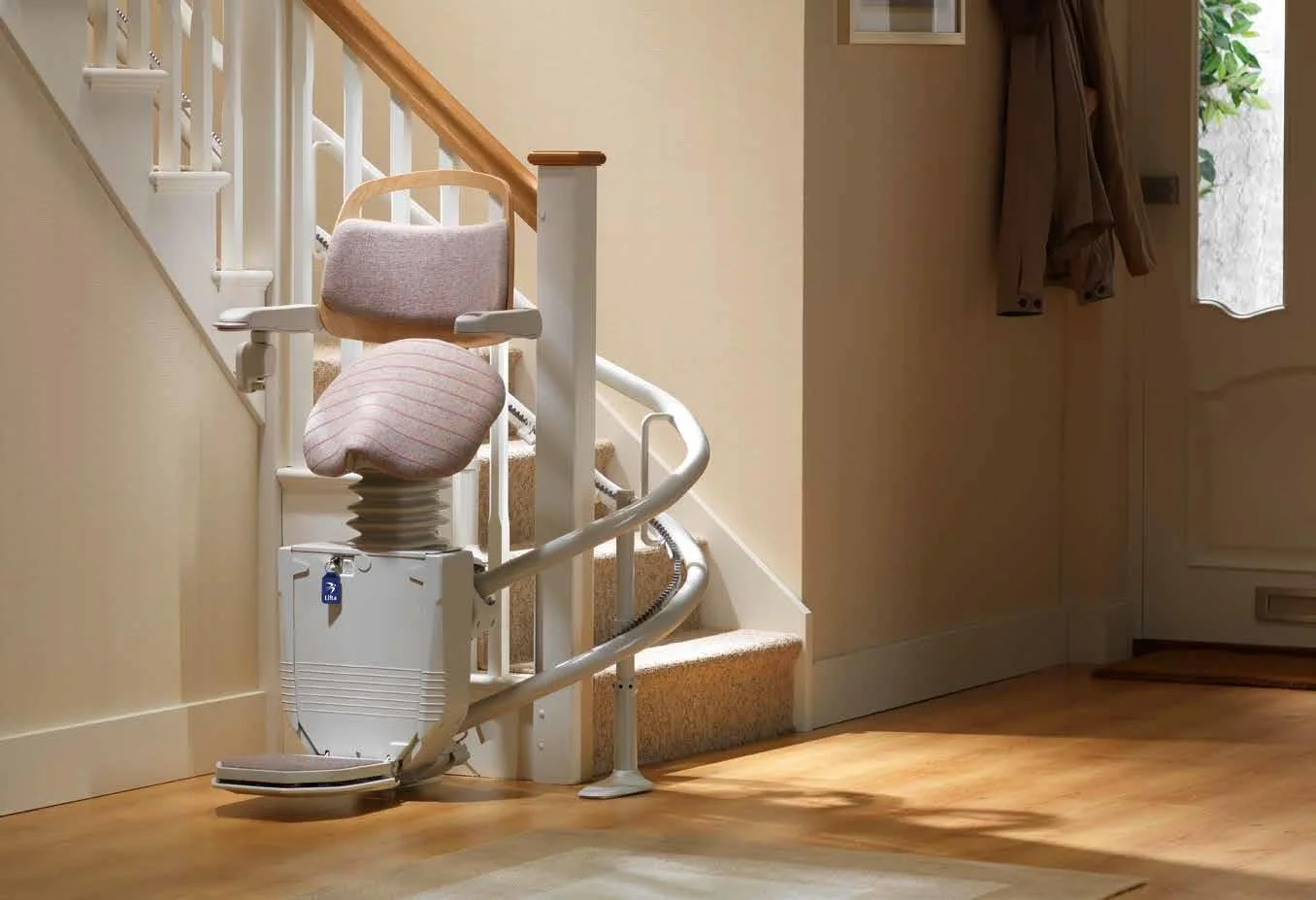
The typical Kendall County subdivision home has one straight staircase between the main floor and the bedrooms. That layout suits a standard straight-rail stair lift, which mounts to the stair treads rather than the wall.
Townhouses and duplexes often follow the same pattern, with a single straight run. If your staircase goes from bottom to top without a turn or landing, a straight rail is usually the simplest option to plan.
Split-level homes work differently. Instead of one long flight, they have shorter flights between several levels, so the question becomes which levels the person actually needs to reach.
When stairs turn at a landing or wrap around a corner, a straight rail will not follow them. In that case a curved rail is measured to the exact shape of the staircase. We look at the full path from the main living area to the bedroom and bathroom before recommending one approach.
Kendall County is not all flat prairie. The Ransom moraine runs through the west and north-central part of the county and rises over 800 feet, while southern areas drop to roughly 500 feet, so some lots sit on grades with steps up to the front door or down from a deck.
Outdoor steps can be handled with an outdoor stair lift built for weather, or with a platform lift where a wheelchair needs to get from the yard to the door. Because 88.6% of residents live in urban areas, most homes are a short drive for an installer, which makes measuring visits and follow-up service easier to schedule.
About 11.4% of Kendall County residents are 65 or older, and 83.1% of homes are owner-occupied, one of the highest rates in the Chicago metro. Owning the home matters, because a stair lift is fastened to the stairs and an owner can decide on that without a landlord.
If that includes you or your parent, the VA and county veterans programs listed below are worth a call before you decide how to pay.
The county has a comparatively affluent profile, with a 2010 median household income of $79,897 and a 2010 poverty rate of 3.9%. That means many households pay privately, and income-based programs like USDA Section 504 and IHDA HRAP will not fit everyone.
Only one program below, the Illinois Home Services Program, names stair lifts on its own page, and it is for people under 60 at application. Seniors 60 and older are pointed to AgeGuide or the Kendall County Health Department for referrals. VA HISA specifically excludes stair glides, so veterans should ask about the other VA grants instead.
This statewide Medicaid waiver lists stair lifts among its home adaptations for Medicaid-eligible Illinois residents under age 60 at application with a severe, long-term disability. Call (877) 581-3690, or reach it through AIM Center for Independent Living.
The program-level page describes home modifications for loss of function in daily activities, but stair lifts are not listed there. Eligibility matches HSP, including the under-60 rule; the phone is (877) 581-3690.
For people enrolled in a DDD waiver, home-based participants can receive up to $15,000 per five-year period for equipment and home modifications documented in their Personal Plan; stair lifts are not listed specifically. Call (800) 843-6154.
CCP provides in-home services such as homemaker care and emergency home response for Illinois residents 60 and older, and stair lifts or home modifications are not listed. The Senior HelpLine is (800) 252-8966.
AgeGuide is the area agency on aging for Kendall County and a referral hub for senior services; it is not listed as a stair lift funder. Call (630) 293-5990.
AIM offers advocacy, information and referral, and other services for people with disabilities, and can help residents work through the state home modification benefit, though its pages do not list stair lifts. Call (630) 469-2300.
The Health Department refers older residents to services such as home-delivered meals through Meals on Wheels for Northern Illinois; stair lifts and home modifications are not listed. Call (630) 553-9100.
The commission connects veterans and families with benefits information and does not list stair lift funding. The county Veteran’s Assistance office at 811 W John Street, Room 254, Yorkville lists (630) 553-8354; confirm contact details when you call.
HISA offers up to $6,800 or $2,000 over a lifetime for medically necessary home accessibility work, but it explicitly excludes stair glides and porch lifts. Call the VA at (800) 827-1000.
These grants, up to $126,526 for SAH and $25,350 for SHA in FY2026, help veterans with qualifying severe service-connected disabilities adapt a home they own; stair lifts are not named on the source page. The listed phone is (630) 553-8355.
Very low income homeowners in USDA-eligible rural areas can borrow up to $40,000 at 1% over 20 years, and those 62 or older may get grants up to $10,000 for repairs including accessibility work, though stair lifts are not named. Much of Kendall County is urban, so eligibility has to be checked address by address.
HRAP funds health, safety and accessibility repairs for low- and very-low-income Illinois homeowners through local grantee organizations, with waitlists and no guarantee of help; stair lifts are not itemized. Call IHDA at (312) 836-5200.
Older adults
1910 S. Highland Ave., Suite 100, Lombard, 60148
Veterans
811 W John Street, Room 254, Yorkville, 60560
Usually, yes. Most two-story subdivision homes here have a single straight staircase, which suits a standard straight-rail stair lift. A measurement confirms it.
Split-level homes have shorter flights between several levels. Depending on which levels you need and whether the stairs turn, you may need a straight rail on one flight or a curved rail that follows the staircase.
The Illinois Home Services Program lists stair lifts as a covered adaptation for Medicaid-eligible residents under 60 at application with a severe, long-term disability. Call (877) 581-3690 or AIM Center for Independent Living at (630) 469-2300.
Start with AgeGuide at (630) 293-5990 or the Kendall County Health Department at (630) 553-9100. Neither lists stair lift funding directly, but both handle referrals for seniors.
The VA HISA benefit specifically excludes stair glides. The SAH and SHA grants cover home adaptations for qualifying severe service-connected disabilities, but their page does not name stair lifts, so ask the VA at (800) 827-1000 about your situation.
Only if the home is in a USDA-eligible rural area and you meet the very low income rules. Because most of the county is urban, check your specific address on the USDA eligibility map.
Tell us about the stairs in your home and we will explain which lift fits, what it costs and how installation works.
