From Watseka and Gilman to Cissna Park, Onarga and Thawville, much of Iroquois County lives in older two-story farmhouses and in-town houses built long before single-story designs became common. In those homes the bedrooms are usually upstairs and the front door often sits a few steps above the yard.
That layout is the reason a stair lift comes up so often here. For a family that has held the same house for decades, a lift on the main staircase can be a way to keep using the whole home instead of moving into town or building a first-floor addition.
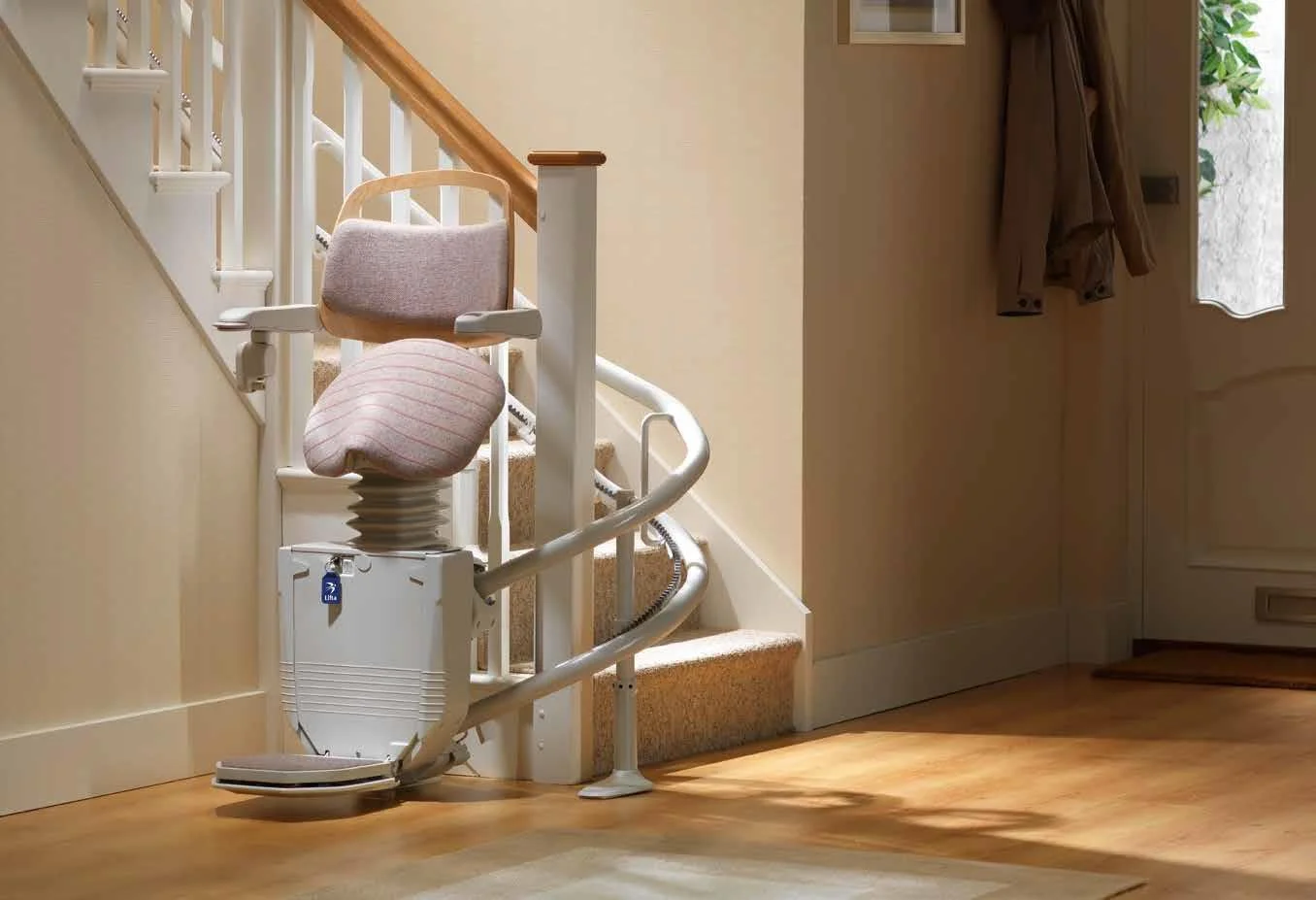
A classic two-story farmhouse with one straight flight is the simplest job. A straight rail runs along the stairs, and the chair folds up so the rest of the family can still use the steps.
Stairs that turn at a landing or wind near the top need a curved rail, which is built to fit that specific staircase. Split-level homes are different again, since they have several short runs instead of one long one, so we look at which levels the person actually needs to reach.
Walk-up apartments raise a separate question, because the stairs may be shared and the building owner has to agree before anything is installed.
In many homes around the county, the first stairs a person meets are the ones at the primary entrance. A lift inside does little good if getting in the door is the hard part.
Outdoor stair lifts are built for porch and entry steps and handle weather. Where someone uses a wheelchair, a platform lift may make more sense than a seat, and we can talk through both during a visit.
Iroquois County covers 1,117 square miles of land along the Indiana border, with flat prairie and the Iroquois River running west toward the Kankakee River. Homes can sit a long way from the nearest town.
Full-service mobility equipment providers are typically based outside the county, which can affect response times and service availability. It helps to plan ahead, ask how service calls are handled, and not wait until a fall forces a rushed decision.
About 21.7% of county residents are 65 or older, and 73.2% own their homes. Many of those homes are long-held and paid off, which is why staying put is often the plan.
Veterans have their own benefit options, though not every VA program pays for a stair lift, as explained below.
Many households here live on fixed or farm-cyclical incomes, so cost matters. A stair lift is often a more affordable way to stay independent than moving or adding a first-floor bedroom.
The clearest public option is the Illinois Home Services Program, which names stair lifts directly but is for people under 60 at application. For people 60 and older, the East Central Illinois Area Agency on Aging at (309) 829-2065 is a good first call for screening and referrals.
Veterans can contact the county Veterans Assistance office at 1001 East Grant Room 112a in Watseka, (815) 432-2721. The programs listed below explain what each one says it covers.
A state Medicaid waiver service that lists stair lifts among covered home modifications for Illinois residents under 60 at application with a severe disability and risk of nursing facility placement. Call (800) 843-6154.
Covers physical changes to the home for people under 60 at application who are Medicaid eligible and at risk of nursing facility placement, but the source does not mention stair lifts. Call (877) 581-3690.
For people 60 or older, this waiver funds homemaker, adult day, emergency home response and medication dispenser services; stair lifts and home modifications are not listed. Call (800) 252-8966.
A statewide referral page for adults 60 and older and their caregivers that names home modification among its supportive services. Call (800) 252-8966.
The regional hub for older adults and caregivers in Iroquois County, offering information, referral and service coordination; stair lifts are not listed among its services. Call (309) 829-2065.
A Watseka nonprofit serving people with disabilities, with peer support and an equipment loan program; stair lifts are not listed. Call (815) 432-1332.
Serves low-income households with energy and weatherization help such as LIHEAP; stair lifts are not listed. Call (815) 785-1002.
Repair loans and, for homeowners 62 and older, grants for very low-income owners in rural-eligible areas, which can fund accessibility improvements; stair lifts are not named specifically, and current amounts should be confirmed with USDA.
Funds health, safety and accessibility repairs for low- and very low-income homeowners through local grantees, often with waitlists; stair lifts are not named specifically. Call (312) 836-5200 to confirm local coverage.
A VA benefit for home accessibility changes with lifetime caps of $6,800 or $2,000, but it excludes stair glides, so it does not cover stair lifts.
VA grants for veterans with qualifying severe disabilities, up to $126,526 for SAH and $25,350 for SHA; the source mentions ramps and wider doorways but does not name stair lifts.
Older adults
1003 Maple Hill Road, Bloomington, 61704
Veterans
1001 East Grant Room 112a, Watseka, 60970
Yes. The Illinois Home Services Program names stair lifts as a covered modification for people under 60 at application who have a severe disability and are at risk of nursing facility placement. Call (800) 843-6154.
Start with the East Central Illinois Area Agency on Aging at (309) 829-2065. They coordinate services for Iroquois County and can point you to the right program.
The HISA benefit specifically excludes stair glides. SAH and SHA grants cover larger adaptations but do not name stair lifts, so ask the Veterans Assistance office in Watseka at (815) 432-2721 what applies to your situation.
Yes. Outdoor stair lifts are made for entry and porch steps, and a platform lift is an option for someone using a wheelchair.
The Illinois HCBS Medicaid Waiver for Persons who are Elderly lists four services only, and stair lifts are not among them. The Illinois Department on Aging at (800) 252-8966 can explain other options.
It can. Full-service providers are typically based outside Iroquois County, which can affect response times, so ask about service calls before you buy.
Tell us about the stairs in your home and we will explain which lift fits, what it costs and how installation works.
