Vandalia served as the Illinois state capital from 1819 to 1839, and the blocks around the 1836 Vandalia State House still hold many two-story homes built long before single-story living became common. Out in St. Elmo, Ramsey, Farina, Brownstown and St. Peter, the story is similar: long-held family houses, often owned for decades, with bedrooms upstairs and steps at the front door.
For many families here, the question is not whether to leave a house that has been home for years. It is how to keep using every floor of it safely. A stair lift is one way to do that, and this page walks through what kind of lift fits local homes and where help with the cost may come from.
Most of the county's housing is single-family homes and detached houses, with some townhouses, walk-up apartments and split-level homes mixed in. In the older two-story houses, stairs show up in two places: at the main entrance and between floors.
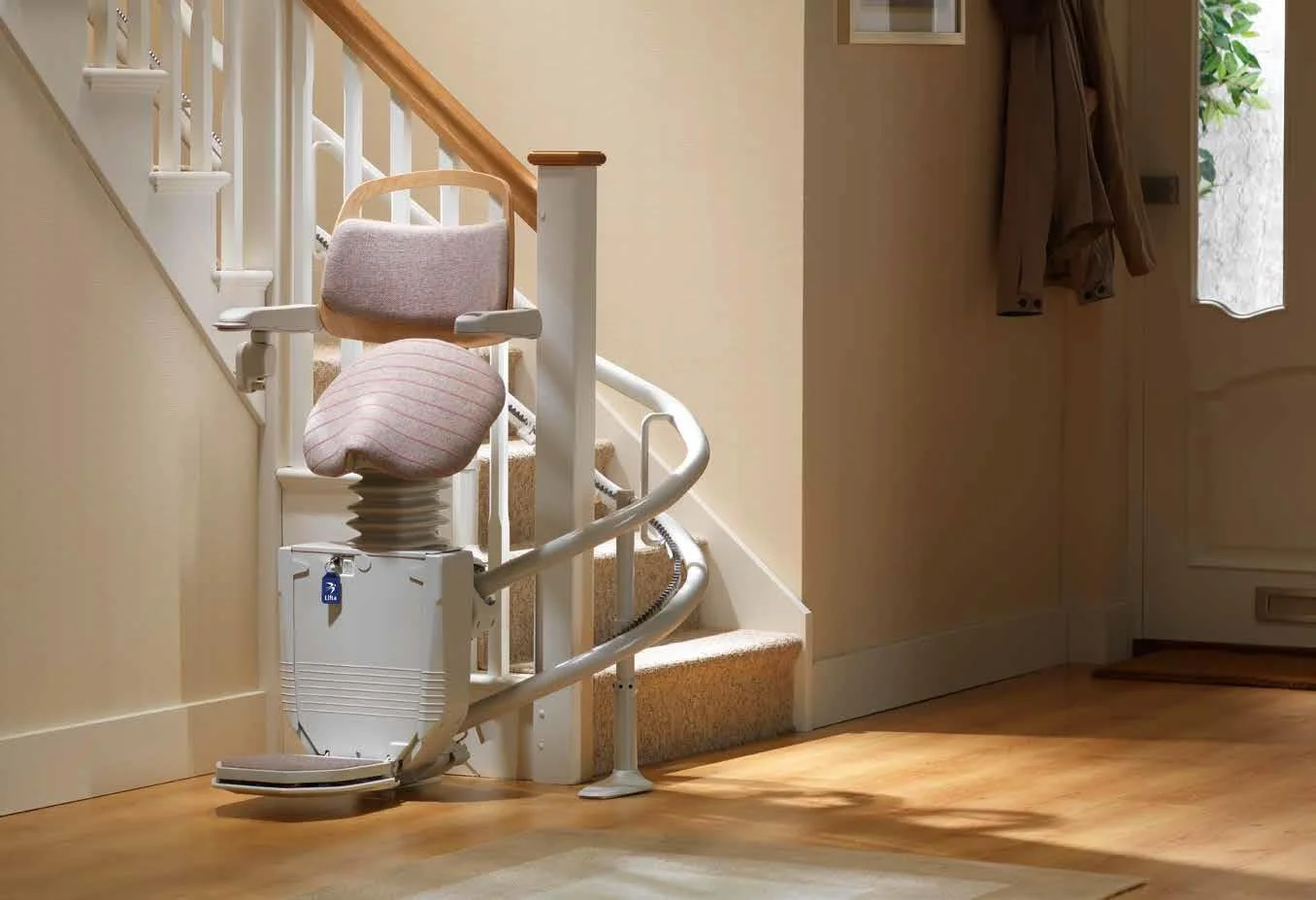
A straight staircase between floors usually takes a straight stair lift, which is the simplest to fit. Stairs that turn at a landing need a curved lift built to that staircase. Split-level homes have short runs of steps between levels, so it pays to look at which run the person actually uses every day before choosing a lift.
Because many older homes put steps right at the primary entrance, the inside staircase is only half the problem. An outdoor stair lift is made to handle weather and can carry a person up porch or entry steps.
If the person uses a wheelchair, a seat lift may not be enough. In that case a platform lift, which carries the chair itself, is worth discussing at the home visit.
Fayette County covers about 725 square miles of flat to gently rolling farmland, and about 30 people live per square mile. As of the 2020 Census, 62.3% of residents lived in rural areas.
That spread means fewer in-home service providers than in more urban parts of Illinois. Vandalia sits on the Interstate 70 and U.S. Route 40 corridor, but a home in the countryside outside town can still mean a longer wait for help, so planning a lift before a fall or a hospital stay makes sense.
Both groups have specific programs worth checking, covered below.
Age matters a lot in Illinois programs. The Home Services Program and the Persons with Disabilities waiver both require the person to be under 60 at application, and both name home modifications, with the Home Services Program listing stair lifts by name.
For people 60 and older, the Medicaid waiver for persons who are elderly does not list home modifications among its services. Older homeowners may want to look at USDA Section 504 repair loans and grants, and Midland Area Agency on Aging can help sort out which route applies.
Veterans should know that the VA HISA benefit specifically excludes stair glides. The SAH and SHA grants cover larger adaptations for severe disabilities, though the VA source does not name stair lifts. The Veterans Assistance Commission in Hillsboro, at (217) 532-9695, is a reasonable place to start.
A state program for Illinois residents under 60 at application with a severe disability and risk of nursing facility placement; its listed home modifications include stair lifts. Call (800) 843-6154.
A Medicaid waiver for Illinois residents under 60 at application that pays to physically modify the home to fit the person's loss of function. Call (877) 581-3690.
A Medicaid waiver for Illinois residents 60 or older that funds in-home help, adult day service, emergency home response and medication dispensers; stair lifts and home modifications are not listed. Call (800) 252-8966.
An information and referral hub for older adults, people with disabilities and caregivers in Fayette County, with services such as Meals on Wheels in Ramsey and Vandalia; stair lift funding is not listed. Call (800) 252-8966.
A nonprofit serving people with disabilities in thirteen counties including Fayette, offering advocacy and referrals; stair lift funding is not listed, but it can explain Home Services Program options. Call (618) 244-9212.
Repair loans for very-low-income rural homeowners and grants for homeowners 62 and older; the source mentions accessibility work but does not list stair lifts, and amounts should be confirmed. Call (217) 403-6200.
A VA benefit for permanent home changes such as entrance ramps and roll-in showers, with a $6,800 or $2,000 lifetime maximum; stair glides are specifically excluded.
VA grants for veterans with qualifying severe disabilities, up to $126,526 for SAH and $25,350 for SHA; the VA source does not name stair lifts among covered adaptations.
Older adults
122 S. Maple, Centralia, 62801
Veterans
201 S Main St, Hillsboro, 62049
Yes, possibly. The Illinois Home Services Program names stair lifts among its home modifications, and the Persons with Disabilities waiver covers home modifications. Both require being under 60 at application, a severe disability and risk of nursing facility placement.
The Medicaid waiver for persons who are elderly does not list home modifications. USDA Section 504 grants are aimed at homeowners 62 and older in rural areas, and Midland Area Agency on Aging at (800) 252-8966 can help with screening and referrals.
Not through HISA, which explicitly excludes stair glides. The SAH and SHA grants serve veterans with severe disabilities, but the VA source does not name stair lifts, so ask the Veterans Assistance Commission in Hillsboro at (217) 532-9695.
Yes. Outdoor stair lifts are built for entry steps, which matters in older Fayette County homes where stairs sit at the main entrance. For a wheelchair user, a platform lift may be the better fit.
Most smaller towns and unincorporated parts of the county may be rural-eligible, but it has to be checked address by address on the USDA eligibility map. Call (217) 403-6200 to confirm.
Tell us about the stairs in your home and we will explain which lift fits, what it costs and how installation works.
