Edgar County covers 623 square miles of flat corn-belt farmland along the Indiana border, with Paris as the county seat and smaller towns like Chrisman, Kansas, Hume and Brocton spread across the map. Many families here have lived in the same house for decades, and plenty of those houses were built long before anyone planned for a parent who can no longer climb stairs.
That is where a stair lift comes in. Older farmhouses and in-town homes tend to put the stairs right at the front door and between floors, so the choice often comes down to adding a lift or leaving a home the family has owned for years. This page walks through what local homes usually need and which programs may help with the cost.
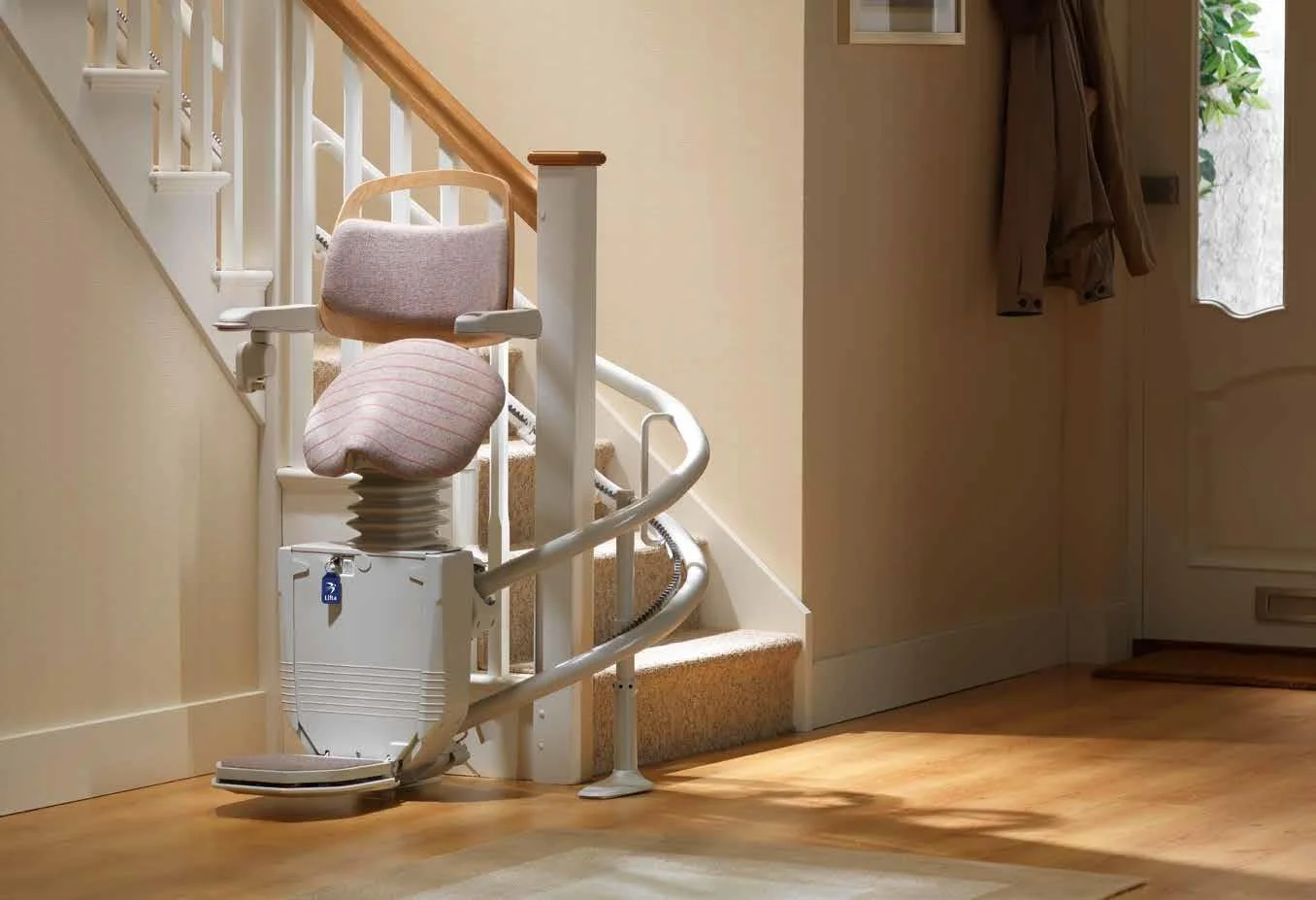
The housing here is a mix of single-family homes, detached houses, ranch-style homes, split-level homes and walk-up apartments. A traditional two-floor farmhouse or in-town house with one straight run of stairs is the simplest job. A straight rail mounts to the stair treads, not the wall, and usually goes in quickly.
Split-level homes are different. They have short flights with landings and turns, which often means a curved rail built to fit that exact staircase, or a separate straight lift on each flight. Ranch-style homes may have few interior stairs but still have steps at the entrance or down to a basement, and those steps can be the real barrier.
Because older homes in this part of Illinois concentrate stairs at the primary entrance, getting in and out of the house is often the first problem a family notices. An outdoor stair lift is built with weather covers and sealed parts so it can handle the porch or stoop steps year round.
If the person uses a wheelchair and cannot transfer to a seat, a seated stair lift will not do the job. In that case a vertical platform lift at the entrance is the better fit, and it is worth asking about during the home visit.
About 20.8% of Edgar County residents are 65 or older, and 65.3% own their homes. Data puts the median home value at $97,300, which points to long-held, often paid-off family houses rather than new subdivisions. For a homeowner on a fixed or modest income, a stair lift is usually a smaller step than moving or building a first-floor addition.
The settlement pattern is spread out. Farms and small towns are far apart, so travel time for installation and service visits can run longer than in more urban Illinois counties. It helps to ask up front how service calls are handled for addresses outside Paris.
Help depends heavily on age at application. Several Illinois programs that can fund home modifications require the person to be under 60 when they apply, while services for people 60 and older are routed through the Department on Aging and the East Central Illinois Area Agency on Aging.
For someone under 60 with a severe disability, the Illinois Home Services Program names stair lifts directly as an example of what it covers. For someone 60 or older, start with the Senior HelpLine at (800) 252-8966, which can connect you to the local care coordination unit. Veterans, low-income rural homeowners and families on a tight budget each have other options, listed below.
The Illinois Department of Veterans’ Affairs has an office in Paris at 11759 IL Highway 1, and you can reach it at (217) 685-2720.
Be aware that the VA HISA benefit explicitly excludes stair glides. A veteran with a qualifying severe disability may want to ask about the VA Specially Adapted Housing (SAH) or Special Home Adaptation (SHA) grants instead.
A state program for Illinois residents under 60 at application with a severe disability who are at risk of nursing facility placement, and it lists stair lifts by name as a covered modification. Call (800) 843-6154, or ask PACE Center for Independent Living about a referral.
A Medicaid waiver for Illinois residents under 60 at application that pays to modify a home for loss of function; the source does not mention stair lifts by name. Call (877) 581-3690 to ask about screening.
A statewide referral point for adults 60 and older and their caregivers that names home modification among its supportive services, with priority for low-income and rural residents. Call the Senior HelpLine at (800) 252-8966.
A Medicaid waiver for Illinois residents 60 and older that covers in-home help, adult day service, emergency home response and medication dispensers; the source does not mention stair lifts or home modifications. Call (800) 252-8966 for details.
The regional aging agency serving Edgar County, offering information, care coordination, benefit access and caregiver support; the source does not list stair lift funding. Call (800) 888-4456 to be screened for programs that may apply.
A disability service organization covering Champaign, Douglas, Edgar, Piatt and Vermilion counties for people of any age with any disability; the source does not list stair lift funding, but it can help with referrals. Call (217) 344-5433.
Repair loans up to $20,000 at 1% interest for very-low-income rural homeowners, and grants up to $7,500 for owners 62 or older, to remove health or safety hazards; the source does not mention stair lifts. Eligibility depends on whether your address is in a USDA-designated rural area.
A VA benefit with a lifetime maximum of $6,800 or $2,000 depending on the disability, for home accessibility improvements. It explicitly does not cover stair glides or porch lifts.
VA grants for veterans with qualifying severe disabilities, up to $126,526 for SAH and $25,350 for SHA. The source mentions ramps and widened doorways but does not name stair lifts.
Funds health and safety repairs and accessibility improvements for low- and very-low-income homeowners through local grantee organizations; the source does not name stair lifts, and demand exceeds funding. Call (312) 836-5200 or check with your local community development office.
Older adults
1003 Maple Hill Road, Bloomington, 61704
Veterans
11759 IL Highway 1, Paris, 61944
Yes, possibly. The Illinois Home Services Program lists stair lifts as a covered modification for people under 60 at application with a severe disability expected to last 12 months or longer. Call (800) 843-6154 or ask PACE Center for Independent Living at (217) 344-5433 about a referral.
Start with the Senior HelpLine at (800) 252-8966 or the East Central Illinois Area Agency on Aging at (800) 888-4456. They can screen for programs and connect you to the care coordination unit that serves Edgar County.
Not through HISA, which explicitly excludes stair glides. A veteran with a qualifying severe disability can ask about the SAH or SHA grants. The Illinois Department of Veterans’ Affairs office in Paris can help at (217) 685-2720.
Usually, yes. Split-level homes have short flights with landings, so the answer is often a curved rail built for that staircase or a separate straight lift on each flight. A home visit sorts out which makes sense.
It can. Rural homeowners with very low incomes may qualify for USDA Section 504 repair loans or, at age 62 or older, grants up to $7,500, depending on the address. Distance can also add travel time for installation and service, so ask about that up front.
Tell us about the stairs in your home and we will explain which lift fits, what it costs and how installation works.
