A lot of houses in Charleston, Mattoon, Oakland, Ashmore, Humboldt and Lerna were built long before anyone thought about getting an older body up a flight of stairs. Eastern Illinois University's architecture survey traces local homes from 1830s Hall-and-Parlor and I-houses through Greek Revival, Queen Anne Victorians, bungalows and ranch homes. Many of them put the bedrooms and the only full bath on the second floor.
That is the practical problem this page is about. If a parent in Coles County wants to stay in a two-story farmhouse or an old house near the courthouse square, the stairs usually decide how long that works. Below we walk through what the local houses mean for stair lift choices and which Illinois and federal programs are worth a phone call.
The county has 24 National Register of Historic Places listings, and that is only the documented part of a large stock of older, multi-story homes. I-houses, Georgian and Greek Revival two-story homes and Upland-South farmhouses tend to have a single interior stairway, often narrow and steep. When that stair runs in one straight flight, a straight stair lift is usually the simplest fit.
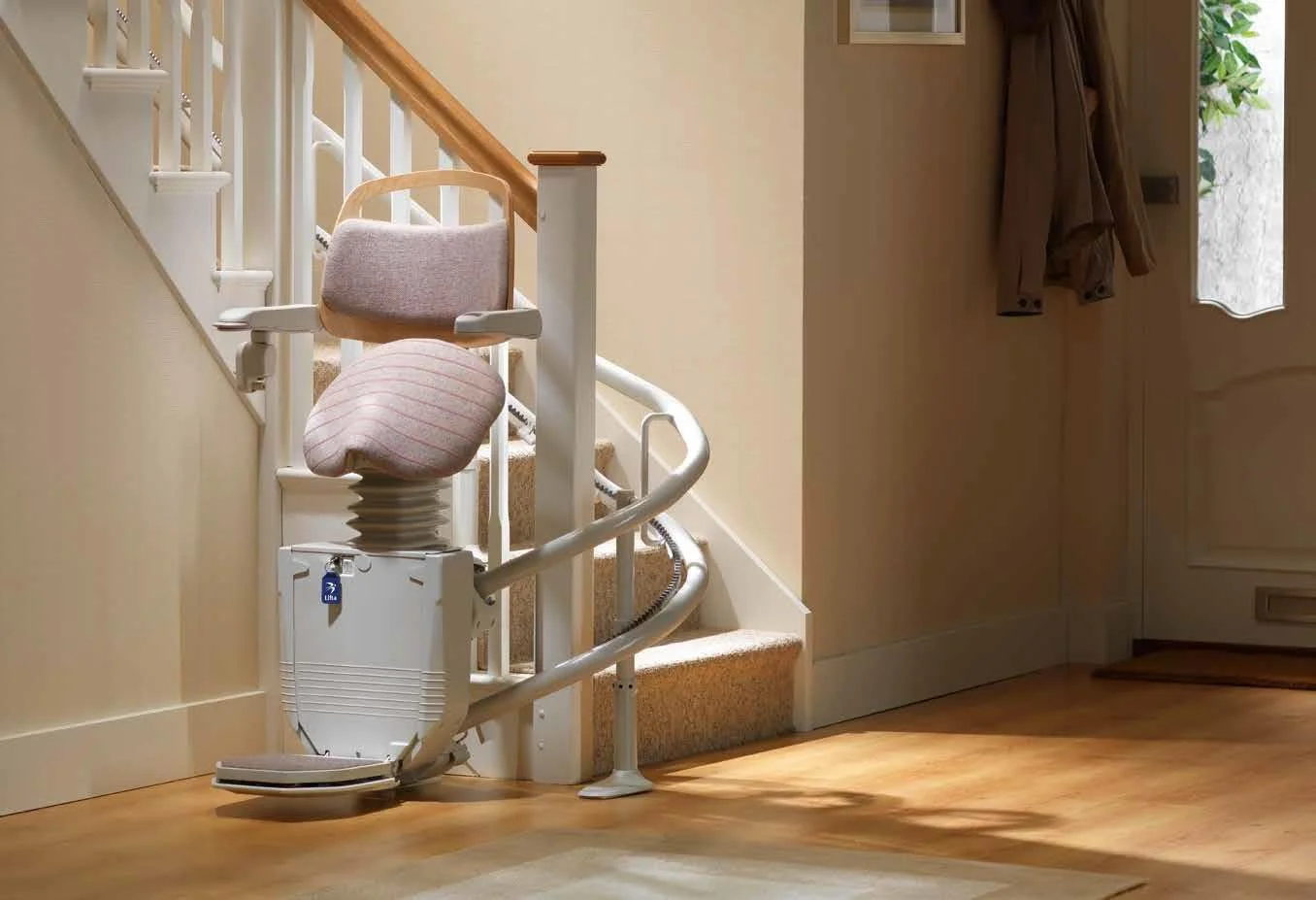
Second Empire, Italianate and Queen Anne Victorians are a different story. Their staircases often turn at a landing or wind partway up. Those stairs call for a curved stair lift, with a rail built to match the exact shape of the stairway, so we measure every step before quoting one.
Rural farmhouses in Coles County were typically built two stories with rear ell additions. An ell can mean a second, smaller stair at the back of the house, or a step down between the old and new sections. Sometimes the better plan is a lift on the back stair, which is often straighter, rather than the main one.
Split-level homes bring short runs of stairs between several levels, and townhouses and walk-up apartments usually have a straight interior flight. Bungalows and ranch homes from the 1910s to 1960s often have stairs only to a basement or to the front porch. For porch and deck steps, an outdoor lift has to handle a continental climate with winter lows near 19°F and summer highs near 88°F, and a vertical platform lift can make more sense where steps are wide or a wheelchair is involved.
About 17.2% of Coles County residents are 65 or older, and 53.0% of households own their homes. Owners can install a lift on their own schedule, while renters generally need landlord approval first. Some funding programs below allow renters to apply with that approval.
Veteran benefits have specific rules about stair lifts, so it is worth reading that part carefully before counting on the VA to pay. Families also often start this conversation after a hospital stay, and Sarah Bush Lincoln Health System in Mattoon, with its orthopedic facilities, is where many local patients head home from.
The clearest route in Illinois is the Illinois DHS Home Modification and Assistive Technology program, which lists stair lifts among the modifications it funds. You apply through your local Center for Independent Living, and for Coles County that is SAIL's Charleston office. Start there if someone in the household has a disability.
Other programs help with home repairs or accessibility in general but do not name stair lifts on their sources, so call and ask before you plan around them. The VA HISA grant specifically excludes stair glides. The program list below shows what each source says and who to call.
State disability services funding for home modifications, and the IDHS page lists stair lifts by name among funded examples. Illinois residents with disabilities apply through a local Center for Independent Living (SAIL's Charleston office serves Coles County); call (800) 843-6154.
A home modification grant for Illinois residents with a household member who has a documented disability and who meet an income requirement; owners and renters with landlord approval can apply. The source describes ramps and interior modifications but does not mention stair lifts; call (217) 525-1308.
The local Center for Independent Living for Coles, Clark and Cumberland counties, offering advocacy, information and referral, peer counseling and transition services, and the access point for statewide home modification programs. Its site does not list its own stair lift fund; call (217) 345-7245.
A VA grant of up to $6,800 or $2,000 lifetime, depending on disability status, for medically needed home changes prescribed by a VA physician. HISA specifically excludes stair glides and porch lifts, so it is not a stair lift funding source.
Grants for veterans with qualifying severe service-connected disabilities to buy, build or modify a home for accessibility, with SAH up to $126,526 and SHA up to $25,350. The source does not say whether stair lifts are an eligible item; the Coles County Veterans Service Office at (217) 345-2192 can help with VA benefits.
Repair loans up to $40,000 and grants up to $10,000 for rural homeowners with income at or below 50% of Area Median Income, with grants requiring age 62 or older. The source does not name stair lifts or accessibility equipment as covered.
In-home services, emergency home response, adult day service and medication dispensers for Illinois residents 60 or older with non-exempt assets of $17,500 or less. Home modifications and stair lifts are not mentioned; call (800) 252-8966.
The regional Area Agency on Aging for Coles County, coordinating services and information for residents 60 and older. Its source does not list a stair lift or home modification fund; call (800) 888-4456 to search for local services.
A local senior services hub in Charleston focused on community connection, activities, transportation and general support. Its site does not mention stair lift or home modification help; call (217) 639-5150.
Illinois Housing Development Authority home repair help for low-income and very-low-income homeowners, with accessibility modifications available through participating agencies. Stair lifts are not named on the source; call (312) 836-5200.
Older adults
1003 Maple Hill Road, Bloomington, 61704
Veterans
1550 Douglas Ave, Suite 1, Charleston, 61920
Yes. The Illinois DHS Home Modification and Assistive Technology program lists stair lifts among the modifications it funds for Illinois residents with disabilities. You apply through a Center for Independent Living, which for Coles County is SAIL's Charleston office at (217) 345-7245.
Not through HISA, which specifically excludes stair glides and porch lifts. The SAH and SHA grants cover home modifications for veterans with severe service-connected disabilities, but their source does not say whether stair lifts qualify. Call the Coles County Veterans Service Office in Charleston at (217) 345-2192 to ask about your situation.
Possibly. The INCIL Home Modification Program accepts renters who have landlord approval, along with a household member who has a documented disability and an income that meets its requirement. Its source does not name stair lifts, so ask when you call (217) 525-1308.
The Illinois Community Care Program serves people 60 and older, but its listed services are in-home help, emergency home response, adult day service and medication dispensers, not home modifications. The East Central Illinois Area Agency on Aging at (800) 888-4456 can point you to other local services.
Usually, yes, with a curved stair lift. The rail is made to follow your specific staircase, which is why it has to be measured in the home first. A straight lift only works on a single straight flight.
USDA Section 504 offers repair loans up to $40,000 and grants up to $10,000 to rural homeowners with income at or below 50% of Area Median Income, and the grant requires age 62 or older. Its source does not name stair lifts as a covered item, so confirm before applying.
Tell us about the stairs in your home and we will explain which lift fits, what it costs and how installation works.
