Clay County is a place of low rolling hills, farm ground and four towns: Flora, Louisville, Clay City and Xenia. The Little Wabash River runs through the middle of the county, and Louisville, the county seat, sits near the center. Many families here have owned the same house for a long time, often an older farmhouse or an in-town home built before single-story living was the norm.
Those houses tend to put stairs in two places: at the front or back door, and between the first and second floors. A stair lift can handle either spot, which lets a person keep living in a home they know instead of moving. This page walks through how local homes affect the choice of lift and where Clay County residents can look for help paying for one.
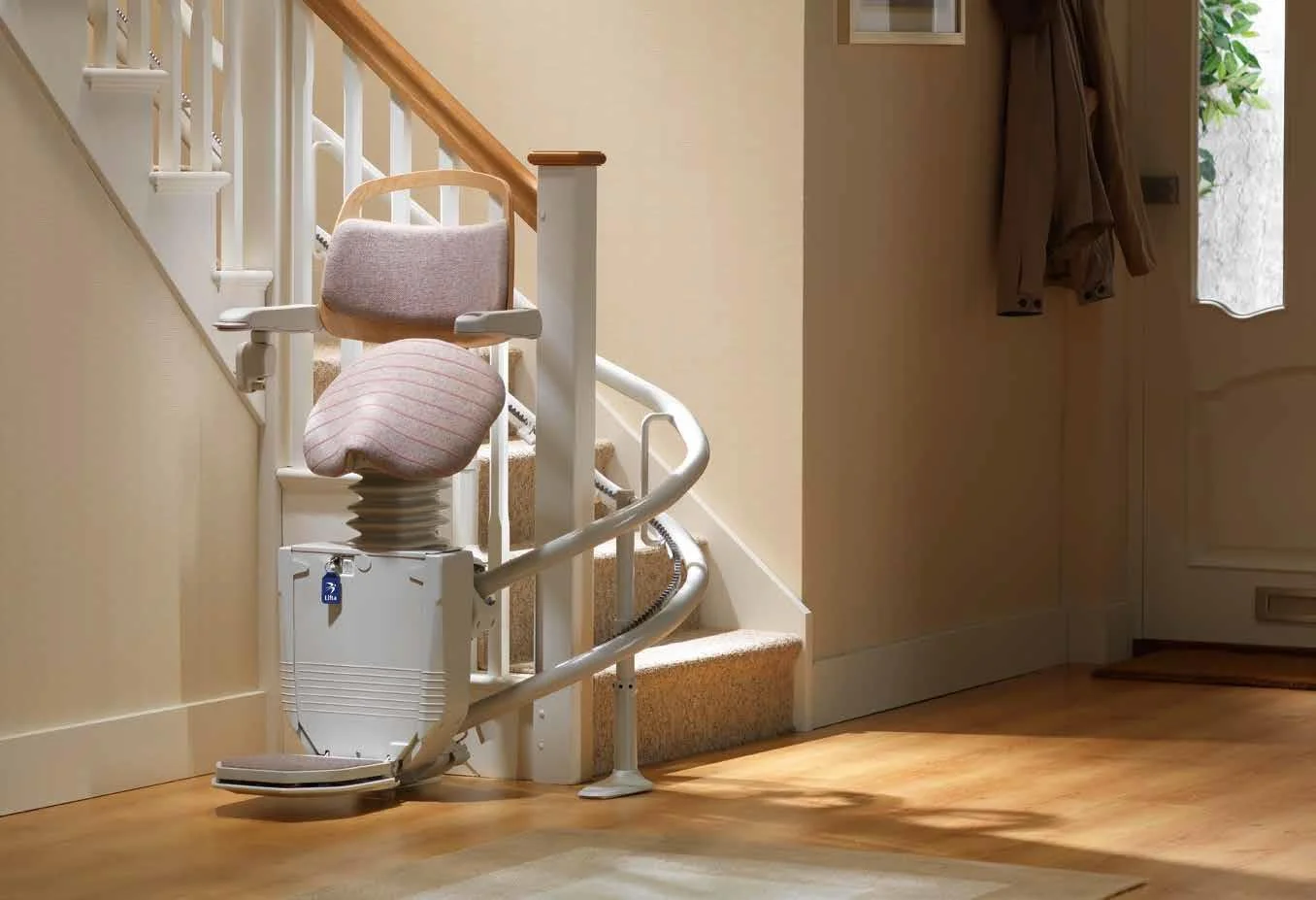
The housing stock here is modest and older. Older farmhouses and in-town homes in places like Flora and Clay City often have a staircase to the bedrooms upstairs and a set of steps at the main entrance.
A straight staircase with no turns or landings is usually the simplest install, since the rail runs in one line. Stairs that turn, wrap around a landing or curve need a curved rail built to fit that staircase. During a home visit we measure the stairs and check where the rail can mount before recommending one or the other.
Not every home in the county has a second floor. Ranch-style homes, mobile homes and modular homes are common here too, and the challenge in those is usually the steps up to the door rather than a staircase inside.
For outside steps, an outdoor stair lift built for weather is one option. If someone uses a wheelchair and cannot transfer to a seat, a platform lift may make more sense than a chair. The right answer depends on the number of steps, the space at the top and bottom, and how the person gets around day to day.
About 21.4% of Clay County residents are 65 or older, and 76.0% of homes are owned by the people living in them. That points to a lot of long-time owners who would rather stay put than sell.
Veterans should know that some VA housing benefits do not pay for stair lifts, so it helps to check the program details below before applying.
As of the 2020 Census, 63.9% of Clay County residents lived in rural areas. Homes are spread out along farm roads and around the small towns, and that affects how quickly an installer can get to a house for setup or service compared with more built-up parts of Illinois.
It helps to plan ahead. If a hospital discharge or a planned surgery is coming up, call early so the measuring visit and the install can be lined up in time.
The 2024 median household income in the county was $60,417, and the poverty rate was 17.5%. For many families on fixed or modest incomes, a stair lift costs less than moving or building a first-floor addition, but help with the cost still matters.
The Illinois Home Services Program names stair lifts as a covered home modification, though it is generally for people under age 60 at application. For people 60 and older, the Senior HelpLine at (800) 252-8966 can connect you with Midland Area Agency on Aging for a Clay County referral. Veterans can reach the Illinois Department of Veterans' Affairs at (217) 782-6641. Each program is summarized below.
A state Medicaid waiver program that lists stair lifts by name among covered home modifications, for Illinois residents with a severe disability who are generally under age 60 at application and at risk of nursing facility placement. Call (800) 843-6154.
A Medicaid waiver for Illinois residents under age 60 at application that covers physical changes to the home tied to loss of function, though the source does not mention stair lifts specifically. Call (877) 581-3690.
A statewide referral point for adults 60 and older and their caregivers that lists home modification among its supportive services. Call the Senior HelpLine at (800) 252-8966.
A Medicaid waiver for Illinois residents 60 and older that funds in-home and homemaker service, adult day service, emergency home response and automated medication dispensers; the source does not list stair lifts or home modifications. Call (800) 252-8966.
The aging services hub for Clay, Effingham, Fayette, Jefferson and Marion Counties, offering information and assistance, Meals on Wheels, caregiver support and referrals; stair lift funding is not listed. Reach it through the Senior HelpLine at (800) 252-8966.
A nonprofit serving people with disabilities in thirteen counties including Clay, offering advocacy, peer support and information and referral; stair lift services are not listed in the source. Call (217) 342-5521.
Federal repair loans and grants for very low income homeowners in USDA-designated rural areas, with accessibility work among the focus areas, though stair lifts are not named. A third-party summary lists loans up to $40,000 at 1% interest and grants up to $10,000 for homeowners 62 and older, so confirm current figures by calling (217) 403-6200.
A VA benefit for enrolled veterans with a medical need for home accessibility changes, with a lifetime maximum of $6,800 or $2,000 depending on disability status. It does not cover stair lifts; the VA excludes stair glides and porch lifts.
VA grants for veterans with qualifying severe disabilities, with FY2026 caps of up to $126,526 for SAH and up to $25,350 for SHA. The source does not mention stair lifts; for help applying, the Illinois Department of Veterans' Affairs is at (217) 782-6641.
Older adults
122 S. Maple, Centralia, 62801
Veterans
833 S Spring Street, Springfield, 62705
Yes, possibly. The Illinois Home Services Program names stair lifts as a covered modification and is generally for people under 60 at application who have a severe disability and are at risk of nursing facility placement. Call (800) 843-6154 to ask about eligibility.
Start with the Senior HelpLine at (800) 252-8966. They can connect you with Midland Area Agency on Aging for a Clay County referral and help sort out which program fits.
The VA HISA benefit does not; its rules exclude stair glides and porch lifts. The SAH and SHA grants do not mention stair lifts either, so ask the Illinois Department of Veterans' Affairs at (217) 782-6641 how they apply to your situation.
Often, yes. An outdoor stair lift can be used on entry steps, and a platform lift may be a better fit for someone who stays in a wheelchair. We look at the steps and the space around them before recommending one.
It can. Most Clay County residents live in rural areas, and travel time affects how fast an installer can get out for setup or repairs. Calling early gives you the best chance of fitting the install around a hospital discharge or other date.
The USDA Section 504 program offers repair loans and grants to very low income homeowners in rural-eligible areas, and accessibility work is one focus area, though stair lifts are not named. Call (217) 403-6200 to check current amounts and whether your address qualifies.
Tell us about the stairs in your home and we will explain which lift fits, what it costs and how installation works.
