Brown County has two towns, Mount Sterling and Versailles, and a lot of long-held family homes in between. Mount Sterling, the county seat, covers just 1.11 square miles and is classified as entirely rural. Many houses here have been in the same family for generations, and that is often why people would rather adapt the stairs than move.
In homes like these, the stairs that cause trouble are usually in two places: the steps up to the main entrance and the flight between floors of a two-story house. A stair lift can handle either one. This page walks through what fits the local homes and which programs may help with the cost.
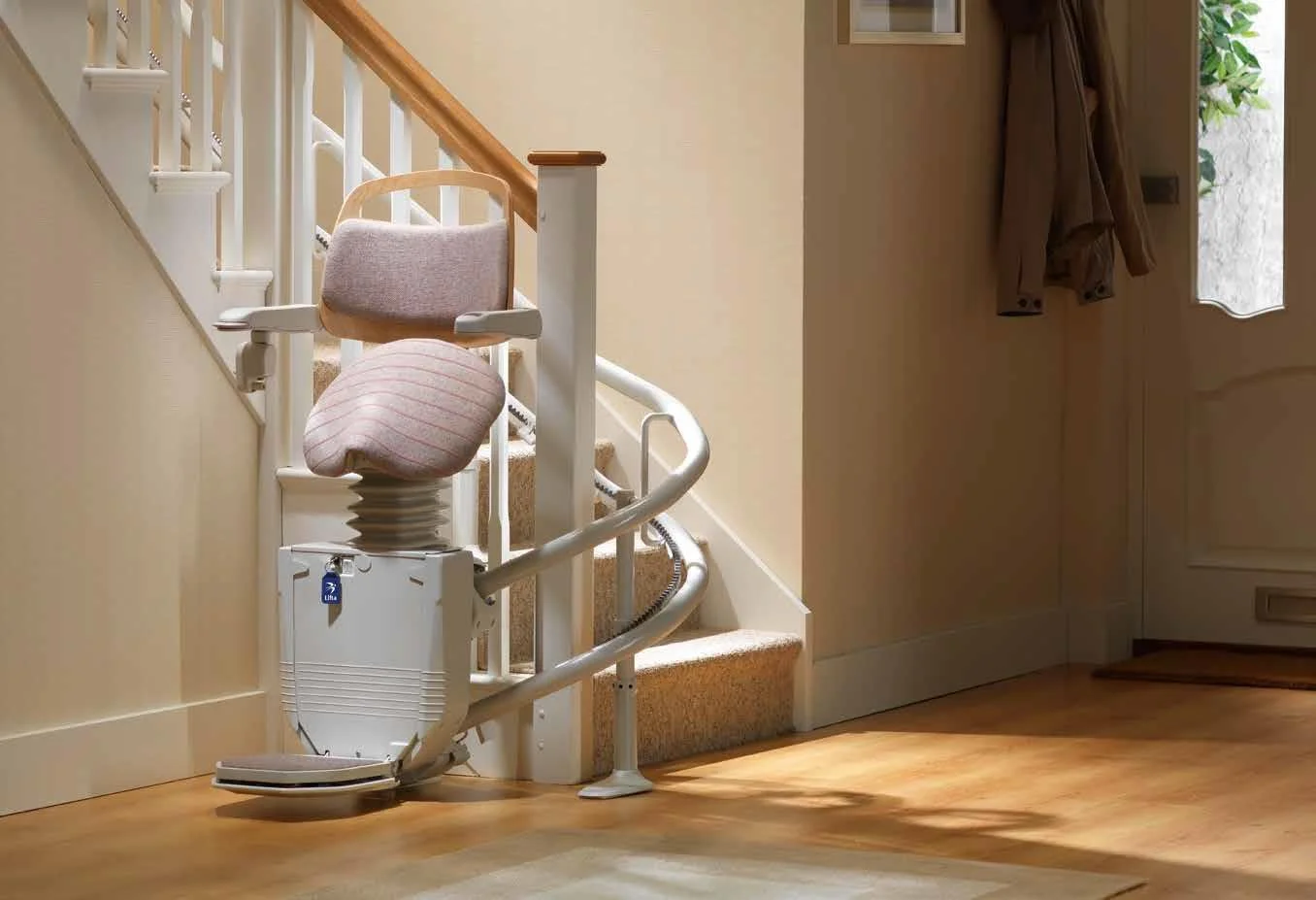
The housing here is mostly single-family homes and detached houses, with ranch-style homes, split-level homes and some low-rise buildings mixed in. Each layout points toward a different kind of lift.
A two-story house with one straight flight is the simplest case. A straight stair lift rides a rail bolted to the stair treads, not the wall, so older plaster walls are usually not a problem.
Split-level homes are different. They tend to have short runs between levels, sometimes with a turn or a landing. Depending on the layout, that can mean a curved lift with a custom rail or a separate lift on each run.
Brown County sits in west-central Illinois, with generally flat terrain and the Illinois River along part of its eastern border. Flat lots make for steady footing around the house, but many homes still have steps at the front or back door.
An outdoor stair lift is built to handle weather on those entrance steps. For someone who uses a wheelchair, a platform lift is usually the better answer, since the person stays in the chair instead of transferring to a seat.
Ranch-style homes often put everything on one floor, yet the entrance steps or a basement stairway can still be the one barrier left. That is worth checking before deciding on a lift.
Both groups have specific programs listed below, and some of them have age cutoffs that matter.
The county is rural and low-density, and the nearest larger service hub is Quincy in neighboring Adams County. Ask any installer how they handle service visits from that distance, since response times can be longer than in more urban counties.
Start with age. Two Illinois programs that name stair lifts or home modifications, the Home Services Program and the Persons with Disabilities waiver, are for people under age 60 at application. For people 60 and older, the Department on Aging Senior HelpLine at (800) 252-8966 can route you to the West Central Illinois Area Agency on Aging, which lists home modification among its supportive services.
For homeowners with lower incomes, the IHDA Home Repair and Accessibility Program offers up to $50,000 as a forgivable loan, and USDA Section 504 offers rural repair loans and grants. Neither source mentions stair lifts specifically, so ask directly before you count on them.
Veterans should know that the VA HISA benefit explicitly excludes stair glides. The Specially Adapted Housing and Special Home Adaptation grants do not name stair lifts either, so ask the VA what your grant can be used for.
An IDHS program for Illinois residents under 60 at application with a severe disability and non-exempt assets below $17,500; stair lifts are named as a covered example. Call (800) 843-6154, or contact the West Central Illinois Center for Independent Living in Quincy at 217-223-0400.
A Medicaid waiver for residents under 60 at application that covers physical modifications to the home when a disability limits daily activities. Call (877) 581-3690.
For adults 60 and older and their caregivers, with home modification listed among the supportive services. Call the Senior HelpLine at (800) 252-8966 to reach the local Care Coordination Unit.
A Medicaid waiver for people 60 and older that funds in-home help, adult day service, emergency home response and medication dispensers; home modifications and stair lifts are not listed. Call (800) 252-8966.
Core in-home services for people 60 and older with non-exempt assets of $17,500 or less; the source does not mention home modifications or stair lifts. Call (800) 252-8966.
A forgivable loan of up to $50,000 for rehab or accessibility work for owner-occupants at or below 80% of Area Median Income; listed examples are ramps, grab bars and widened doorways, and stair lifts are not mentioned. Call Two Rivers Regional Council of Public Officials at (217) 773-3141.
According to a third-party summary, loans of up to $40,000 at 1% and grants of up to $10,000 for homeowners 62 and older at or below 50% of Area Median Income in rural areas; stair lifts are not mentioned. Confirm the current figures and your address eligibility with USDA.
A lifetime benefit of up to $6,800 or $2,000 for medically necessary home accessibility work, but stair glides are explicitly excluded. Call (217) 224-3366.
Grants of up to $126,526 (SAH) or $25,350 (SHA) for veterans with qualifying severe disabilities; the source names ramps and widened doorways and does not mention stair lifts. The Illinois Department of Veterans Affairs is at (217) 782-6641.
A community action agency for low-income residents of Adams, Brown, Pike & Schuyler Counties offering energy assistance, a home buyer program, food pantry and workforce help; stair lift funding is not listed. Call (217) 773-3141 to ask about referrals to home repair resources.
Older adults
639 York Street, Suite 333, Quincy, 62301
Veterans
833 South Spring Street, Springfield, 62704
Yes. The Illinois Home Services Program names stair lifts as a covered example, and the Persons with Disabilities waiver covers home modifications. Both require being under 60 at application. Call (800) 843-6154 or the West Central Illinois Center for Independent Living at 217-223-0400.
Call the Senior HelpLine at (800) 252-8966 or the West Central Illinois AAA in Quincy at (217) 223-7904. Home modification is one of the listed supportive services. The Community Care Program core services do not list home modifications.
The HISA benefit explicitly excludes stair glides. SAH and SHA grants do not mention stair lifts either way, so ask the VA directly. The Illinois Department of Veterans Affairs is at (217) 782-6641.
The program funds accessibility projects of up to $50,000 as a forgivable loan, but its examples are ramps, grab bars and widened doorways. Stair lifts are not mentioned, so ask Two Rivers Regional Council at (217) 773-3141 before applying.
Split-level homes usually have short runs between levels, sometimes with a turn. That can call for a curved lift or a separate lift on each run, depending on how the stairs are laid out.
It can. Brown County is rural, and the nearest larger service hub is Quincy in Adams County. Ask how service calls are handled before you buy.
Tell us about the stairs in your home and we will explain which lift fits, what it costs and how installation works.
