Quincy sits on bluffs above the Mississippi River, and many of its houses were built long before anyone thought about stairs as a barrier. The South Side German Historic District, with structures like the 1857 Dick Brothers Brewery Buildings, and the Victorian-era homes in the neighborhoods that once housed Quincy's elite are full of tall, multi-story layouts.
Beyond the county seat, Adams County spreads across 871 square miles of mostly rural land, with 12 towns including Camp Point, Mendon, Payson, Golden, Clayton and Plainville. When a single-story home or assisted living is a long drive away, a stair lift is often the practical way to keep living in the house you already know.
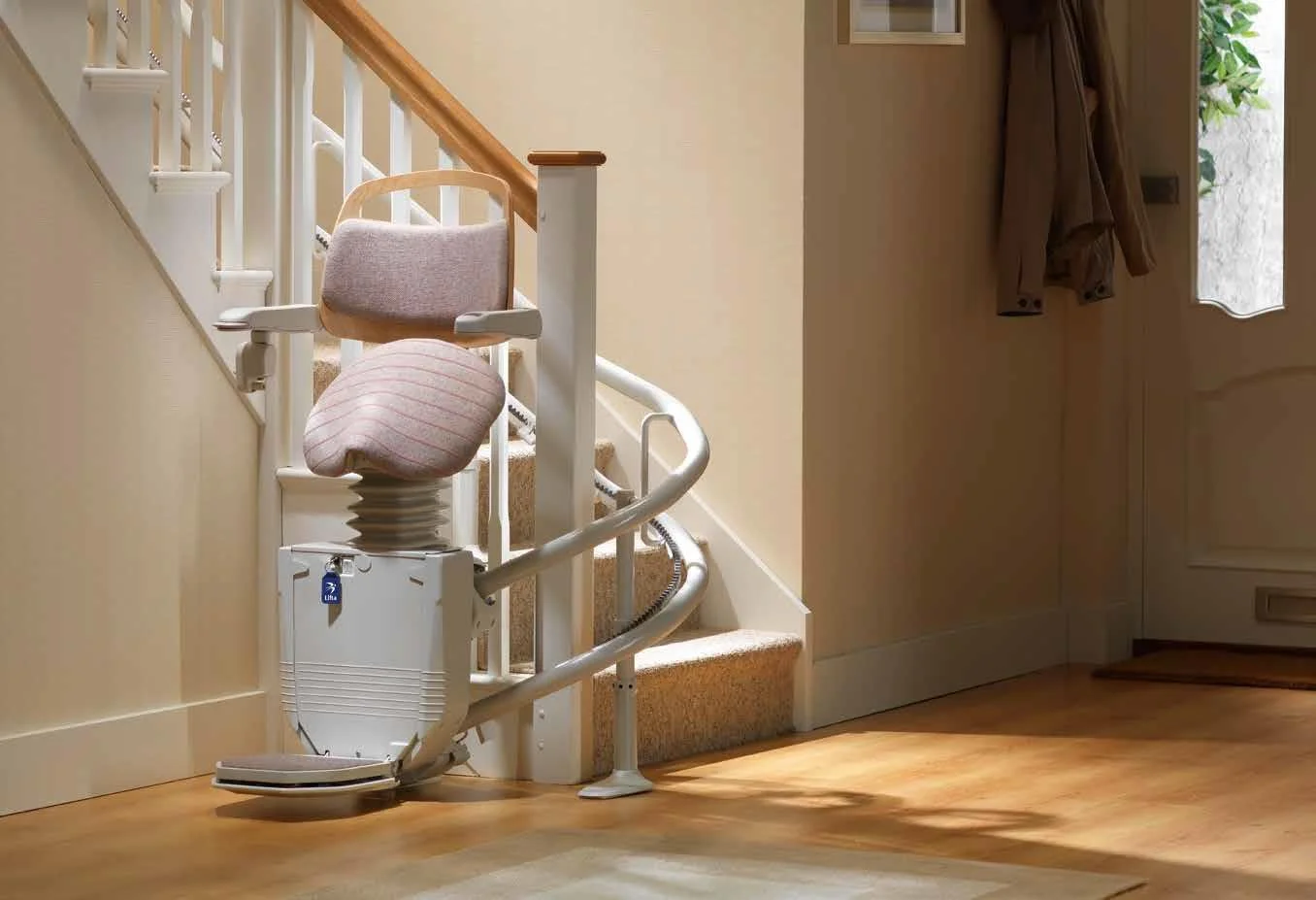
The county's long-established towns hold a lot of 19th- and early-20th-century homes with two or more floors. Those staircases are often narrow, steep or turn at a landing, so we measure every one before recommending a lift.
A straight run of stairs with no turns usually takes a straight stair lift on a rail fixed to the treads, not the wall. Staircases that curve, turn at a landing or wrap around in an old Victorian usually need a curved rail built to fit that exact staircase.
Housing here also includes single-family homes, detached houses, townhouses, walk-up apartments and split-level homes. A split-level often has short flights between floors, and each flight may need its own look.
Townhouses and walk-up apartments raise a different question: who owns the stairs. If the stairway is shared or the unit is rented, the owner or association usually has to approve an installation before any work starts.
Adams County is Illinois's westernmost county, with bluff terrain along the Mississippi River and dispersed small towns. On hilly lots, the hardest stairs are sometimes outside, between the driveway and the front door.
An outdoor stair lift built for weather can handle exterior steps, and a platform lift can be the better choice for someone who uses a wheelchair. We look at the whole route from car to bedroom, not just the inside staircase.
About 19.9% of county residents are 65 or older, and 66.6% of households own their homes. That is a lot of long-time owners in houses with stairs who would rather stay put.
Veterans can start with the Veterans Assistance Commission in Quincy at (217) 515-2822 to sort out which VA benefits apply.
The rules split mostly by age. People under 60 with a severe disability may qualify for the Illinois Home Services Program, which lists stair lifts by name. Adults 60 and older should call the West Central Illinois Area Agency on Aging at (217) 223-7904, located at 639 York Street, Suite 333, in Quincy.
Other options include the West Central Illinois Center for Independent Living, USDA Section 504 repair loans and grants for rural homeowners, and VA housing grants. Statewide programs to ask about include the Illinois Community Care Program (CCP), the IATP ATLOAN$ Program and the Senior Citizens Assessment Freeze Homestead Exemption. Details for each program are listed below.
A state Medicaid waiver for Illinois residents under 60 at application with a severe disability, and its home modification page lists stair lifts as an example. Call the IDHS Help Line at (800) 843-6154.
The HFS page for the same waiver describes home modifications for loss of function but does not mention stair lifts by name. Eligibility questions can go to (877) 581-3690.
For people with a developmental disability enrolled in a DDD waiver, with funding for adaptive equipment and home modifications; the source mentions exterior lifts but does not list stair lifts specifically. Call (800) 843-6154.
The local center for independent living serving Adams County, offering an equipment loan program and a transition program that includes home accessibility; stair lifts are not mentioned. Call (217) 223-0400 to ask what can be funded or referred.
The Quincy-based hub for senior services and the first call for adults 60 and older seeking home modification help or a Community Care Program referral; stair lift funding is not listed. Call (217) 223-7904.
Funds health, safety and accessibility repairs for low- and very-low-income homeowners through local grantee organizations, and the source does not mention stair lifts. Contact IHDA to find the current local grantee.
The Quincy, Adams County Habitat affiliate at 521 State St; its page does not describe stair lifts or modification details. Call (217) 223-4224 to ask about current home repair work.
Loans up to $40,000 at 1% and grants up to $10,000 for very-low-income rural homeowners, with grants limited to those 62 or older; accessibility changes qualify but stair lifts are not named. Call (217) 403-6200 and check your address on the USDA eligibility map.
A VA benefit for medically necessary home accessibility improvements, with lifetime maximums of $6,800 or $2,000. HISA explicitly excludes stair glides, so it does not cover stair lifts.
Grants for veterans with qualifying severe service-connected disabilities, up to $126,526 for SAH and $25,350 for SHA; the source does not name stair lifts among covered changes. The Veterans Assistance Commission in Quincy at (217) 515-2822 can help with next steps.
Older adults
639 York Street, Suite 333, Quincy, 62301
Veterans
3701 East Lake Center Suite 3, Quincy, 62305
Start with the West Central Illinois Area Agency on Aging in Quincy at (217) 223-7904. It handles home modification questions and Community Care Program referrals for adults 60 and older, though it is not itself a confirmed stair lift fund.
Yes, the Illinois Home Services Program lists stair lifts among its home modifications for Medicaid-eligible residents under 60 at application with a severe disability. Call the IDHS Help Line at (800) 843-6154.
No. HISA specifically excludes stair glides. Veterans with qualifying service-connected disabilities can ask about SAH or SHA grants through the Veterans Assistance Commission at (217) 515-2822.
Possibly. USDA Section 504 grants go up to $10,000 for very-low-income homeowners 62 or older in eligible rural areas, but eligibility is checked by address. Call (217) 403-6200.
Usually, with a curved rail made to fit that staircase. Many older homes in Quincy and the county's long-established towns have landings or turns, so an in-home measurement comes first.
The West Central Illinois Center for Independent Living runs an equipment loan program for items like walkers, canes and wheelchairs for three months. Call (217) 223-0400 to ask what else they can help with.
Tell us about the stairs in your home and we will explain which lift fits, what it costs and how installation works.
