Lewiston drops from about 1,400 feet in the Orchards neighborhood to roughly 741 feet downtown, where the Snake and Clearwater Rivers meet. The steep Thain Grade road links the two, and a lot of houses in between were built on hillside or plateau lots instead of flat ground.
That shape matters when stairs start to feel harder. In Lewiston, Lapwai and Culdesac, the steps that cause trouble are often both inside the house and outside it, on the walk up from the driveway. This page covers which kind of stair lift fits the homes here and where to look for help paying for one.
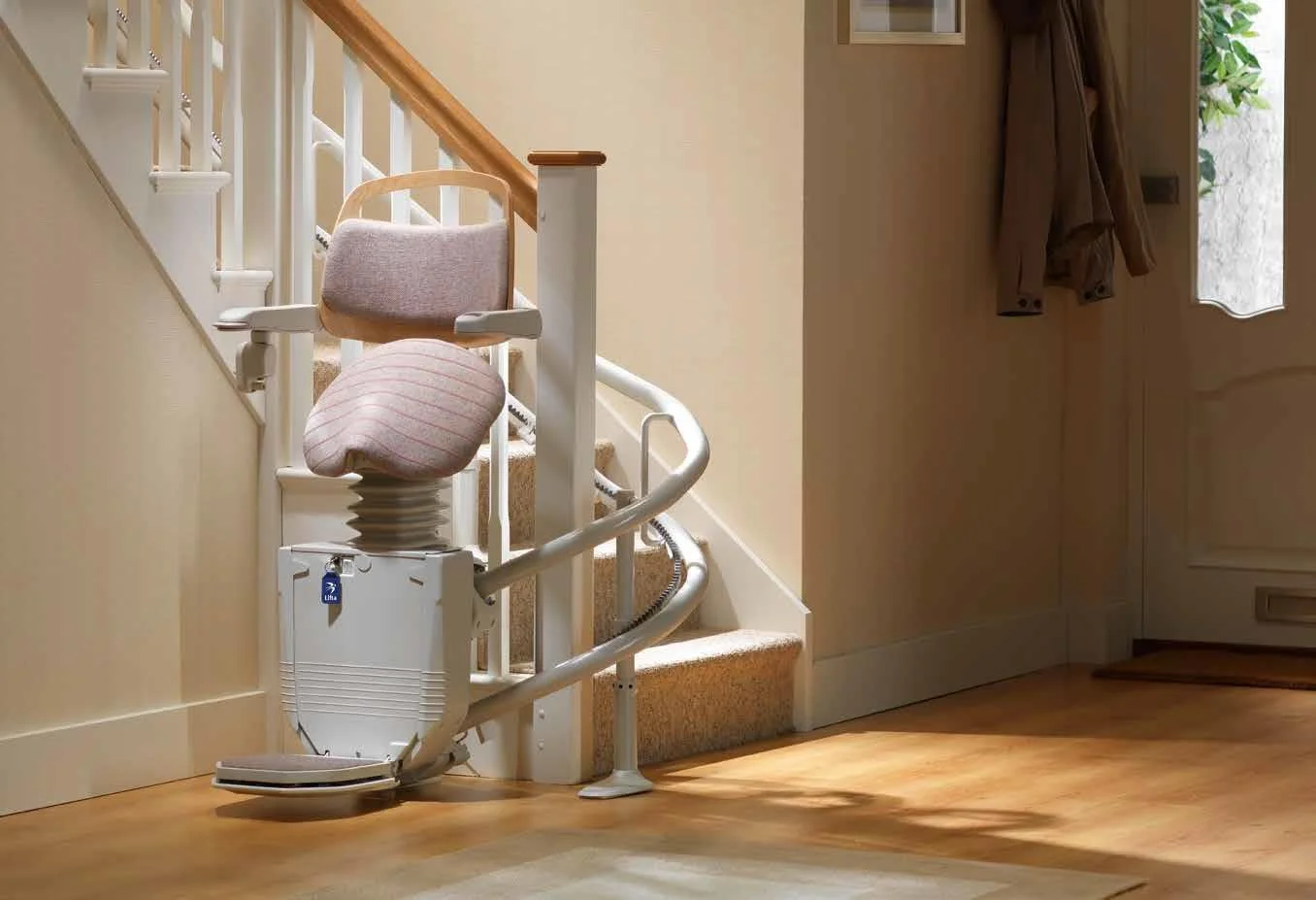
Because so many Lewiston-area homes sit on sloped lots, split-level homes are common here alongside single-family homes, detached houses and townhouses. A split-level usually has short runs of stairs between floors instead of one long flight.
A short, straight run is often the simplest case: a straight stair lift rides a rail bolted to the stair treads, not the wall. If the stairs turn at a landing or change direction, a curved rail built to that staircase is the usual answer. When we visit, we measure each run and check where the landings fall before recommending anything.
Nez Perce County covers 856 square miles, and the land rises fast from the river valleys. North of Lewiston, U.S. 95 climbs to roughly 2,756 feet within a short distance of the city, and the northern part of the county rolls into the hilly Palouse farm country.
On ground like that, entry steps, walkways and driveways can be a bigger problem than the inside staircase. Outdoor stair lifts are built for weather exposure and can run along exterior steps to a porch or door. For someone using a wheelchair, a platform lift may make more sense than a seat, since the person stays in the chair.
About 20.0% of county residents are 65 or older, and 69.8% own their homes. Owning the house usually makes a permanent installation easier, since there is no landlord to ask.
If that includes someone in your family, the veteran programs below are worth a call before you decide how to pay. Walk-up apartments are also part of the local housing mix, and renters there should talk with the building owner before any rail goes in.
Cost is a real question here. The county's reported median household income was $44,395 (a 2010 figure), so many older homeowners are working with a fixed or modest budget.
None of the programs listed below name stair lifts outright, so ask each one directly. Idaho Medicaid's home and community-based services list environmental accessibility adaptations, and the Idaho Medicaid Aged & Disabled (A&D) Waiver is the statewide route many older adults use. Veterans can ask about VA Benefits for Veterans (HISA + Prosthetics) as well as the SAH and SHA grants.
Two local offices can help sort this out. Idaho Aging Commission Area II is at 1424 Main St., Suite 6, Lewiston, 83501, phone (208) 743-5580. The Central Idaho State Service Officer for veterans is at 2604 16th Avenue, Suite A, Lewiston, 83501, phone (208) 748-7663. Homeowners on a tight budget can also ask about the Idaho Property Tax Reduction (Circuit Breaker) program.
Federal grants for veterans with qualifying service-connected disabilities to buy, build or modify a permanent home: SAH up to $126,526 and SHA up to $25,350 (FY2026), with TRA for veterans living temporarily in a family member's home. The source does not mention stair lifts specifically, so the Central Idaho State Service Officer at (208) 748-7663 is a good first call.
For Idaho residents 65 and older or with a qualifying disability who meet Medicaid income and resource rules and need a nursing-facility level of care; covered services include environmental accessibility adaptations and specialized medical equipment, though stair lifts are not named. Call (877) 456-1233 to apply.
A Center for Independent Living with an office in Lewiston that lends aluminum modular exterior ramps short term and lists home modifications among its housing advocacy services; stair lifts are not mentioned. Call the Lewiston office at (208) 746-9033 to confirm eligibility.
A statewide referral line, not a grant, that connects Idaho residents with local aging, disability and home-modification resources; it does not list stair lift funding itself. Call (800) 926-2588, Monday through Friday, 8:00 a.m. to 6:00 p.m. MST.
Older adults
1424 Main St., Suite 6, Lewiston, 83501
Veterans
2604 16th Avenue, Suite A, Lewiston, 83501
Usually, yes. Split-levels tend to have short straight runs, which suit a straight stair lift. If a run turns at a landing, a curved rail is built to match it. We measure each run during the home visit.
Yes. Outdoor stair lifts are made for exterior steps, which is common on Lewiston's hillside and plateau lots. If the person uses a wheelchair, a platform lift may be the better fit. DAC NW in Lewiston also lends exterior ramps short term through its Ramp Up Project; call (208) 746-9033.
The Idaho Medicaid home and community-based services list covers environmental accessibility adaptations but does not name stair lifts. You first qualify financially, then go through a level-of-care assessment before home modifications are authorized. Call (877) 456-1233 to start.
The VA SAH, SHA and TRA grants cover home modifications for veterans with qualifying service-connected disabilities, though stair lifts are not itemized. The Central Idaho State Service Officer at 2604 16th Avenue, Suite A, Lewiston, can help; call (208) 748-7663.
Idaho Aging Commission Area II, at 1424 Main St., Suite 6 in Lewiston, is the local aging office; call (208) 743-5580. The Idaho 211 CareLine at (800) 926-2588 can also refer you to services.
Tell us about the stairs in your home and we will explain which lift fits, what it costs and how installation works.
