Clearwater County has three towns: Orofino, Pierce and Weippe. Orofino sits low in the Clearwater River valley at 1,286 feet, while the rest of the county stretches across 2,488 square miles of rural country, from rolling Palouse prairie to the Bitterroot Mountains foothills and Dworshak Reservoir.
Most people here own their homes, and many of those homes are single-family, split-level or ranch-style houses built without accessibility in mind. If a parent is starting to struggle with the stairs, this page walks through which kind of lift fits these homes and which programs may help cover the cost.
The county has about 4,101 residents, and 23.2% of them are 65 or older. Homeownership runs at 78.3%, so most older residents are making decisions about a house they own rather than waiting on a landlord.
Local housing data points to a large share of older, unmodified single-family homes. That usually means interior stairs with no grab bars, no landing space planned for equipment and no step-free entry.
A single straight flight, common in many detached houses, is the simplest case. A straight stair lift mounts to the treads, not the wall, and usually takes the least time to install.
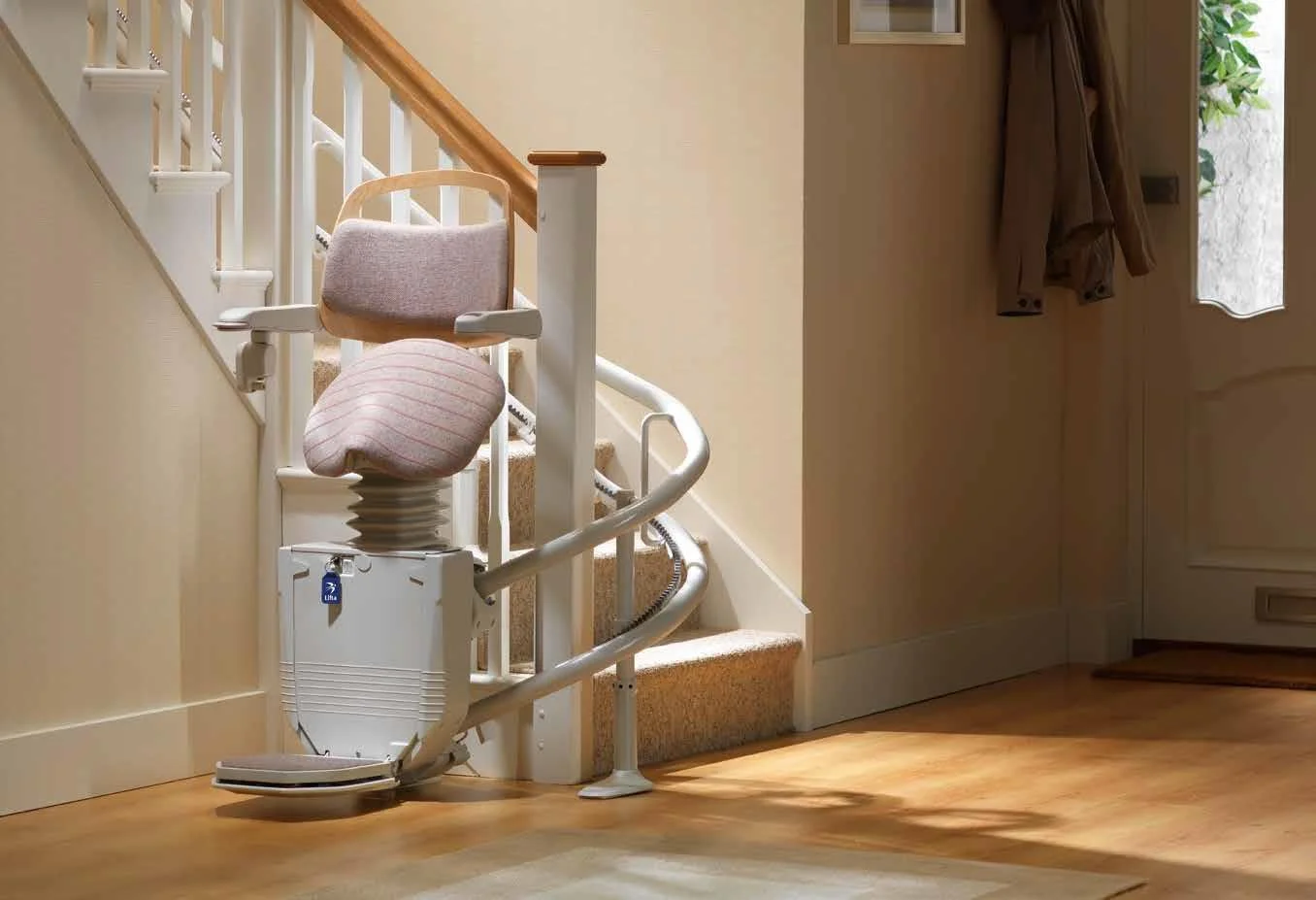
Split-level homes are different. They often have two short flights going in opposite directions from the entry, so you may need two straight lifts or one curved rail that follows the turn. We measure each flight before recommending either.
Ranch-style homes often have most living space on one floor, but steps to a basement, laundry or the front door can still be a problem. For a few entry steps, an outdoor lift or a platform lift may make more sense than an indoor chair.
Orofino averages about 26.5 inches of snow a year. Outdoor steps to a porch or deck get icy, and that is often where a fall happens first. An outdoor-rated lift is built to handle weather, but it still needs the path to it kept clear.
Distances here are long and most trips are by car. A stair lift that lets someone reach the garage or front door safely can matter as much as one inside the house, since getting to appointments depends on getting out the door.
Household incomes in the county are modest, so many families look at grants and low-interest loans before paying out of pocket. Several programs below fund home modifications, but most do not name stair lifts directly, so ask each one about your specific case before you count on it.
The Veterans Service Officer in Orofino at 330 Michigan Avenue, (208) 476-7378, can help sort out which VA grant applies. For general aging services, Idaho Aging Commission Area II in Lewiston can be reached at (208) 743-5580.
For homeowners 62 and older on very low incomes, the USDA Section 504 program is worth a close look, since Clearwater County is a USDA-eligible rural area.
This Medicaid waiver funds home modifications such as ramps, grab bars and doorway widening for Idaho residents 65+ or disabled who need nursing-facility level of care, with an income limit of $3,002/month and a $2,000 asset limit; stair lifts are not named and enrollment has a waiting list. Call (877) 456-1233.
AAANI serves older adults, people with disabilities and vulnerable adults 18+ in ten northern Idaho counties, including Clearwater County. Its source does not mention stair lift funding, but it is a starting point for local services at (208) 667-3179.
HISA is a lifetime benefit of $6,800 for veterans with a service-connected disability (or $2,000 for other qualifying disabilities) for medically necessary home changes. It does not cover stair lifts: the VA lists stair glides and porch lifts as excluded.
SAH provides up to $126,526 for FY2026 to veterans who own or will own their home and have a qualifying severe service-connected disability. The VA gives ramps and widened doorways as examples, and stair lifts are not listed.
SHA provides up to $25,350 for FY2026 to veterans with qualifying disabilities such as loss of use of both hands, severe burns or a severe breathing injury. Stair lifts are not listed in the program description.
Very-low-income homeowners in eligible rural areas, including Clearwater County, can get repair loans up to $40,000 at 1% and, if 62+ and unable to repay a loan, grants up to $10,000. Accessibility examples include ramps and walk-in tubs; stair lifts are not listed.
This center for independent living serves people with disabilities in Clearwater County and nearby north Idaho counties. Stair lift funding is not listed, but you can ask about local resources at (208) 746-9033.
Older adults
1424 Main St., Suite 6, Lewiston, 83501
Veterans
330 Michigan Avenue, Orofino, 83544
Not through HISA, which specifically excludes stair glides and porch lifts. The SAH and SHA grants do not name stair lifts either way, so call the Veterans Service Officer in Orofino at (208) 476-7378 to ask whether your situation qualifies.
The A&D waiver funds home modifications like ramps, grab bars and doorway widening, but stair lifts are not named. It also has limited slots and a waiting list, so it is worth applying early by calling (877) 456-1233.
The USDA Section 504 grant requires age 62 or older, but the 1% repair loan of up to $40,000 does not carry that age requirement. You must be very low income, own the home and live in it.
Usually yes. Split-level homes often need either two straight lifts, one per short flight, or a single curved rail. A measurement visit tells you which fits your stairs.
Outdoor-rated lifts are made for weather, including the roughly 26.5 inches of snow Orofino averages each year. Keep the rail and seat clear of snow and ice so it runs properly.
Idaho Aging Commission Area II in Lewiston at (208) 743-5580 and the Area Agency on Aging of North Idaho at (208) 667-3179 both serve older adults in the region.
Tell us about the stairs in your home and we will explain which lift fits, what it costs and how installation works.
