From the historic blocks around downtown Sandpoint to sloped lots above Lake Pend Oreille and Priest Lake, Bonner County homes rarely sit flat on a single level. Raised entries, split-level floor plans and multi-story layouts are common here, in town and out in places like Clark Fork, Laclede and Blanchard.
That layout matters when someone in the house starts having trouble with steps. This page walks through how the county's homes and terrain affect the kind of stair lift that fits, and which programs Bonner County residents can contact about paying for one.
Sandpoint was officially incorporated in 1898, and its downtown still holds buildings like the vaudeville-era Panida Theater. A good share of the housing around it was built before modern accessibility norms, so staircases can be narrow, steep or turn partway up.
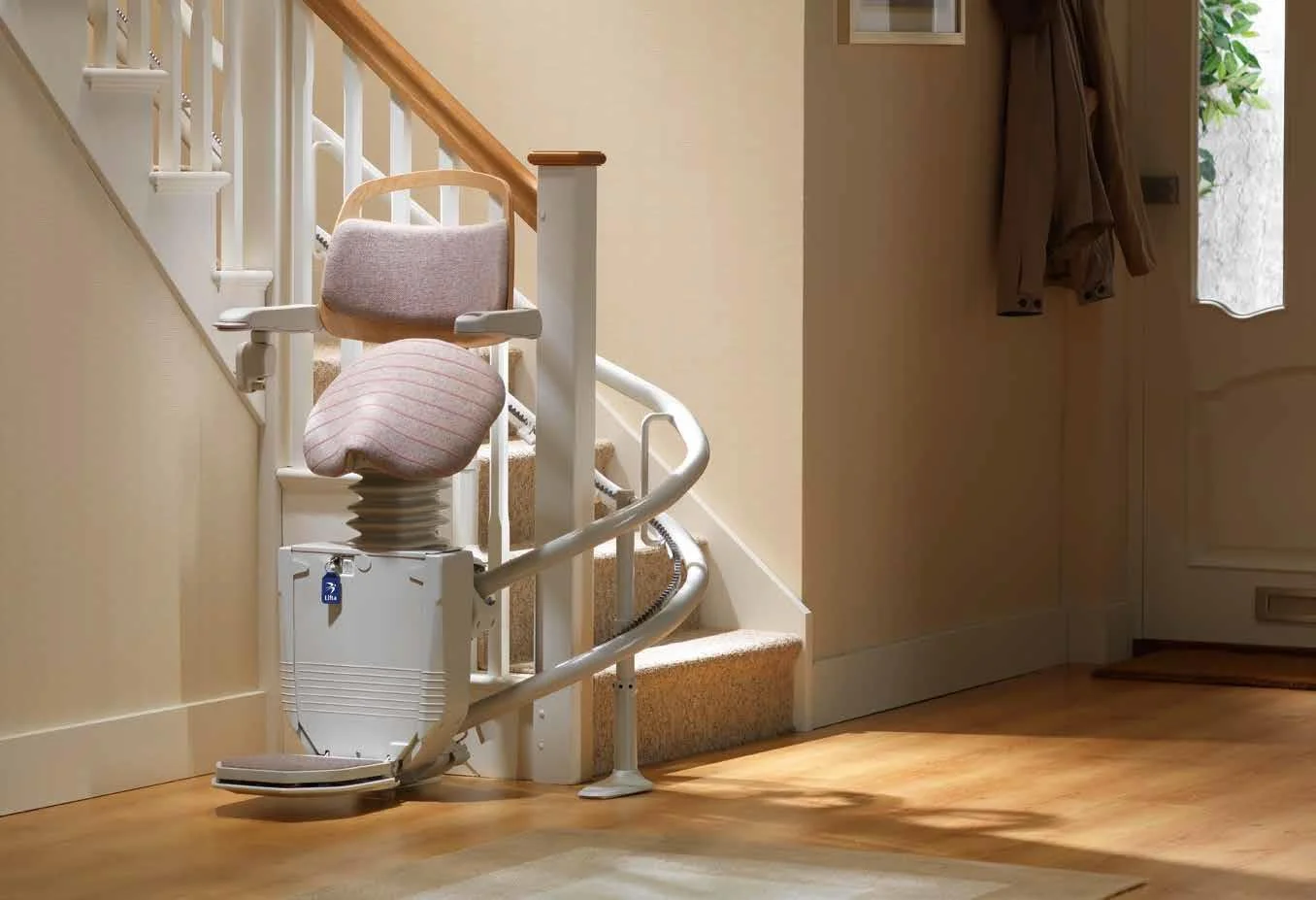
A single straight run of stairs is usually the simplest job: a straight stair lift rides a rail mounted to the treads. Stairs with a landing, a turn or a curve need a curved rail built to that staircase.
Split-level homes, which you see in Ponderay, Kootenai and Dover as well as Sandpoint, often have several short flights instead of one long one. Each flight may need its own lift, or a curved rail that carries the rider past the landing. We look at how the household actually moves through the house before suggesting either.
Bonner County covers 1,919 square miles of mountain, lake and forest country, ringed by the Selkirk, Cabinet and Bitterroot ranges and topped by Scotchman Peak at 7,018 ft. Newer homes on sloped rural and lakefront lots are often built with raised entries, which puts steps outside the front or back door.
For those exterior steps, an outdoor stair lift is built to handle the weather. Where someone uses a wheelchair, a platform lift may make more sense than a seat-style lift, and some homes call for a ramp instead. The slope of the lot and the height of the entry decide which is practical.
As of the 2020 census, the county's median age was 49.3 and 26.3% of residents were 65 or older. About 60.8% of households own their homes, which matters because owners can make permanent changes like a mounted rail.
Most residents, 72.8% as of the 2020 census, live in rural areas. That can make it harder to line up contractors outside the Sandpoint area, so tell us exactly where the house is, whether that is Priest River, East Hope or Oldtown, when you call.
Read the notes on each one, because not every VA grant pays for a stair lift.
There is no single program that clearly pays for stair lifts here. The VA HISA grant specifically excludes stair glides, and the other programs listed below do not name stair lifts on their source pages.
The Idaho Aged and Disabled (A&D) Medicaid Home and Community-Based Services Waiver lists environmental accessibility adaptations as a covered service, decided case by case through a care plan. Veterans with severe service-connected disabilities can ask about the VA Specially Adapted Housing (SAH) / Special Home Adaptation (SHA) Grants as part of a larger home project.
Statewide, residents can also ask about the Idaho Assistive Technology Project and its Low-Interest Financial Loan Program, and about the Idaho Property Tax Reduction (Circuit Breaker). For help sorting out which applies, start with the Area Agency on Aging of North Idaho at (208) 667-3179 or the Veteran Service office at 521 S Division Street, Suite 121, Sandpoint, (208) 255-5291.
A lifetime VA grant of up to $6,800 for veterans with a service-connected disability (or a non-service-connected disability with a 50%+ service-connected rating), or $2,000 for other eligible disabilities, applied for through the VA Prosthetic and Sensory Aids Service. It does not cover stair lifts: the VA excludes stair glides and porch lifts, though it can fund permanent ramping, widened doorways and roll-in showers.
VA grants for veterans with specific severe service-connected disabilities who own or will own their home, with SAH up to $126,526 and SHA up to $25,350 for a permanent home (FY2026). The VA page gives ramps and widened doorways as examples but does not list stair lifts, so ask whether one can be part of an approved project.
A state Medicaid waiver for Idaho residents age 65+ or meeting disability criteria who need nursing-facility level of care and meet income and resource limits. It lists environmental accessibility adaptations as a covered service, but stair lifts are not named and coverage is decided through your care plan; call (800) 926-2588.
The regional aging agency serving Bonner County, mainly for seniors 60+, offering meals, homemaker help, caregiver respite, transportation and information and referral. It does not list a stair lift or home-modification program, but it can point you to benefits that may apply; call (208) 667-3179.
A free statewide information and referral line that connects Idaho residents to health, housing and aging resources. It does not fund stair lifts itself or name home-modification programs, but it can help identify what you may qualify for; call (800) 926-2588.
A free federal referral service that connects older adults, people with disabilities and caregivers to local agencies such as AAANI and Medicaid waiver intake points. It is not a funding source and does not describe stair lift benefits; call (800) 677-1116.
Older adults
2120 Lakewood Drive, Suite B, Coeur d'Alene, 83814
Veterans
521 S Division Street, Suite 121, Sandpoint, 83864
No. The VA's HISA page lists stair glides and porch lifts as items it will not pay for. HISA can cover fixed changes like permanent ramping, widened doorways or a roll-in shower, so it may still help with other parts of making the home accessible.
Possibly, but it is not confirmed. The Idaho Aged and Disabled (A&D) Medicaid Home and Community-Based Services Waiver covers environmental accessibility adaptations, and whether a stair lift qualifies is decided case by case through the care plan. You can reach the program at (800) 926-2588.
Often, yes. Split-level homes usually have short separate flights, so the answer may be a straight lift on each flight or a curved rail that runs past a landing. A look at the stairs and how the household uses each level settles which one fits.
The Area Agency on Aging of North Idaho serves residents mainly 60 and older in its 10-county area, which includes Bonner County. It does not list a stair lift program, but it can route you to services that may apply; call (208) 667-3179.
The Veteran Service office is at 521 S Division Street, Suite 121, Sandpoint, and the phone is (208) 255-5291. They can help you look at the VA Specially Adapted Housing (SAH) / Special Home Adaptation (SHA) Grants and other VA benefits.
An outdoor stair lift is designed for exterior steps. If the person uses a wheelchair, a platform lift or a ramp may be the better fit, depending on the height of the entry and the slope of the lot.
Tell us about the stairs in your home and we will explain which lift fits, what it costs and how installation works.
