From Milford in the west to Madison in the east and up to Meriden in the north, this region wraps around New Haven on Long Island Sound. Many homes here are older multi-story capes and colonials with one interior staircase between the kitchen and the bedrooms. That staircase is where most stair lift questions start.
In New Haven County the median home was built around 1967, and about 22.4% of homes went up before 1940. Older stairs can be narrow, steep or turned at a landing. Those details decide whether a straight rail will work or a curved one is needed, and they shape what a lift costs and how it gets paid for.
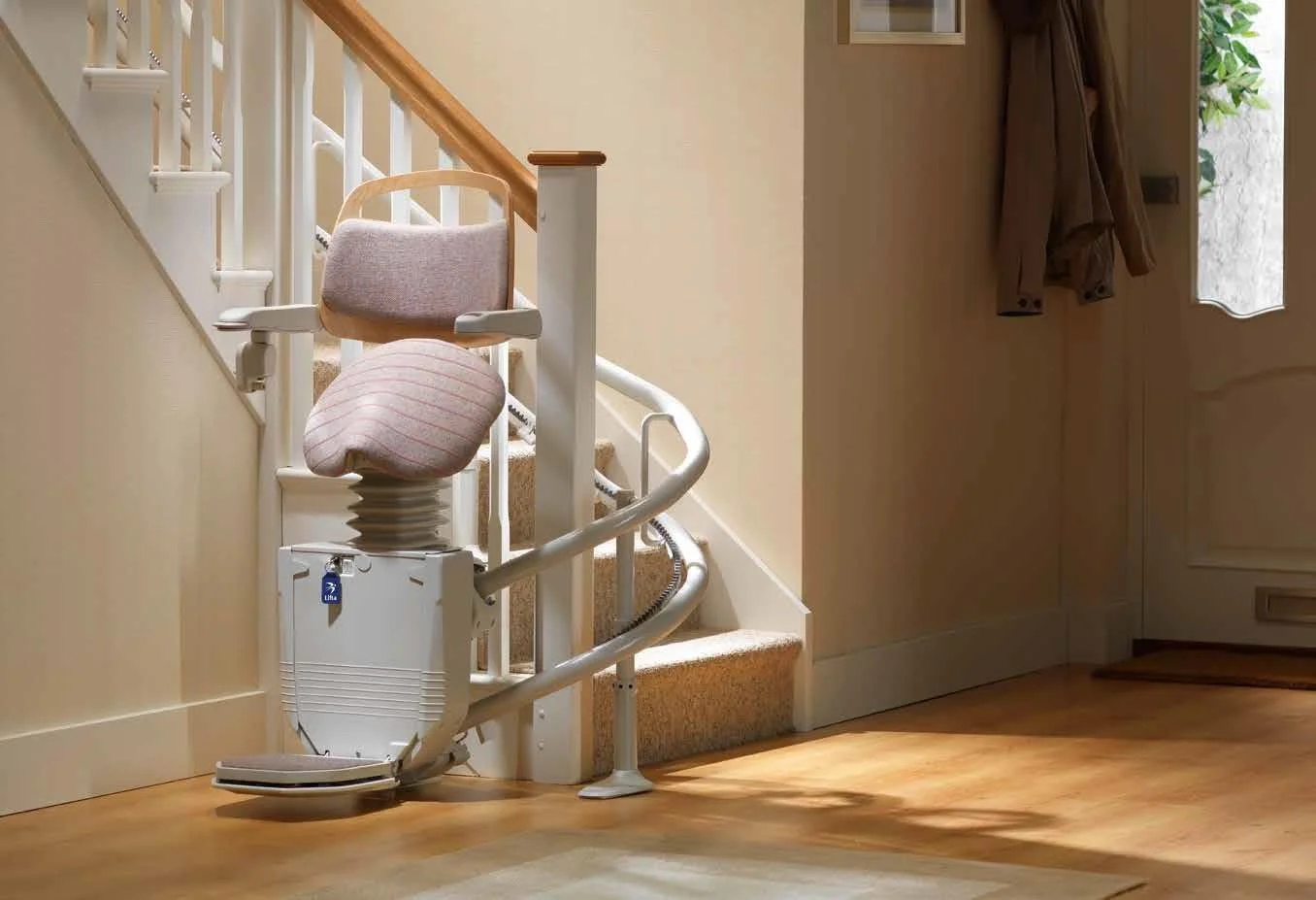
A cape or colonial in Hamden, Meriden or West Haven usually has a single straight flight to the upper floor. That is the simplest job for a stair lift. The rail mounts to the stair treads, not the wall, so plaster walls in an older house are not a problem.
Some older homes have a stair that turns at a landing or winds near the top. Those need a curved rail built to the exact shape of the staircase. We measure first, then tell you which type fits.
Row houses and townhouses in New Haven often stack living space over two or three floors, so a family may want a lift on more than one flight. Split-level homes are different. They have short runs of a few steps between levels, and each run is treated as its own small installation.
Walk-up apartments raise a separate question, because the stairs are often shared. A tenant generally needs the building owner to agree before anything is attached to a common stairway.
Trap-rock ridges stretch north from New Haven, and homes built on that sloped ground often have steps from the driveway or yard up to the front door. Along the shoreline in Milford, Branford and Guilford, homes may also sit up off the ground with a set of entry steps.
For those outside steps, an outdoor stair lift built to handle weather is one option. When someone uses a wheelchair and cannot transfer to a seat, a platform lift is usually the better fit.
Just 48.7% own their homes, which matters because most grants and loans for home changes expect you to own the house or have the owner's permission.
If you rent, talk with your landlord before you apply for anything. If you own, the programs below are worth checking before you pay out of pocket.
Two local options name stair lifts or home modifications directly. The Agency on Aging of South Central Connecticut says it helps identify and fund stair-glides, and the Connecticut Home Care Program for Elders lists minor home modifications for safety and accessibility.
Other programs cover lifts or accessibility in general terms, or offer loans. Veterans should know that the VA HISA grant does not pay for stair glides, so it is better used for things like an entrance ramp. Call the Agency on Aging at (203) 785-8533 first if you are not sure where to start.
A state program run by the CT Department of Social Services for residents 65 and older who need help with daily tasks, and its benefits include minor home modifications for safety and accessibility, which can cover a stair lift based on a needs assessment. Call (800) 445-5394.
The regional Area Agency on Aging helps older adults and people with disabilities find and fund home changes, and its own service page names stair-glides along with ramps and grab bars. Call (203) 785-8533.
A state Medicaid program that helps people move from a nursing home or other institutional setting back to community living; the source does not mention stair lifts or home modifications. Call (800) 445-5394.
A statewide nonprofit that funds accessibility work such as ramps, lifts and grab bars for income-eligible households with a member who has a disability; stair lifts are not named specifically. Call (860) 563-6011.
Loans of generally $500 to $30,000 for Connecticut residents with disabilities, or their family members, to buy assistive technology; the loan page does not mention stair lifts by name. Call (800) 537-2549.
Federal repair loans up to $40,000 and grants up to $10,000 for very low income owners in USDA-eligible rural areas, with grants for those 62 and older; stair lifts are not named, and most of this region is not USDA-eligible. Call (203) 269-6665 to check an address.
A VA grant of up to $6,800 or $2,000 lifetime for medically necessary home improvements, but it specifically excludes stair glides. Veterans here are served by the West Haven VA Medical Center.
VA grants for veterans with certain severe service-connected disabilities, up to $126,526 for SAH and $25,350 for SHA in FY2026; stair lifts are not specifically listed. Call (800) 827-1000.
Older adults
1 Long Wharf Drive, Suite 1L, New Haven, 06511
Veterans
291 South Lambert Road, Orange, 06477
Usually, yes. Most capes and colonials in the region have a straight interior flight, which takes a straight rail. If the stair turns at a landing, a curved rail is made to match it.
Its service page says it helps identify and fund stair-glides and that public funds are available for these modifications. The amount depends on what funds are available for each case. Call (203) 785-8533.
The state-funded part of CHCPE has no income limit, with asset limits of $48,798 for a single person and $65,064 for a couple in 2026. Applicants must be 65 or older and at risk of nursing-home placement.
No. HISA excludes stair glides and porch lifts. Veterans can call the New Haven Vet Center in Orange at (203) 795-0148 or the VA at (800) 827-1000 to ask about SAH and SHA grants.
Shared stairs belong to the building owner, so you need the owner's approval before an installation. Ask your landlord first, then contact the Agency on Aging about funding.
Most of this region, including the dense New Haven-area towns, is not USDA-eligible. Call (203) 269-6665 to check a specific address before you count on it.
Tell us about the stairs in your home and we will explain which lift fits, what it costs and how installation works.
