Many of the oldest houses in the Quiet Corner sit in former mill villages along the Quinebaug and Willimantic Rivers. In Putnam, the Cargill Falls Mill complex began in 1806 as the Pomfret Manufacturing Company, and its oldest surviving building dates to 1824. Homes built in that era, from Federal and Greek Revival houses to Victorian-era mill-owner houses, often have narrow, steep original staircases.
Those stairs are where we spend most of our time in this region. In places like Danielson, Moosup, Dayville and North Grosvenor Dale, a well-fitted stair lift can let someone keep using the bedroom and bath upstairs instead of moving out. This page covers what the local homes mean for the type of lift, and which Connecticut programs can help with the cost.
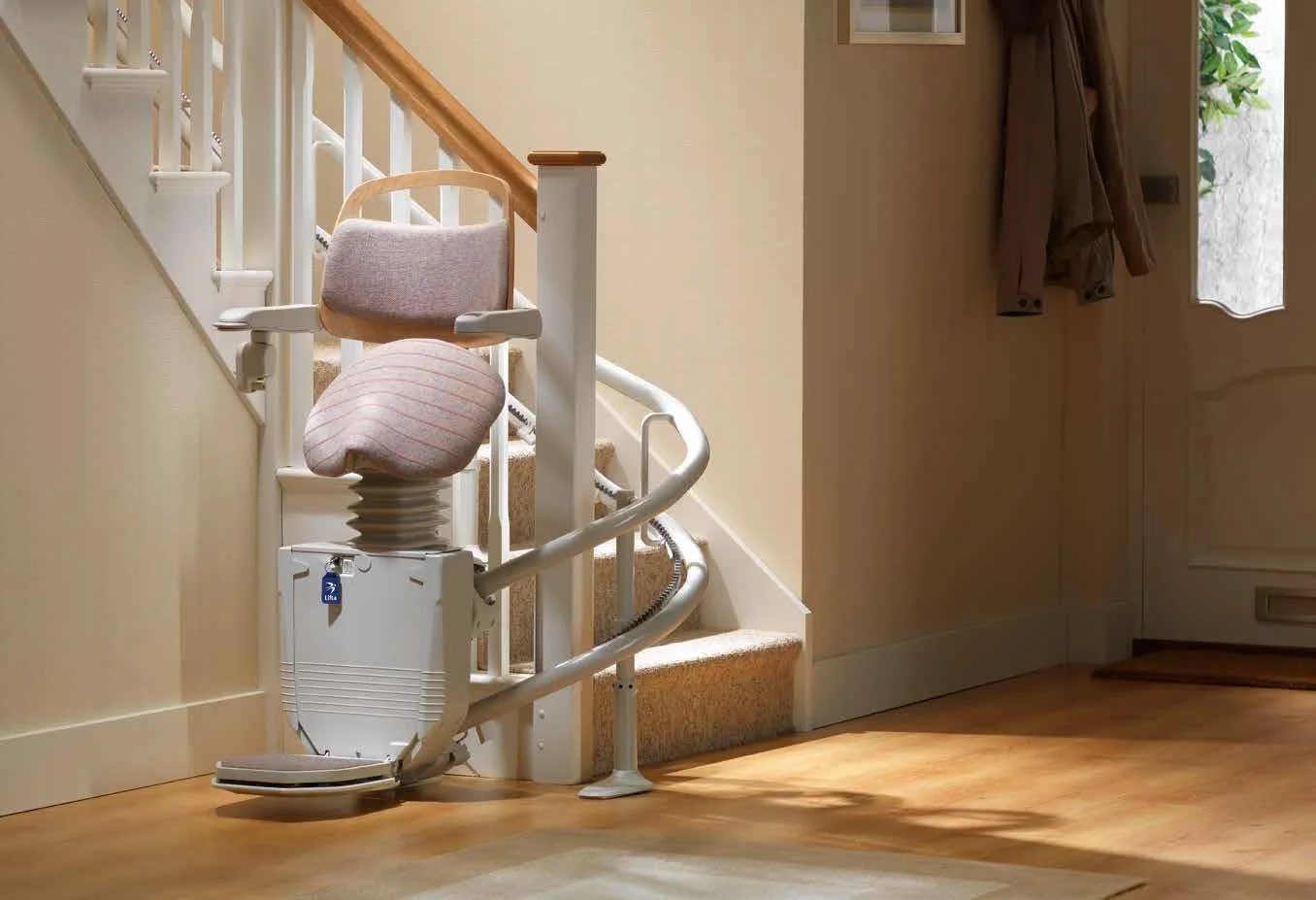
The historic districts in Putnam, Woodstock, Brooklyn, Thompson and Pomfret hold a dense stock of homes built from the 1820s through the early 1900s. Their staircases tend to be narrow and steep, so measuring the width and the angle comes first.
When the run goes straight from bottom to top, a straight rail is usually the simplest fit. Stairs that turn at a landing or wind partway up need a curved rail built to that staircase. We look at both before recommending either.
Not every home here is a 19th-century house. The region also has single-family homes, split-level homes, ranch-style homes, townhouses and walk-up apartments.
A split-level often has short flights between floors, and each one may need its own look. Ranch-style homes may have few interior steps but still have stairs to a basement or at the entry. In a walk-up apartment, the building owner usually has to agree before anything is mounted in a shared stairway.
The planning region covers about 553.9 square miles of rural, hilly land across 16 towns, including Killingly, Plainfield, Thompson and Woodstock. Low density means longer drives to medical care and to licensed contractors.
In the communities this page covers, 17.8% of residents are 65 or older and 60.2% own their homes. For many of those homeowners, adapting the house they already own is more practical than relocating, and a stair lift is often the piece that makes the upstairs usable again.
The region's economy moved from large textile mills toward small manufacturing, tourism, antiques and craft beverages. That shift means fewer employer benefit programs, so most families here look to state, federal and nonprofit sources.
Several Connecticut programs list lifts or home modifications as covered, including CHCPE, Money Follows the Person, the CIL grants and the CT Tech Act loan. Others, such as USDA Section 504 and town CDBG rehab rounds, do not name stair lifts, so call and ask before you count on them.
Be aware that the VA HISA grant explicitly excludes stair glides. The Connecticut Department Of Veterans Affairs office in Norwich can be reached at (860) 887-9162, and the Eastern CT Area Agency on Aging, also in Norwich, is at (860) 887-3561.
A state Medicaid home care waiver for residents 65 and older who meet nursing-home level of care; it lists Assistive Technology and Minor Home Modifications and Environmental Accessibility Adaptations as covered, with scope set by a care-plan assessment. Apply through the statewide line at (800) 842-4524.
Helps Medicaid recipients who have lived in a nursing home or other long-term care facility for at least 60 consecutive days move back home, and home modifications are an eligible transition cost. Call (888) 992-8637.
A statewide grant for Connecticut homeowners with a disability that funds ramps, exterior and interior lifts and other access work, generally $5,000 to $70,000 secured by a lien on the home. Applicants must first be denied other funding; call (860) 563-6011.
A low fixed-interest loan of $500 to $30,000 with 1-10 year terms, and stair glides or lifts are listed as eligible items. This is a loan, not a grant; call (860) 424-4881.
A Center for Independent Living serving people with disabilities, including older adults, in Windham County and Northeastern CT towns, by appointment. Stair lift coverage is not listed in current sources, so ask when you call (860) 823-1898.
The regional Area Agency on Aging for older adults, people with disabilities and caregivers, including the NECCOG towns; its program list does not name a stair lift grant of its own. Call (860) 887-3561 to ask about referrals and funding cycles.
Federal repair loans and grants for low-income owners in USDA-eligible rural areas, with grants for homeowners 62 and older limited to removing health and safety hazards; stair lifts are not named. Check your address on the USDA eligibility map and call (860) 887-3604.
State funds that towns under 50,000 people, which includes every NECCOG town, can use for housing rehab that principally benefits low- and moderate-income homeowners; stair lifts are not listed. Ask your town whether a rehab round is open and whether accessibility work qualifies.
A VA grant of up to $6,800 or $2,000 lifetime for medically necessary home changes, but it explicitly excludes stair glides, so it does not pay for a stair lift. It can cover items like permanent ramps or accessible bathrooms; call (860) 666-6951.
Larger VA grants for veterans with qualifying severe service-connected disabilities, up to $126,526 for SAH and $25,350 for SHA in FY2026; stair lifts are not named in current VA materials. Call (800) 827-1000.
Older adults
401 West Thames St., Suite 201, Norwich, 06360
Veterans
100 BroadwaynNorwich City Hall (Room 305), Norwich, 06360
Not through HISA, which explicitly excludes stair glides. SAH and SHA grants do not name stair lifts either, so call (800) 827-1000 to ask, or the Connecticut Department Of Veterans Affairs in Norwich at (860) 887-9162.
CHCPE requires age 65 or older, but other programs do not. The CT Tech Act loan is open to Connecticut residents of at least 1 year with a qualifying disability, and the CIL grants serve homeowners with a disability.
Money Follows the Person counts home modifications as a transition cost for Medicaid recipients who have been in a facility for at least 60 consecutive days. Call (888) 992-8637.
Often, yes. Many 19th-century homes in this region have narrow, steep staircases, and a straight or custom stair lift is often the practical way to keep using the whole house. A measurement visit settles which type fits.
CIL grants are secured by a lien against the home. Ask CIL at (860) 563-6011 how the lien works before you apply.
It may, if your address is in a USDA-eligible rural area. Section 504 grants for owners 62 and older are limited to health and safety hazards and do not name stair lifts, so call (860) 887-3604 to ask.
Tell us about the stairs in your home and we will explain which lift fits, what it costs and how installation works.
