From the Main Street Historic District in Middletown down to the river villages of Essex Village, Chester Center and Deep River Center, this part of Connecticut holds a lot of old staircases. Many of them sit inside 18th- and 19th-century multi-story period homes that were built long before anyone thought about aging in place.
Those colonial and Victorian stairs are often steep, narrow or turning, and they are the main reason families here call us. This page walks through how local homes affect the type of stair lift you need, and which programs in Connecticut may help cover the cost.
The Lower Connecticut River Valley Planning Region covers 424.1 square miles centered on the Connecticut River as it approaches Long Island Sound. It is run by the Lower Connecticut River Valley Council of Governments (RiverCOG) and replaced the former Middlesex County for statistical purposes.
That means some agencies and forms still say Middlesex County while newer ones use the planning region name. If a program asks for your county, ask which name they expect so your application is not held up.
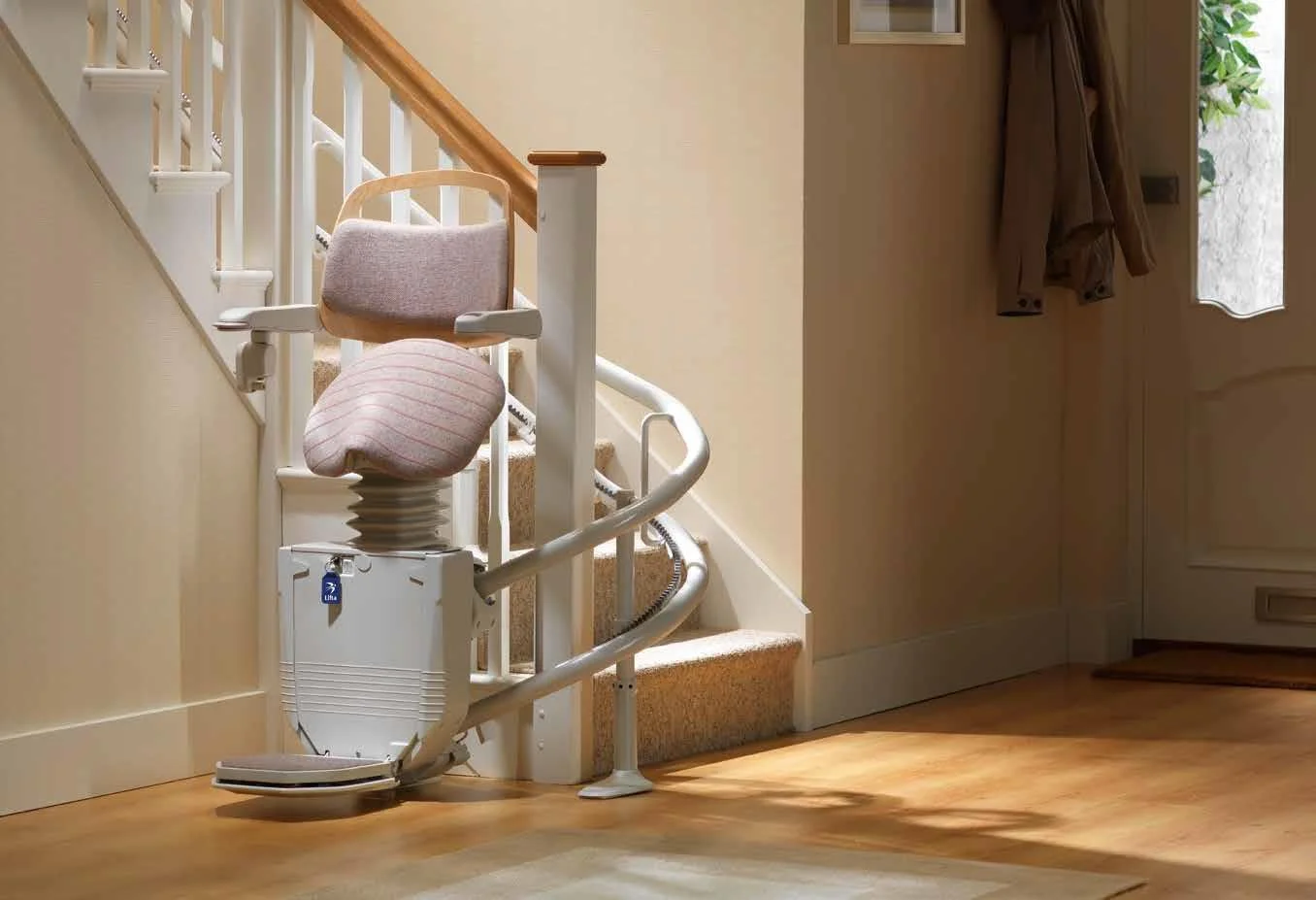
A period home in Essex Village or a Victorian near Middletown's Main Street often has a staircase that turns at a landing or winds at the top. Those stairs usually call for a curved rail, which is built to the exact shape of your steps.
Straight stairs are more common in later single-family homes, detached houses and townhouses across Higganum, Moodus and Westbrook Center. A straight rail is simpler to fit and usually comes together faster.
Split-level homes are their own case. The short runs of stairs between levels may need more than one lift, or a platform lift if a wheelchair has to go from one level to another.
Plenty of homes in towns like Old Saybrook Center and Saybrook Manor have steps up to the front door or down to a yard. An outdoor stair lift is built to handle Connecticut weather, and a platform lift can work where a wheelchair user needs to get in and out.
In walk-up apartments, the stairs are usually shared space. Before any measuring, the building owner has to agree to the installation, so talk with them first.
About 19.6% of residents in the region's towns are 65 or older, and 59.5% own their homes. Owning matters, because several grant and loan programs below are only open to homeowners.
For veterans, the Office of Advocacy and Assistance at 287 West Street in Rocky Hill can be reached at (860) 616-3685 for help sorting out VA benefits.
Only one program on our list names stair lifts directly: the Corporation for Independent Living, which lists a 'Stairglide' among the modifications it funds. Most others cover home modifications in general, so you will need to ask whether a stair lift counts.
Medicaid waivers like CHCPE and Money Follows the Person, a low-interest loan through the CT Tech Act Project, and USDA repair loans in rural areas are all worth a call. Statewide, also ask about Community First Choice (CFC) and the Homeowners' Elderly/Disabled Circuit Breaker Tax Relief Program.
Veterans should know that the VA HISA grant does not pay for stair lifts. Details on each program are listed below.
A state program run by the CT Dept. of Social Services for residents 65 and older at risk of nursing-home placement; it includes minor home modifications for safety and accessibility but does not name stair lifts. Call (800) 445-5394.
Helps Medicaid-eligible people who have been in a nursing facility or hospital for at least 60 consecutive days move home, and can include home modifications, though stair lifts are not named. Call (888) 992-8637.
Grants generally $5,000 to $70,000, secured by a lien on the home, for Connecticut homeowners with a disability; the application explicitly lists a 'Stairglide' among covered modifications. Call (860) 563-6011.
Loans of $500 to $30,000 at a fixed 4% to 4.5% interest for people with disabilities or older adults; home modifications for accessibility are fundable, but stair lifts are not named. Call (860) 876-9595.
Loans up to $40,000 at 1% for 20 years, and grants up to $10,000 for homeowners 62 and older who cannot repay a loan, in USDA-eligible rural areas; stair lifts are not named. Call (860) 902-5382 to check whether your address qualifies.
A VA grant of up to $6,800 or $2,000 lifetime for medically necessary home changes like entrance ramps and roll-in showers; it does not pay for stair lifts. Call (800) 827-1000.
Grants of up to $126,526 (SAH) or $25,350 (SHA) for veterans with certain severe service-connected disabilities to build or modify a home; stair lifts are not specifically listed. Call (800) 827-1000.
The Area Agency on Aging for towns including Middletown, Essex, Chester, Deep River, Old Saybrook, Westbrook, Haddam and East Haddam; it offers referrals and case management rather than a stair lift grant. Call (203) 785-8873 to ask about current minor-repair funding.
Low-interest loans for low- and moderate-income homeowners inside Middletown city limits, covering up to 100% of rehab cost on owner-occupied homes; stair lifts are not named, so confirm eligibility first. Call (860) 344-3425.
Offers assistive technology help and independent-living support rather than a fixed grant, and stair lifts are not listed; a directory shows Westbrook and Clinton among the towns it serves. Call (203) 934-7077 to confirm coverage for your town.
Older adults
1 Long Wharf Drive, Suite 1L, New Haven, 06511
Veterans
287 West Street, Rocky Hill, 06067
Usually, yes. Steep or turning stairs in 18th- and 19th-century homes like those in Essex Village typically need a curved rail built to the shape of the staircase, so we measure on site first.
The Corporation for Independent Living's Loans & Grants for Accessibility lists a 'Stairglide' among covered modifications. Grants generally run $5,000 to $70,000 for Connecticut homeowners with a disability. Call (860) 563-6011.
Not through the HISA grant, which excludes stair glides. The SAH and SHA grants fund home modifications for certain severe service-connected disabilities but do not list stair lifts, so call (800) 827-1000 to ask.
CHCPE requires age 65 or older, but the CT Tech Act loan is open to Connecticut residents with a disability who have lived in the state for at least 1 year. Family members can apply on the person's behalf. Call (860) 876-9595.
Homeowners inside Middletown city limits can ask about the CDBG Residential Rehabilitation Loan at (860) 344-3425. On the other hand, Middletown's denser core may not qualify for USDA rural repair loans, which are more likely to fit outlying towns.
Often, because each short run of stairs between levels is its own staircase. In some split-level homes a platform lift makes more sense, especially for a wheelchair user.
Tell us about the stairs in your home and we will explain which lift fits, what it costs and how installation works.
