From the row houses of Bridgeport to single-family homes in Trumbull Center, Long Hill and Stepney, a lot of staircases in this part of Connecticut were built long before anyone thought about aging in place. The region runs from the Long Island Sound shoreline at Lordship and Stratford Point to quieter inland places like Easton, Monroe and Tashua.
This page explains what that mix of old housing and coastal and inland terrain means for fitting a stair lift, and which local, state and federal programs may help with the cost. If you are helping a parent stay in their home in Fairfield, Stratford, Southport or Bridgeport itself, start here before you call anyone.
Greater Bridgeport has one of Connecticut's oldest housing stocks. In Bridgeport, 64% of homes were built before 1960 and 35% before 1940, which puts the region among the nation's oldest midsize-metro housing markets.
Many of these are multi-story homes with the interior stairs they were built with. Those stairs are often the reason a family starts looking at a lift in the first place.
Age also matters during installation. Older wiring and framing can affect how and where a lift is mounted and powered, so we look at the stair, the wall and the nearest outlet before giving you a plan.
The region's homes include single-family homes, townhouses, row houses, walk-up apartments and low-rise buildings. A single straight run of stairs usually takes a straight stair lift, which is the simplest type to fit.
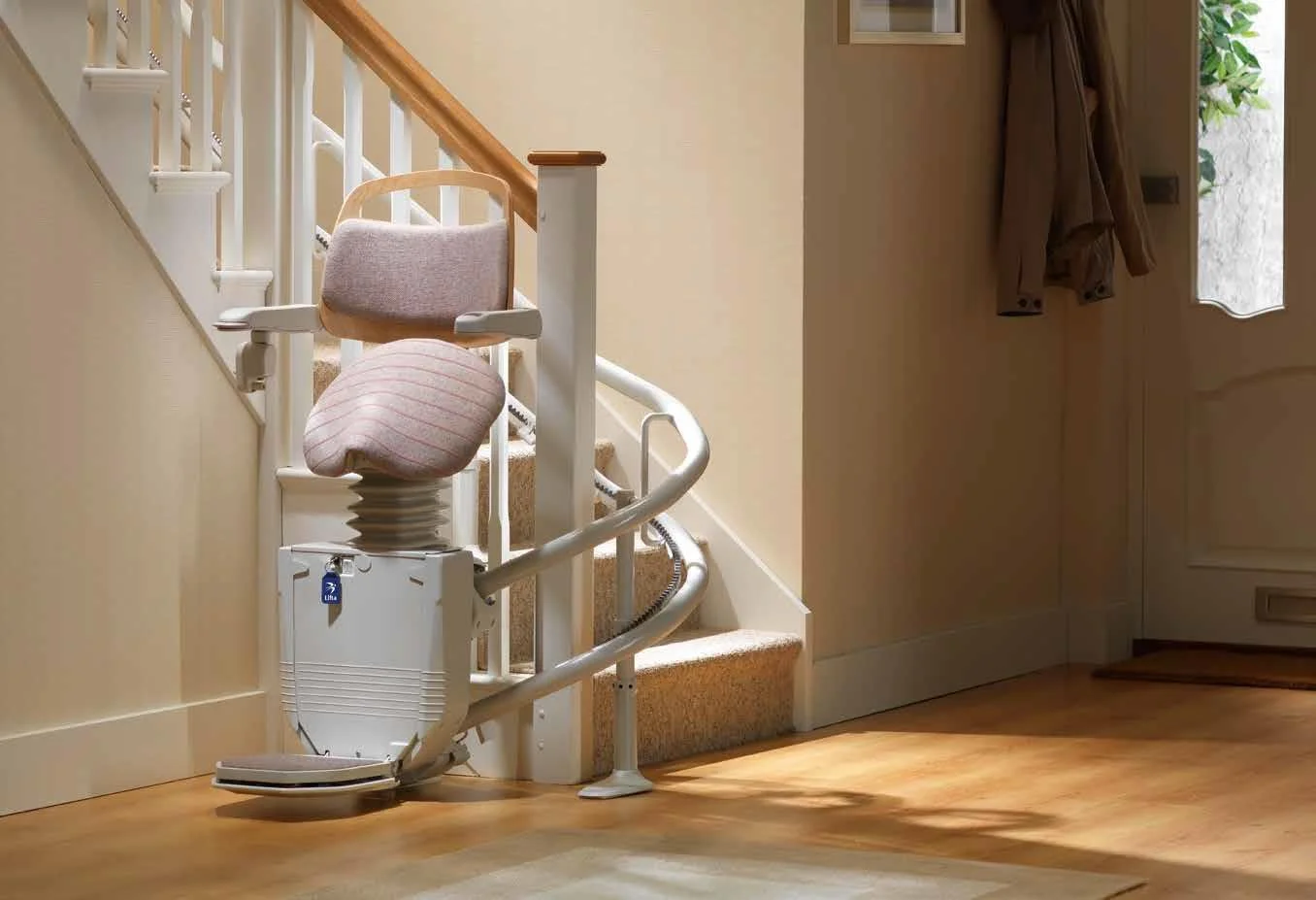
Stairs with a turn, a landing or a winding section need a curved lift built to that staircase. Front steps or a porch can call for an outdoor lift, and someone who uses a wheelchair may be better served by a platform lift.
The split between the dense Bridgeport waterfront core and the lower-density towns of Easton, Monroe and Trumbull shows up at the front door too. City row houses and walk-ups tend to have interior stairs only, while suburban homes may add entry steps outside. If you rent in a walk-up apartment, talk with the building owner before any installation.
Both groups have their own paths to help, covered in the program list below.
Across the region, 54.5% of households own their home. In Bridgeport the homeownership rate is 42.8%, and several funding programs require you to own the home, so that detail matters when you compare options.
Income varies sharply across the region. Bridgeport's median household income is $58,685 with a 21% poverty rate, well below the wider Fairfield County average, so some families pay out of pocket while others need a loan, grant or Medicaid-based help.
Two programs on this page clearly list stair lifts: the Connecticut Assistive Technology Loan Program, which is a loan you repay, and AccesSolutions grants through the Corporation for Independent Living, which have very limited funds right now. Others cover home modifications or accessibility without naming stair lifts, so ask directly.
A good first call is the Southwestern CT Agency on Aging at 2 Lafayette Square, Bridgeport, (203) 333-9288. They can point you toward programs that fit your situation. Statewide, you may also hear about Community First Choice (CFC) and the Homeowners' Elderly/Disabled Circuit Breaker Tax Relief Program.
The VA HISA grant does not pay for stair lifts. The VA page lists stair glides as excluded removable equipment, so plan on another source for the lift itself.
The larger SAH and SHA grants do not name stair lifts either way. For local help sorting out benefits, the Veterans Affairs office at 20 Thorme Street, Bridgeport, can be reached at (203) 576-8348.
A lifetime grant of $6,800 for service-connected disabilities or $2,000 for non-service-connected qualifying disabilities, for permanent changes like ramps and roll-in showers. It explicitly excludes stair lifts; call (800) 827-1000.
Larger grants for veterans with severe service-connected disabilities who own or will own the home, up to $126,526 for SAH and $25,350 for SHA on a permanent home. The source does not mention stair lifts; call (800) 827-1000 to ask.
A state loan for Connecticut residents of at least 1 year with a disability, and also open to older adults, that lists stair glides or lifts among eligible modifications. It must be repaid at rates based on income; call (800) 537-2549.
The area agency on aging for all of Greater Bridgeport, helping with Medicare, Medicaid and home-based services. It does not list its own stair lift funding, but it is the place to start for referrals; call (203) 333-9288.
Home care services for Connecticut residents 65 and older at risk of nursing home placement, with Medicaid and State-funded tiers. It lists assistive technology but does not name stair lifts; call (855) 744-4488.
Helps Medicaid-eligible people who have lived in a nursing home or long-term care facility for at least 60 consecutive days move back home, including home modifications. Stair lifts are not named specifically; call (888) 992-8637.
A no-interest, forgivable loan for income-eligible homeowners in the City of Bridgeport only, with Handicap Accessibility among its repair categories and priority for seniors and people with disabilities in neighborhoods such as the Hollow, East Side and South End. Stair lifts are not named; call (203) 576-8144.
Grants generally from $5,000 to $70,000, secured by a lien, for low-to-moderate income Connecticut homeowners with a disability, and interior lifts are among fundable equipment. Funding is extremely limited at this time, so call (860) 563-6011 to check availability.
Repair grants up to $10,000 for very-low-income owners 62 or older and loans up to $40,000 at 1% over 20 years, only in USDA rural-designated areas, which likely excludes the City of Bridgeport. Stair lifts are not named; call (413) 253-4300.
Older adults
2 Lafayette Square, Bridgeport, 06604
Veterans
20 Thorme Street, Bridgeport, 06606
Often, yes, but older wiring and framing can affect installation planning. That is why we check the staircase, the wall and the power source in the home before recommending a lift.
The HISA grant does not; it excludes stair glides. SAH and SHA grants do not name stair lifts either way, so call (800) 827-1000 or the local Veterans Affairs office at (203) 576-8348 to ask about your case.
The Connecticut Assistive Technology Loan Program lists stair glides or lifts, but it is a loan you repay, reached at (800) 537-2549. AccesSolutions grants list interior lifts, though funding is extremely limited right now; call (860) 563-6011.
The City of Bridgeport Homeowner Rehabilitation Program offers no-interest, forgivable loans to income-eligible homeowners whose taxes and WPCA assessments are current, with Handicap Accessibility as a repair category. Call (203) 576-8144 to ask whether a lift would qualify.
Possibly. Section 504 only applies in USDA rural-designated tracts, and some lower-density parts of the region may qualify while the City of Bridgeport likely does not. Check your exact address with USDA before counting on it.
The Southwestern CT Agency on Aging at (203) 333-9288 covers Bridgeport, Easton, Fairfield, Monroe, Stratford and Trumbull. They can steer you to programs like CHCPE and the state loan program.
Tell us about the stairs in your home and we will explain which lift fits, what it costs and how installation works.
