Teller County sits on the western slope of Pikes Peak, and its homes reflect that ground. From Woodland Park, the county's most populous city, to the old gold-mining towns of Cripple Creek and Victor, houses are often built into slopes. That means stairs inside, steps outside, and sometimes both.
The county was established in 1899 out of the Cripple Creek gold boom, so a lot of the housing here is older. Split-level layouts are common on the mountain lots. If someone in your family is finding those stairs harder each year, this page walks through what kind of lift fits a Teller County house and where to look for help paying for it.
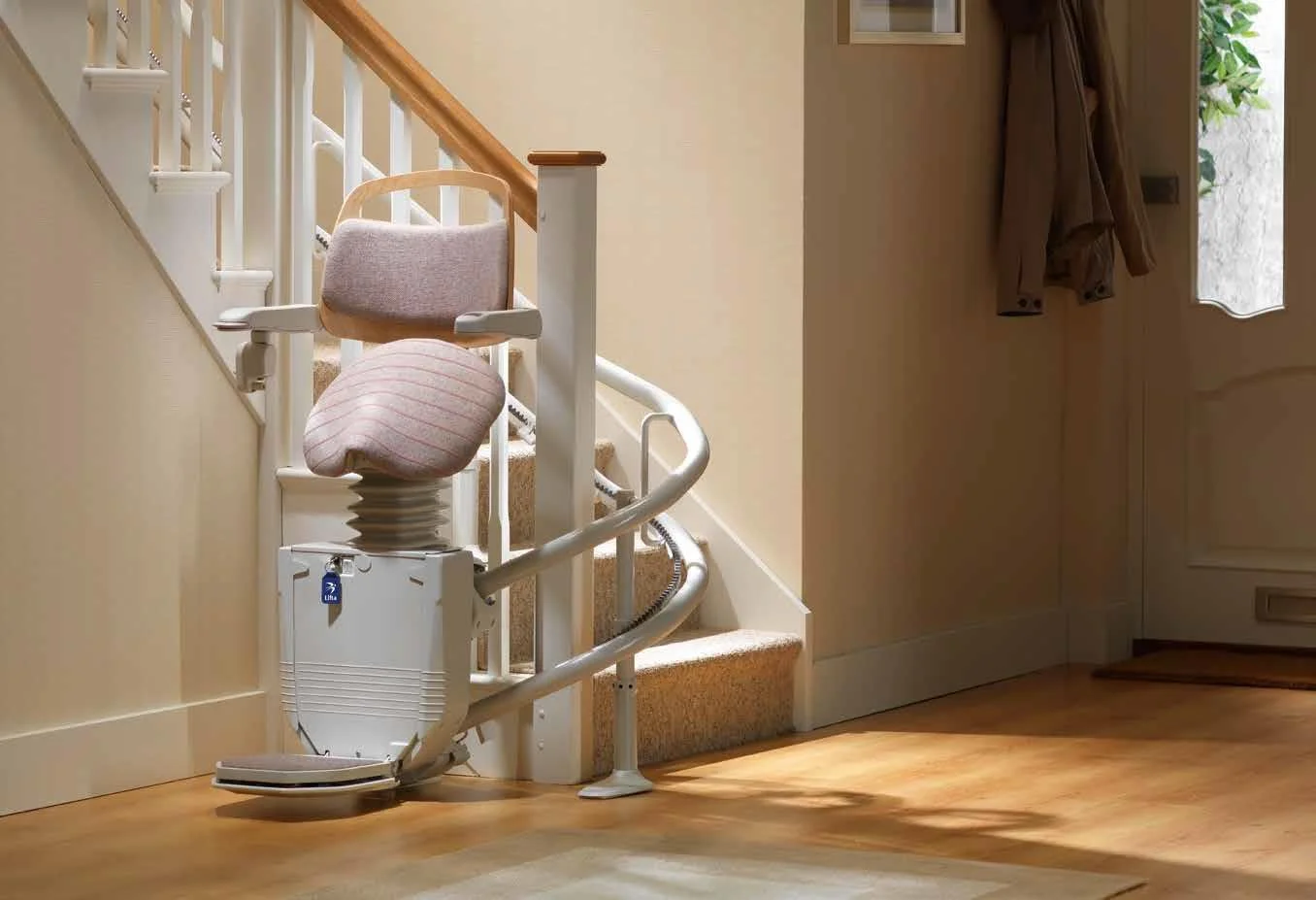
Teller County covers about 559 square miles of rugged, mountainous country with narrow valleys. Builders here worked with the slope, which is why split-level homes show up so often. A split-level usually has several short flights instead of one long one, and each flight needs its own look.
A short, straight run of a few steps is often the simplest install. Where a flight turns at a landing, or where two flights connect, a curved rail built to the exact shape of the stairs may be the better answer. We measure each flight before recommending anything.
Mining-era towns tend to have older houses, and older stairs are not always uniform. Steps can be steep or narrow, and walls may not be square. None of that rules out a stair lift, but it does mean the rail has to be fitted to what is actually there.
Many homes also have steps up to the front door because of the grade. For those, an outdoor stair lift or a platform lift can be worth discussing, especially if a wheelchair is part of the picture.
About 73.9% of Teller County households own their homes, and 23.1% of residents are 65 or older. Many people want to stay in the house they already own.
Local officials and casino operators have pointed to a persistent housing shortage in the county. With fewer single-level or accessible homes on the market, adapting the stairs you have can be more practical than trying to find a ranch-style house to move into.
No program in our list names stair lifts as a guaranteed covered item, so it pays to ask the right questions. Health First Colorado home modification benefits and USDA Section 504 help may be worth asking about, and the Pikes Peak Area Agency on Aging is a good first call to sort out options.
Be aware that the VA HISA grant explicitly excludes stair glides, while the SAH and SHA grants are decided case by case. Teller County Veteran Services in Woodland Park can help with VA paperwork at (719) 686-5526.
Statewide, you can also look into the Assistive Technology Act Program of Colorado (AT Partners) and the Colorado Senior Property Tax Exemption (Senior Homestead Exemption). A lower tax bill does not pay for a lift directly, but it can free up room in the budget.
A Medicaid waiver benefit that pays for ramps, grab bars, bathroom conversions and similar changes; stair lifts are not named, so ask your case manager whether one can be approved as medically necessary equipment. Call (800) 221-3943.
A VA grant of up to $6,800 or $2,000 for disability-related home changes like ramps and roll-in showers. It explicitly excludes stair glides and porch lifts, so it will not cover a stair lift.
Larger VA grants for veterans with qualifying severe service-connected disabilities who own or will own the home. The VA source does not mention stair lifts; covered adaptations are decided case by case with a VA Regional Loan Center.
Repair loans up to $40,000 and grants up to $10,000 for very-low-income rural homeowners, with grants limited to those 62 and older; much of Teller County, including Cripple Creek, Divide and Florissant, qualifies as rural. Stair lifts are not named but may fit as an accessibility fix for a safety hazard, so contact the local USDA Rural Development field office.
The Area Agency on Aging for El Paso, Teller and Park counties, serving adults typically 60 and older and their caregivers with referrals and case management. It does not name a stair lift benefit but can point you toward home modification funding; call (719) 471-2096.
A Divide-based nonprofit whose handyman program installs grab bars and railings for Teller County older adults; stair lifts are not mentioned. Its meal delivery, transportation and heating or rent assistance may ease a household budget; call (719) 687-3330.
Older adults
15 S. 7th Street, Colorado Springs, 80905
Veterans
800 Research Drive, Suite 230, Woodland Park, 80863
Usually, yes. Split-levels have several short flights, and each one is measured on its own. A short straight flight is often simple, while a flight with a turn may need a curved rail.
The HISA grant does not; it explicitly excludes stair glides. The SAH and SHA grants do not list stair lifts either, but adaptations are decided case by case. Teller County Veteran Services at 800 Research Drive, Suite 230 in Woodland Park, (719) 686-5526, can help you ask.
The Health First Colorado home modification benefit does not name stair lifts. Ask your case manager whether one can be approved as medically necessary equipment, or call (800) 221-3943.
USDA Section 504 loans are for very-low-income rural homeowners, but the grants require age 62 or older and an inability to repay a loan. Check your address on the USDA eligibility site and contact the local Rural Development office.
The Pikes Peak Area Agency on Aging at (719) 471-2096 serves Teller County and can connect you with case management. The Teller Senior Coalition at (719) 687-3330 is another local contact for in-home support.
Outdoor stair lifts and platform lifts are both options for steps up to a door. We look at the steps, the grade and whether a wheelchair is involved before suggesting one.
Tell us about the stairs in your home and we will explain which lift fits, what it costs and how installation works.
