Salida holds Colorado's largest National Register historic district, with Victorian-era commercial buildings and period homes like the Alexander House. Head out past Buena Vista or Poncha Springs and the picture changes to ranch homesteads and houses set on sloped mountain lots. Both kinds of homes tend to have raised entries, front steps or several floor levels.
Those layouts are why stair lifts come up so often here. This page walks through how Chaffee County homes and terrain affect the type of lift that fits, and which local, state and federal programs are worth a call before you pay out of pocket.
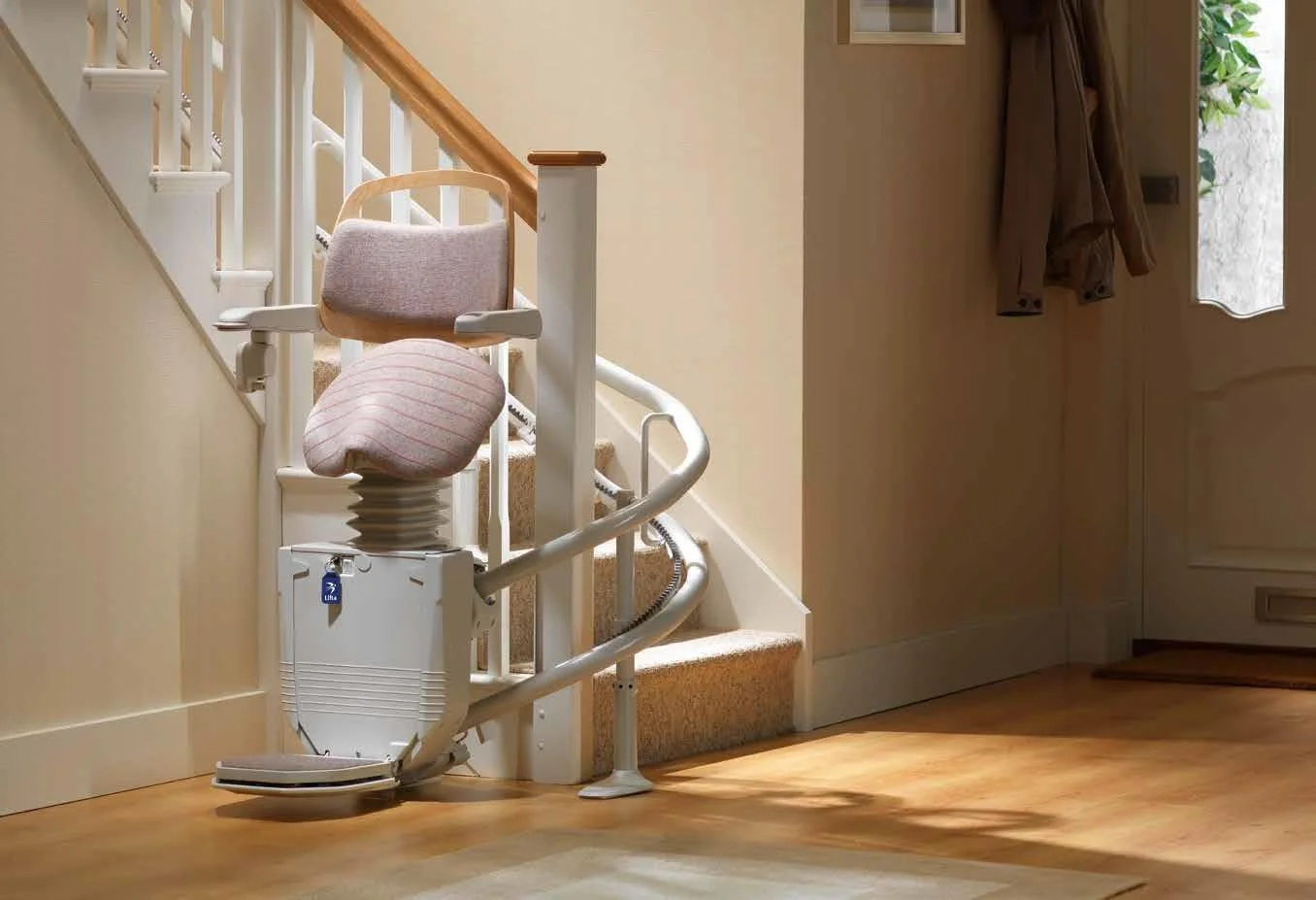
Older multi-story houses in and around Salida's historic core often have stairs that turn, narrow at a landing or climb straight up from a front hall. A straight staircase with no turns usually takes a straight stair lift, which is the simplest to fit.
Stairs that curve or change direction at a landing need a curved lift with a rail built to that exact staircase. We measure the stairs in person so the rail follows the treads and clears doorways and railings.
Split-level homes are common in the county, and they often have short runs of stairs between each level. Each run is its own question, so we look at which floors you actually need to reach every day, usually the bedroom, bathroom and kitchen.
Townhouses and walk-up apartments bring their own limits. Renters and owners in shared buildings should check with the building owner or association before any rail goes on a wall or stair.
Chaffee County covers about 1,013 square miles of the Upper Arkansas River valley, with San Isabel National Forest inside the county. Off the flatter valley floor around Salida, many homes sit on sloped ground, so the climb from the driveway to the front door can be as hard as the stairs inside.
For that grade change, an outdoor stair lift built for weather can run along exterior steps. If the person uses a wheelchair and cannot transfer to a seat, a platform lift is the option to discuss instead.
A Chaffee County Community Foundation initiative called Places to Age reports that over 5,400 county residents are 65 or older, a number projected to exceed 8,000 by 2050. The same initiative states the county has no assisted living or memory care facility.
That means many families plan on staying in the house they already have. With 57.3% of county households owning their homes, changes like a stair lift are often a practical way to keep using every floor.
No single program here is confirmed to pay for a stair lift by name, so it helps to call a few. Colorado's Medicaid EBD waiver covers home accessibility modifications in general, and your local Case Management Agency can tell you whether a stair lift qualifies in your case.
The Chaffee County Veterans Service Office at 448 E. 1st Street, Suite 134, Salida, can be reached at (719) 239-4678 to sort through VA grants. For residents 60 and older, the Upper Arkansas AAA in Canon City answers at (719) 275-8350.
Statewide resources to ask about include the Assistive Technology Act Program of Colorado (AT Partners) and the Colorado Senior Property Tax Exemption (Senior Homestead Exemption). Each program is summarized below.
This Medicaid waiver lists Home Accessibility Modifications and Adaptations as a covered service for people who meet nursing facility level of care and Medicaid financial rules, but stair lifts are not named in the source. Call (800) 221-3943 or your local Case Management Agency to confirm whether a stair lift is covered.
HISA offers up to $6,800 lifetime for service-connected disabilities, or $2,000 for other non-service-connected disabilities, for medically necessary home changes. It does not cover stair lifts, since removable equipment such as stair glides and porch lifts is excluded.
SAH provides up to $126,526 (FY2026 maximum) for veterans with severe service-connected disabilities who own or will own the home. The source does not mention stair lifts, so ask the Chaffee County Veterans Service Office at (719) 239-4678 about your situation.
SHA provides up to $25,350 (FY2026 maximum) for veterans or qualifying family members with certain service-connected disabilities who own or will own the home. Stair lifts are not mentioned in the source, so confirm with the county veterans office.
Very-low-income homeowners in USDA-eligible rural areas can get loans up to $40,000 at 1% for 20 years, and homeowners age 62+ who cannot repay a loan can get grants up to $10,000. Stair lifts are not mentioned in the source, and you need to check your address on the USDA eligibility map.
Residents 60 or older in Lake, Chaffee, Custer or Fremont County can get a voucher up to $200.00 toward home accessibility items such as ramps and hand rails; stair lifts are not named. Call (719) 539-3341.
This service provides up to $600.00 toward home repairs, maintenance and yard work for residents 60 or older in the region; stair lifts and accessibility installations are not mentioned. Call (719) 539-3341.
CFI serves people of any age, disability type or income in Chaffee, Lake, Gunnison and Hinsdale counties with no-charge information, advocacy, peer support and a DME program. Stair lifts are not named in the source; call (970) 241-0315 to ask.
Older adults
3224 Independence Rd., Canon City, 81212
Veterans
448 E. 1st Street, Suite 134, Salida, 81201
The EBD waiver covers home accessibility modifications and adaptations, but the source does not name stair lifts. Call (800) 221-3943 or your local Case Management Agency to find out if a stair lift qualifies for you.
No. HISA specifically excludes removable equipment such as stair glides and porch lifts. The SAH and SHA grants do not name stair lifts either, so it is worth asking the Chaffee County Veterans Service Office at (719) 239-4678.
Yes. The Upper Arkansas Area Agency on Aging offers a DME voucher up to $200.00 and a Chore Service up to $600.00 for Chaffee County residents 60 and older. Neither names stair lifts, and proof of income is typically required. Call (719) 539-3341.
Many homes outside the valley floor around Salida have this problem. An outdoor stair lift can run along the exterior steps, and a platform lift is the choice to consider if the person cannot move from a wheelchair to a seat.
Most of the county is small-town and rural, so many addresses are likely eligible, but you must check your specific address on the current USDA eligibility map. Income must also be below 50% of area median.
Usually, yes. Stairs that turn or have a landing need a curved lift with a custom rail, while a straight run takes a straight lift. We measure the staircase in person before recommending either.
Tell us about the stairs in your home and we will explain which lift fits, what it costs and how installation works.
