Broomfield did not grow the way most Colorado towns did. Broomfield Heights began in 1955 as a master-planned 'model city' along the new Denver-Boulder Turnpike, and the subdivisions that followed filled in through the 1990s and beyond. That history shapes the stairs you find here: ranch homes on one level, two-story tract homes with a full interior staircase, and split-level homes with short runs between floors.
Today Broomfield is a consolidated city and county, Colorado's smallest by area at 32.968 square miles of land, sitting at 5,348 feet between Denver and Boulder. This page walks through what Broomfield homes usually need in a stair lift and which programs may help cover the cost.
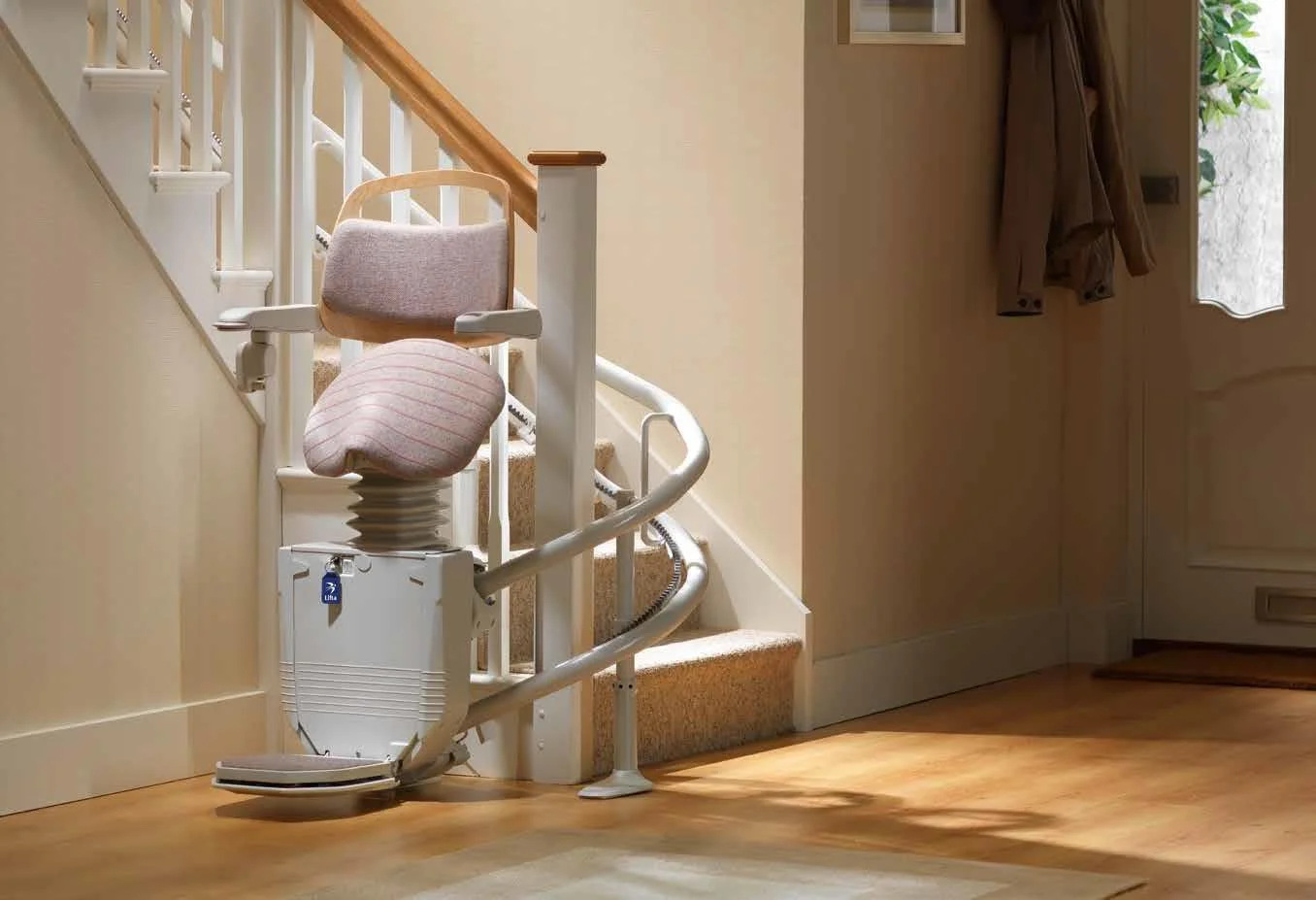
Most housing in Broomfield is mid-century-and-later suburban construction, not older urban-core homes. A single-story ranch may need no interior lift at all, though a basement stair can still be a problem. A two-story tract home with one straight staircase is usually the simplest install, with a rail that runs along the stair treads.
Split-level homes are different. The short flights between levels sometimes turn or meet at a landing, and that can mean a curved rail or a separate lift for each run. Townhouses often have narrow stairs, so we measure width and the space at the top and bottom before recommending a model.
Broomfield has a cold semi-arid climate on the plains. If the trouble is the steps up to the front door or down from a deck, an outdoor-rated lift or a vertical platform lift may make more sense than an indoor unit. Platform lifts also work for someone who uses a wheelchair and cannot transfer to a seat.
Walk-up apartments and low-rise buildings raise another question: who owns the stairs. Shared stairways usually need the building owner's approval, so it helps to ask early. About 62.6% of Broomfield households own their home, and owners have the most freedom to install.
Broomfield's population is about 75,110, and 15.1% of residents are 65 or older. Many of those homeowners bought two-story houses during the area's postwar-through-1990s growth and now find the stairs harder each year.
The Broomfield Veteran Service Office at 100 Spader Way, Broomfield 80020, can be reached at (720) 887-2263 to help sort out which VA benefits apply.
Median household income here was $125,055 in the 2024 estimate, yet many families still combine private funds with outside help. The clearest public source is the Colorado Medicaid EBD waiver, which explicitly lists stair lifts and vertical platform lifts as covered home modifications.
VA options are mixed. The HISA grant specifically excludes stair glides, and the SAH and SHA grants do not name stair lifts. Local options include the City and County of Broomfield Home Rehab Program and the Home Builders Foundation of Metro Denver, both of which fund accessibility modifications in general terms. Details for each program are listed below.
For general guidance, the Denver Regional Council of Governments AAA is at (303) 455-1000, 1001 17th Street, Suite 700, Denver 80202.
Stair lifts and vertical platform lifts are explicitly covered for eligible Health First Colorado members; projects under $2,500 can be approved by a case manager, while larger ones need Department authorization and an OT/PT evaluation. Some EBD benefits moved to Community First Choice on July 1, 2025, so confirm with a local Case Management Agency or call (800) 221-3943.
A VA grant of up to $6,800 or $2,000 lifetime for medically needed home changes such as ramps and roll-in showers. Stair glides and porch lifts are specifically excluded, so it does not cover a stair lift.
Up to $126,526 (FY2026 maximum) for veterans with qualifying severe service-connected disabilities who own or will own the home. The source describes ramps and widened doorways but does not mention stair lifts.
Up to $25,350 (FY2026 maximum) to adapt a home owned by a veteran or family member with certain service-connected disabilities. Stair lifts are not named on the source.
Repair loans up to $40,000 and grants up to $10,000 for very low income homeowners, with grants limited to age 62+; accessibility changes are covered but stair lifts are not named. Broomfield is almost entirely an ineligible urban area, so check your address on the USDA eligibility map first.
Information, options counseling and case management for adults 60+ and adults with disabilities, including in the City and County of Broomfield. It can refer you to home-modification resources but does not list a stair lift benefit; call (303) 480-6700.
A non-refundable state income tax credit of up to $5,000 per person with a disability for qualifying modifications made in tax years 2019 through 2028, claimed after costs are paid and a credit certificate is issued by the Colorado Division of Housing. Stair lifts are not itemized; questions can go to [email protected].
A nonprofit that provides accessibility home modifications for homeowners with financial need in an 8-county area that includes Broomfield, subject to available funds. Stair lifts are not named on its program page; call (303) 551-6721.
Funds repairs and accessibility modifications for Broomfield single-family and mobile homeowners with income up to 80% of area median income; stair lifts are not named specifically. Apply at brothersredevelopment.org or call (303) 685-4225.
Older adults
1001 17th Street, Suite 700, Denver, 80202
Veterans
100 Spader Way, Broomfield, 80020
It can. The EBD waiver's Home Accessibility Modifications benefit explicitly lists installing stair lifts or vertical platform lifts. You must be enrolled in a qualifying waiver, and work done before Department approval is not covered.
The HISA grant specifically excludes stair glides. The SAH and SHA grants do not name stair lifts, so call the Broomfield Veteran Service Office at (720) 887-2263 to ask what may apply to you.
Often not for daily living, since ranch homes are single-story. If you have a basement stair or steps at the entry, an indoor lift or an outdoor or platform lift may still help.
Most Broomfield addresses will not qualify because the county is almost entirely classified as urban under USDA rules. Check your exact address on the current USDA eligibility map before applying.
The City and County of Broomfield Home Rehab Program, run through Brothers Redevelopment, serves homeowners with income up to 80% of area median income and includes accessibility modifications. Call (303) 685-4225.
Yes. The DRCOG Aging and Disability Resource Center serves Broomfield residents age 60+ with options counseling and referrals. Call (303) 480-6700.
Tell us about the stairs in your home and we will explain which lift fits, what it costs and how installation works.
