Montgomery County has two towns, Montgomery and Pike Road, and a housing stock that spans nearly two centuries. Greek Revival cottages such as the 1854 Wharton-Chappell House and Queen Anne homes like the 1890 Mills House sit in historic districts. Single-story brick ranch homes fill the postwar neighborhoods.
That range matters when someone starts having trouble on the stairs. An older in-town home often still has its original interior staircase, which is where a stair lift does its work. A ranch house may have no indoor stairs at all, so the question shifts to entry steps. This page walks through what fits each kind of home and where county residents can look for help paying for it.
Federal-style mansions, Greek Revival cottages, Queen Anne homes and Neo-Classical Revival estates like the 1907 Governor's Mansion were built as multi-story houses. Many still have their original interior staircases, and those stairs are a common reason families call about a retrofit.
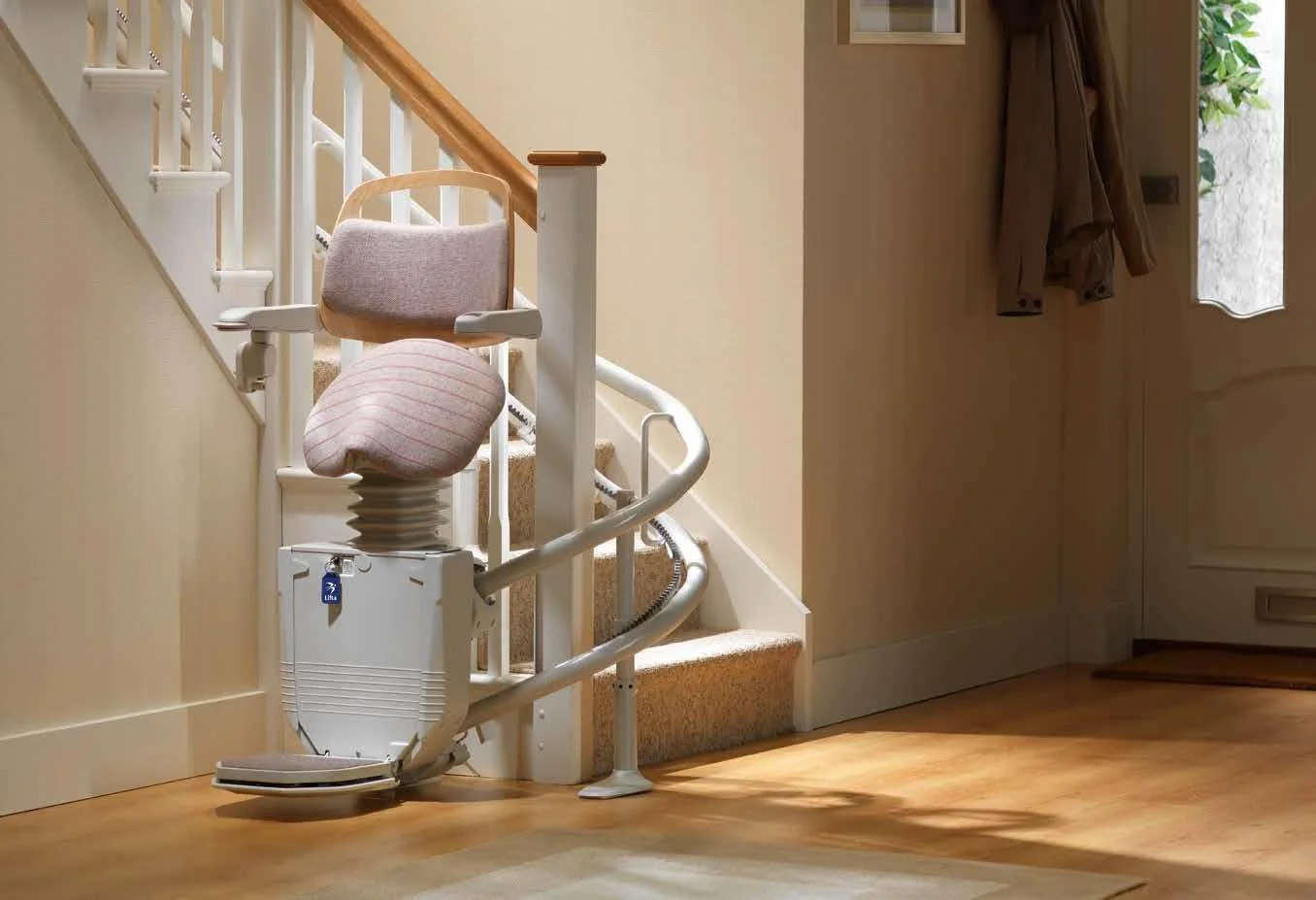
A straight staircase with no landing usually takes a straight stair lift, which mounts to the treads rather than the wall. Stairs that turn, wind or stop at a landing need a curved rail built to that staircase. We measure the stairs in person before recommending either one, because older stairs rarely match a standard layout.
Much of the suburban housing built from the 1950s onward is single-level ranch construction. In those homes the challenge is usually the few steps at the front or back door, and an outdoor lift or a platform lift may be the better fit than an indoor stair lift.
Split-level homes are different. Short runs of stairs between levels can each take a straight lift, or a curved rail if the run turns. Townhouses often have a full flight inside, which is typically a straight lift. Walk-up apartments and low-rise buildings involve shared stairs, so the building owner has to be part of the conversation before anything is installed.
Montgomery County has 208,543 residents, and 15.4% are 65 or older. About 55.8% of households own their home, which matters because most installations and many assistance programs depend on ownership.
If that includes you or a parent, read the VA program details below carefully, since not every VA grant pays for a stair lift. The Montgomery/Bullock/Lowndes County Veterans Service Office at (334) 832-1392 can help sort out which benefits apply.
Two Alabama Medicaid sources explicitly name stair lifts: the SAIL Waiver and the home modification services under the Community Waiver Program, ID Waiver and LAH Waiver. The E&D Waiver, which most seniors use, covers home modifications as a category but the source reviewed does not mention stair lifts.
For many families the first call is the Central Alabama Aging Consortium at (334) 240-4680, located at 4400 South Court Street in Montgomery. It is the local intake point for the E&D Waiver and other in-home aging services. Homeowners with low incomes can also look at Rebuilding Together Central Alabama and the USDA Section 504 program.
Other statewide options worth asking about include the Alabama Community Transition (ACT) Waiver, the Alabama Ability Loan Program (STAR / Southern Disability Foundation), and the Alabama Senior / Disabled Homestead Exemption (H-2 / H-3). Each program is listed below with what the source says about coverage.
A Medicaid waiver for people 65 and older, or younger with a qualifying disability, who meet a nursing-facility level of care; home modifications are a covered category, but the source does not mention stair lifts. Apply through the Central Alabama Aging Consortium or call (877) 425-2243.
Administered by the Alabama Department of Rehabilitation Services for older adults and adults with disabilities who need an institutional level of care. The source explicitly lists stair lifts among home modifications it can fund.
For enrolled participants in these three waivers, stair lifts, transfer equipment and handrails are listed as approved items when medically necessary. All projects need pre-approval.
The Area Agency on Aging for Montgomery, Autauga and Elmore counties, handling intake and case management for the E&D Waiver and other in-home services; it does not list a stand-alone stair lift benefit. Call (334) 240-4680.
Loans up to $40,000 at 1% over 20 years, and grants up to $10,000 for homeowners 62 and older, for very-low-income owners in USDA-eligible rural areas; the source does not specifically name stair lifts. Call (334) 725-3321.
Funds permanent changes like roll-in showers and permanent ramps, but the VA explicitly excludes stair glides, so it does not pay for stair lifts. Call (334) 272-4670.
Grants for veterans with qualifying severe service-connected disabilities to build, buy or remodel a home, up to $126,526 for SAH and $25,350 for SHA in FY2026; the source does not mention stair lifts. Call (800) 827-1000.
Free critical repairs and accessibility modifications for low-income homeowners in Montgomery, Autauga and Elmore counties, with applications taken in October, November and December; stair lifts are not itemized. Call (334) 625-9062.
Offers information, referral, advocacy and skills training for people with disabilities in an 18-county area that includes Montgomery County, and lists home modification among its services without mentioning stair lifts. Call (334) 240-2520.
Older adults
4400 South Court Street, Montgomery, 36105
Veterans
Montgomery County Courthouse Annex II, 125 Washington Ave, Second Floor, Room 220, Montgomery, 36102
It can. The SAIL Waiver and the Community Waiver Program, ID Waiver and LAH Waiver home modification services both name stair lifts in their sources. The E&D Waiver covers home modifications generally, but its source does not mention stair lifts, so ask the Central Alabama Aging Consortium at (334) 240-4680.
The HISA grant does not; the VA excludes stair glides from it. The SAH and SHA grants fund accessibility remodeling, but the source does not mention stair lifts. The county veterans service office at (334) 832-1392 can review your options.
Yes. The E&D Waiver accepts people younger than 65 who have a qualifying disability and meet a nursing-facility level of care. Independent Rights & Resources also serves people with disabilities of any age in Montgomery County.
Applications are accepted in October, November and December each year. You must own and live in the home for at least 5 years, meet HUD 50% income limits, and live in Montgomery, Autauga or Elmore county. Call (334) 625-9062.
Usually, yes. Many of Montgomery's older multi-story homes have original staircases, and lifts mount to the stair treads rather than the walls. Stairs that turn or have a landing need a curved rail measured to that staircase.
Often not inside, since most ranch homes built from the 1950s onward are single-level. The steps at the entry door are the usual problem, and an outdoor or platform lift may fit better there.
Tell us about the stairs in your home and we will explain which lift fits, what it costs and how installation works.
