Fort Yukon, Galena, Nenana, Tanana, Coldfoot, Nulato and Holy Cross sit across 147,842.51 square miles of interior Alaska, and most of these communities have no road connection to each other or to the outside. That one fact shapes a stair lift job here more than anything else. The rail, the chair and the tools usually arrive by small plane or barge, not on a truck.
The homes themselves are a mix of single-family homes, detached houses, split-level homes and two-story homes. In Galena, roughly 90% of homes were affected by the May 2013 ice-jam flood on the Yukon River, so much of the housing there is newer rebuild construction. This page walks through what that means for choosing a lift and for paying for one.
Galena is inaccessible by road to the rest of Alaska and relies on river cargo, planes, boats and snowmachines. Most communities in the census area follow the same pattern. Any stairlift or accessibility hardware typically has to be shipped in by air or barge, which adds lead time and cost beyond the price of the unit.
Travel for the installer works the same way, so scheduling depends on small aircraft, riverboats and snowmachines. The practical advice is to measure early, settle on the lift type before ordering, and plan the visit around when freight and flights are moving. A wrong part is much harder to fix here than in a town on the road system.
Two-story homes with one straight run of stairs are the simplest case. A straight rail is cut to length, ships compactly and goes in quickly, which matters when every trip is by air. Ask about this first if your stairs have no turns or landings.
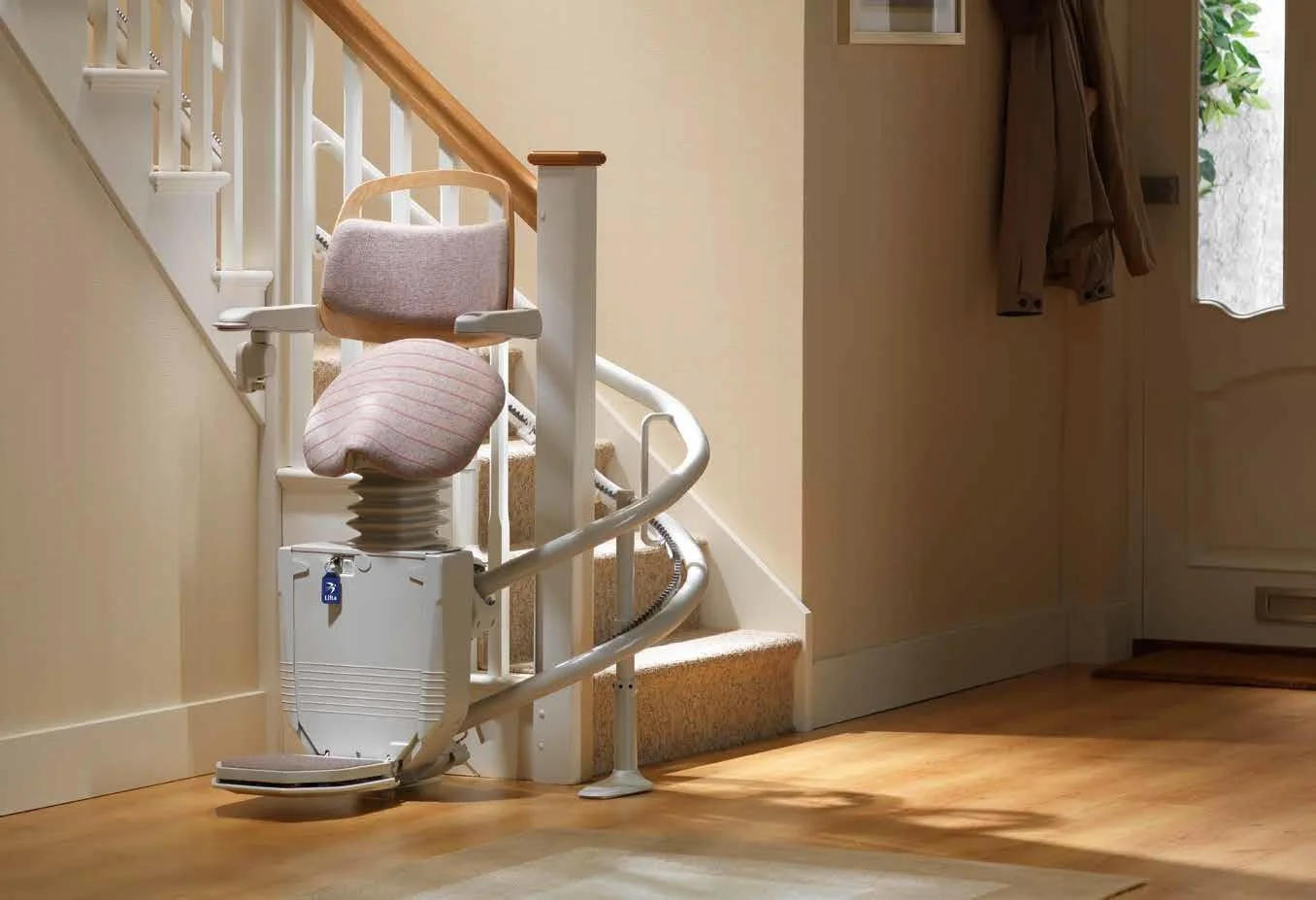
Split-level homes often have short flights with a turn or a landing between levels. Those can call for a curved rail built to your exact stairs, or in some cases a platform lift for a few steps. Curved rails are made to order, so the measurements have to be right before anything ships.
For a newer rebuild in Galena, the stairs and walls are usually in good condition for mounting a rail. If the main problem is getting from the yard into the house, an outdoor lift or a platform at the entry may help more than an indoor chair.
About 18.2% of residents are 65 or older, and 70.2% of households own their homes. Owners can generally make permanent changes like a mounted rail without asking a landlord, which keeps the process simpler.
If a family member served and has a service-connected disability, the VA grants listed below are worth checking before paying out of pocket.
Much of the help here comes through tribal and regional organizations rather than a borough government. Tanana Chiefs Conference, also known as Dena' Nena' Henash, covers interior Alaska including Yukon-Koyukuk villages and is a main channel for federal and tribal housing, health and elder-care funding.
The ALI waiver through the TCC Home Care Program lists Environmental (Home) Modifications as a covered service, which is the clearest path for Medicaid-eligible elders. Other programs below do not name stair lifts on their source pages, so call and ask directly about scope.
Statewide, you can also ask about the AHFC Senior Access Program (SAP), HomeMAP – Home Modifications for Aging in Place, VA Benefits for Veterans (HISA + Prosthetics), Alaska Medicaid Personal Care Services (PCS) and the Alaska Senior Benefits Program. The Alaska Commission on Aging / Senior & Disabilities Services can be reached at (907) 465-3250.
Alaska's Medicaid home and community based waiver, reached in this region through TCC, for Medicaid-eligible elders and disabled adults age 21+ in TCC region villages; it lists Environmental (Home) Modifications and Specialized Medical Equipment as covered services. Call (907) 451-6682.
Home construction and rehabilitation help for Alaska Native and American Indian residents of TCC region villages, with applications taken January 1 through mid December and a USDA Rural Development partnership for residents age 63+. The source does not mention stair lifts, so confirm scope at (907) 452-8251.
Federal grants for veterans with qualifying service-connected disabilities: SAH up to $126,526, SHA up to $25,350, and TRA up to $50,961 or $9,100 (FY2026), usable up to 6 times. Stair lifts are not named on the source page; the Alaska Office of Veterans Affairs at (907) 334-0874 can help you ask.
A nonprofit Center for Independent Living serving people who experience a disability and senior Alaskans, with a Durable Medical Equipment loan closet ([email protected]) at 975 Van Horn Road, Suite 6, Fairbanks. Stair lifts are not listed, so call (907) 479-7940 to ask.
Older adults
550 W. 7th Avenue, Suite 1600, Anchorage, 99501
Veterans
4600 DeBarr Rd, Suite 180, Anchorage, 99508
Yes, but the equipment typically has to be shipped in by air or barge, and the installer travels by small aircraft, riverboat or snowmachine. That adds lead time and cost beyond the unit price, so plan ahead.
The ALI waiver through the Tanana Chiefs Conference Home Care Program lists Environmental (Home) Modifications as a covered service for Medicaid-eligible elders and disabled adults age 21+. No dollar cap is stated. Call (907) 451-6682.
The BIA Housing Improvement Program is open to Alaska Native and American Indian residents of TCC region villages, and the USDA Rural Development partnership is for residents age 63+. Stair lifts are not named, so ask the Housing Department at (907) 452-8251.
TCC names Fort Yukon, Tanana, Galena and Nulato as served villages. Tribal members in those communities apply for housing help through their home tribal offices.
Much of Galena's housing was rebuilt after the May 2013 ice-jam flood, so many homes are newer construction rather than older adapted homes. A newer staircase with a straight run is usually the simplest case for a straight rail.
Contact the Alaska Office of Veterans Affairs at (907) 334-0874, 4600 DeBarr Rd, Suite 180, Anchorage. Ask a caseworker whether a stair lift qualifies under SAH, SHA or TRA.
Tell us about the stairs in your home and we will explain which lift fits, what it costs and how installation works.
