Anchorage stretches from a strip of coastal lowland up onto the lower slopes of the Chugach Mountains, and its homes climb with it. Split-level homes, townhouses, walk-up apartments and single-family houses make up much of the housing here, and most of them put a set of stairs between the front door and the bedroom, the laundry or the bathroom.
Much of the city was built or rebuilt after the 1964 Good Friday earthquake, which shaped how homes went up across the municipality. Local accessibility programs list stairway modification first among the improvements they fund, which tells you how often stepped entries and interior stairs get in the way for people trying to stay in their homes.
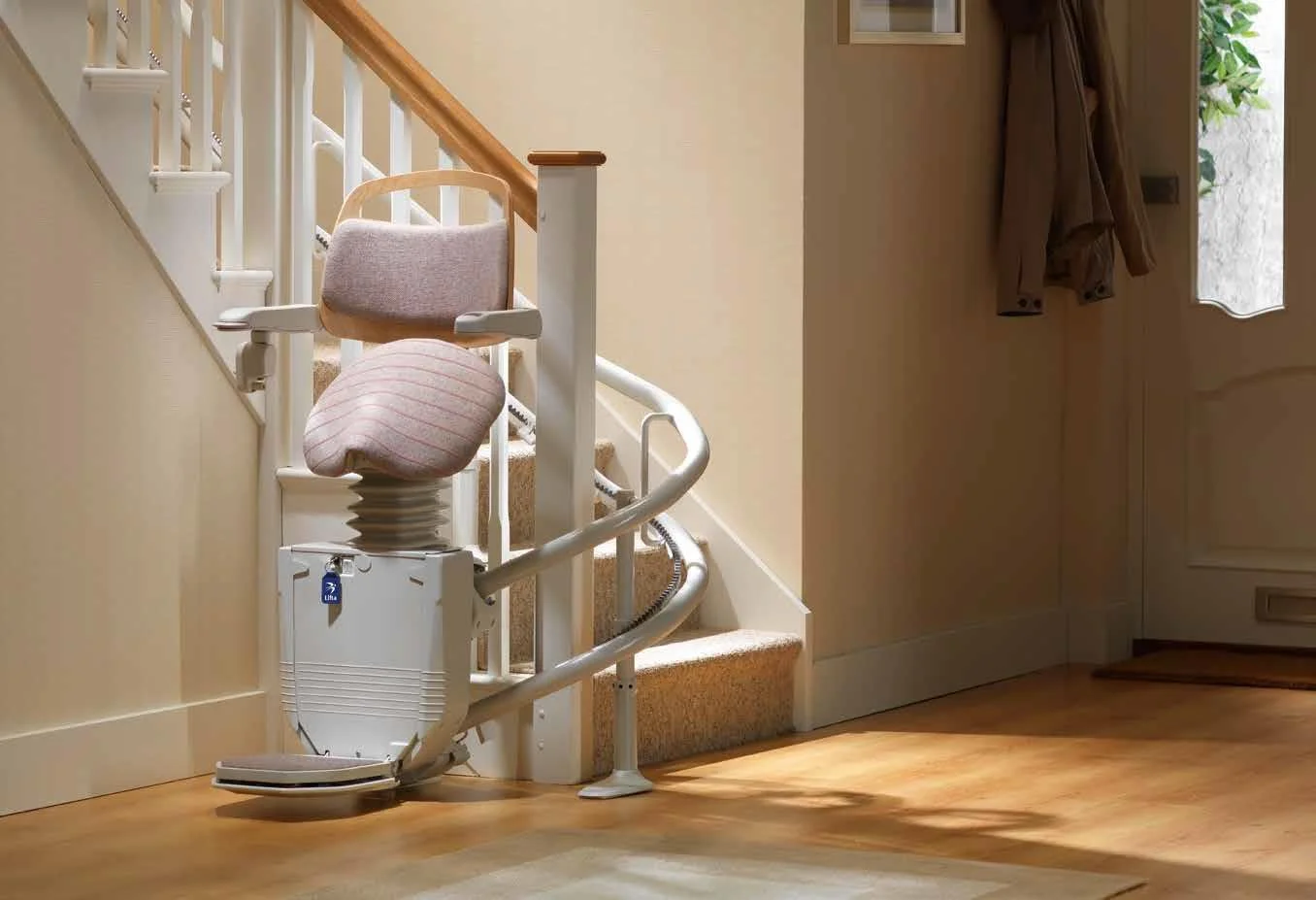
Split-level homes are common here, and they usually have several short flights instead of one long one. A short, straight run of a few steps can often take a straight stair lift, but if you have to use more than one flight to reach daily living space, we look at each flight separately or talk about a curved lift that follows the turn.
Townhouses tend to have one tall, straight staircase, which is the simplest and usually the quickest install. Stairs with a landing, a turn or a curve need a curved rail built to the staircase, so we measure before giving any recommendation.
In walk-up apartments and low-rise buildings, the stairs may be shared and may not belong to the person who lives there. That means building owner permission comes first, and it is worth sorting out before you pick a model.
Anchorage averages 75.5 inches of snow a year, and the 2011-12 season reached 134.5 inches. January lows and highs run about 11 to 23°F, with only around 7 hours of daylight on an average January day.
Icy exterior steps in the dark are where many falls happen. If the main problem is getting from the driveway or yard up to the door, an outdoor stair lift or a vertical platform lift may help more than an indoor lift, and we will talk through which one suits your entry.
Homes on the sloped ground toward the Chugach Mountains often have longer approaches and more outside steps. A lift solves the stairs, but the path to it still needs to be cleared, so plan who will keep it free of snow.
The municipality is home to 289,069 people, and 12.4% are 65 or older. About 63.7% of households own their homes, which matters because owners can usually approve an install on their own schedule while renters need a landlord on board.
That is a large enough share that VA benefits deserve a close look, though one of the VA grants below does not pay for stair lifts, so it helps to know which is which before applying.
Two programs name this kind of work directly. The Alaskans Living Independently (ALI) Medicaid HCBS Waiver covers home modifications for people who qualify, and NeighborWorks Alaska lists stairway modification first among its fundable improvements for Anchorage households.
Other programs fund senior accessibility work in general without naming stair lifts, so call and ask before you count on them. For the ALI Waiver, the first step is a Person-Centered Intake with the Anchorage ADRC at (907) 343-7770.
The state aging office, Alaska Commission on Aging / Senior & Disabilities Services, is at 550 W. 7th Avenue, Suite 1600, Anchorage, and can be reached at (907) 465-3250. Veterans can contact the Alaska Office of Veterans Affairs at 4600 DeBarr Rd, Suite 180, Anchorage, at (907) 334-0874.
A state Medicaid waiver for people 65 and older, or 21 to 64 with a physical disability, who meet nursing facility level of care and Medicaid financial limits (income up to $2,982 a month single, assets $2,000 single or $3,000 for a couple both applying). It covers approved home modifications, which includes stair lifts, so confirm your specific lift with your care coordinator; call (855) 565-2017.
A nonprofit grant for homes in the Municipality of Anchorage where someone is an Alaska Mental Health Trust beneficiary, with a letter showing medical necessity. Stairway modification is the first improvement it funds, and recipients sign a 3-year agreement to repay if the person with special needs no longer lives there; call (907) 677-8490.
A nonprofit grant for people 55 or older that meet income guidelines, open to homeowners and renters, with up to $15,000 for owner-occupied homes. It funds accessibility modifications but does not list stair lifts, so contact the program through its website to ask.
State funding for accessibility changes for seniors over 55, delivered through local nonprofits such as Alaska CDC and NeighborWorks Alaska. Stair lifts are not listed; call (907) 338-6100 for details.
An Anchorage-based center for independent living that builds accessibility modifications such as ramps and grab bars for people with disabilities. Stair lifts are not mentioned, so ask about your case at (907) 248-4777.
A lifetime VA grant of up to $6,800 for service-connected disabilities or $2,000 for other eligible disabilities, applied for through the Prosthetic and Sensory Aids Service at the Alaska VA Healthcare System in Anchorage. It does not cover stair lifts; stair glides are specifically excluded.
VA grants for veterans with certain severe service-connected disabilities who own or will own the home: SAH up to $126,526 and SHA up to $25,350 for FY2026. They fund structural adaptations like ramps and wider doorways, but stair lifts are not listed.
A Municipality of Anchorage Health Dept. service at 825 L Street, Suite 200, that gives benefits information and handles the Person-Centered Intake, the first step for the ALI Waiver. It does not fund stair lifts itself; call (907) 343-7770.
Older adults
550 W. 7th Avenue, Suite 1600, Anchorage, 99501
Veterans
4600 DeBarr Rd, Suite 180, Anchorage, 99508
The Alaskans Living Independently (ALI) Medicaid HCBS Waiver covers approved home modifications for people who meet nursing facility level of care and Medicaid financial limits. Start with a Person-Centered Intake at the Anchorage ADRC, (907) 343-7770, and confirm with your care coordinator that your specific lift is approved.
No. HISA specifically excludes stair glides and porch lifts. SAH and SHA grants fund larger home adaptations for certain severe service-connected disabilities, but stair lifts are not listed, so ask the Alaska Office of Veterans Affairs at (907) 334-0874.
The Alaska CDC Senior Access Program serves people 55 or older who meet income guidelines and is open to both homeowners and renters. It does not list stair lifts, so ask before applying, and you will also need your landlord's permission for any install.
Not always. Split-levels often have short straight flights, and each one may take a straight lift. If the stairs turn or have a landing, a curved rail is usually needed, which is why we measure first.
Only if the home is no longer occupied by the person with special needs within 3 years, unless otherwise agreed. Call NeighborWorks Alaska at (907) 677-8490 for the full terms.
With 75.5 inches of average yearly snowfall and short January days, outside steps are a real fall risk here. An outdoor stair lift or a platform lift can help, but the path to it still needs regular snow clearing.
Tell us about the stairs in your home and we will explain which lift fits, what it costs and how installation works.
